How to Read an East Indian Jātaka
Fixed signs, counter-clockwise houses, and the eastern frame
By Vamsikrishna Sankarayogi ·
An East Indian jātaka—encountered in Bengali, Odia, Maithili and neighbouring practices—is often omitted from beginner material. That omission makes the diagram seem more exotic than it is. Its governing rule is straightforward: the zodiac signs occupy fixed locations, while the houses are counted counter-clockwise from the lagna.
The format combines a sign-centred frame with the same counter-clockwise house sequence familiar to North Indian readers. Four corner squares are divided diagonally, allowing twelve sign fields to fit around a central square. Once the fixed sign map and the corner triangles are understood, the chart is quick to read.
Teaching chart used throughout the series Name: Ananya — a fictional teaching chart, not a real client Birth data: 15 March 1990, 2:30 PM IST; Bengaluru, India Calculation: Swiss Ephemeris 2.10.03; Lahiri (Chitrapaksha) ayanāṃśa (the offset used to define a sidereal zodiac); true node; whole-sign houses Ascendant: Cancer 04°25′41″ Moon: Libra 14°32′04″, Svātī pāda 3 Birth-period balance: approximately 7.38 years of Rahu mahādaśā remained at birth.
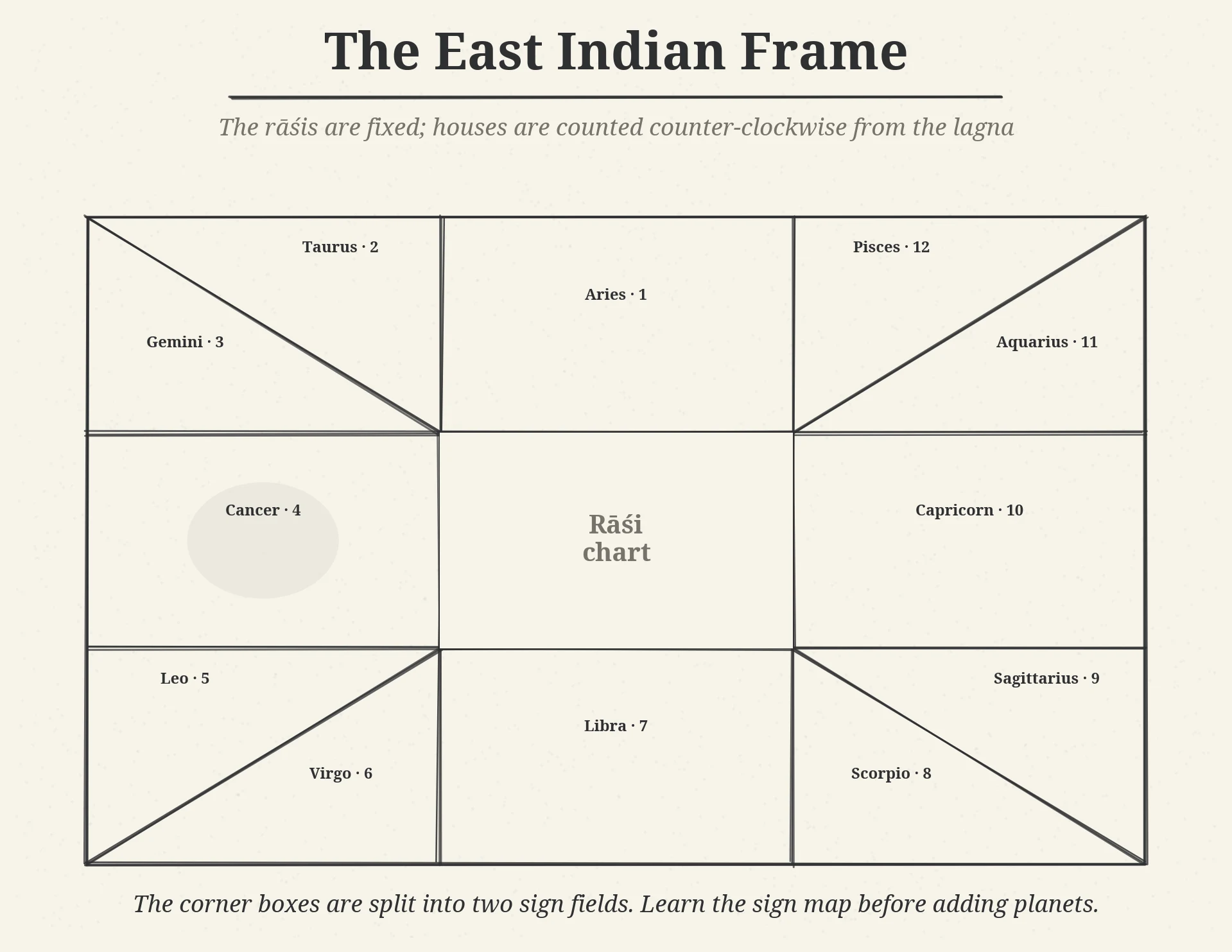
Figure 1. The fixed-sign map used in a common East Indian chart.
1. The eastern chart is a visual convention, not a different sky
A birth recorded in Bengaluru does not acquire different graha positions because its chart is drawn in Kolkata, Bhubaneswar, Patna or Chennai. The astronomical longitudes, selected Ayanāṃśa, node convention and house method determine the data. The regional diagram determines how that data is displayed.
This is not a trivial point. Labels such as “South Indian astrology,” “North Indian astrology” and “East Indian astrology” are often used too broadly. A chart shape does not tell us whether the practitioner uses Parāśari, Jaimini, Tajika, KP, a regional lineage or a personal synthesis. Layout and interpretive school are related by history and practice, but they are not synonyms.
Software such as Jagannatha Hora can display the same calculation in South, North and East Indian styles. Its mixed mode exists precisely because practitioners accustomed to different visual grammars may collaborate on the same horoscope.
2. Learn the fixed sign map
In the common square eastern layout used here, Aries occupies the upper middle and Libra the lower middle. Cancer is at the middle left and Capricorn at the middle right. The corners are split:
- Upper-left: Taurus and Gemini
- Lower-left: Leo and Virgo
- Lower-right: Scorpio and Sagittarius
- Upper-right: Aquarius and Pisces
The zodiacal order moves counter-clockwise from Aries:
Aries → Taurus → Gemini → Cancer → Leo → Virgo → Libra → Scorpio → Sagittarius → Capricorn → Aquarius → Pisces.
The signs are fixed. The lagna mark is placed in the sign rising at birth.
3. Count houses counter-clockwise from the lagna
Ananya’s lagna is Cancer. Cancer therefore becomes House 1. Moving counter-clockwise through zodiacal order:
- Cancer
- Leo
- Virgo
- Libra
- Scorpio
- Sagittarius
- Capricorn
- Aquarius
- Pisces
- Aries
- Taurus
- Gemini
Notice that the house sequence is the same as in the South Indian article because both use the same Cancer lagna and whole-sign houses. What differs is the direction in which the regional drawing is followed.
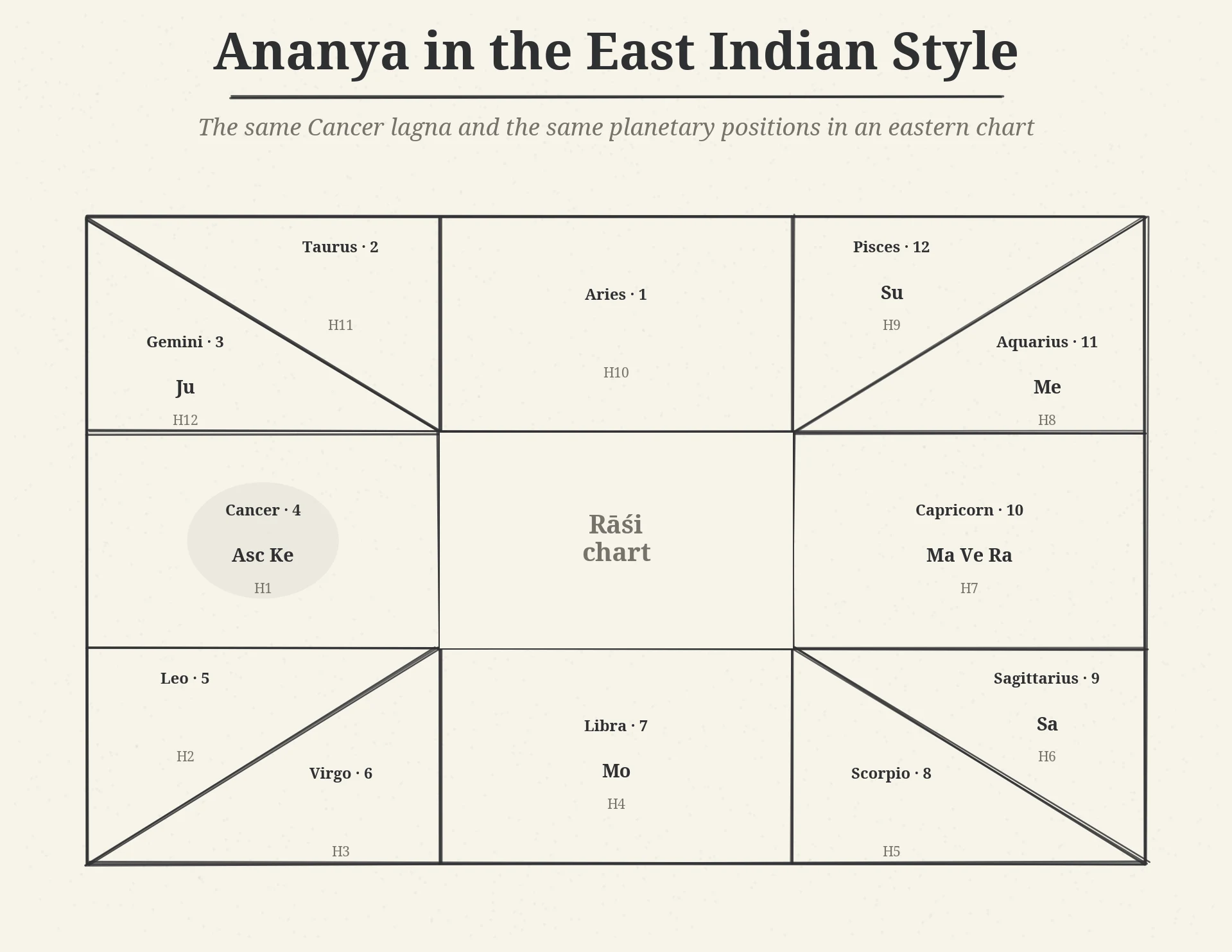
Figure 2. The same synthetic horoscope redrawn in the East Indian format.
4. The corner triangles are sign fields
Each divided corner contains two zodiac signs. They are not extra houses and they do not represent half-houses. The diagonal is a space-saving boundary.
In the upper-left corner, Taurus and Gemini occupy separate triangular fields. In the teaching chart, Jupiter appears in Gemini. Because Gemini is twelfth from Cancer, Jupiter is in House 12.
In the lower-right corner, Scorpio and Sagittarius share the corner square. Saturn appears in Sagittarius, which is House 6. A hurried reader who treats the whole corner as one field could misplace the planet by a sign and a house.
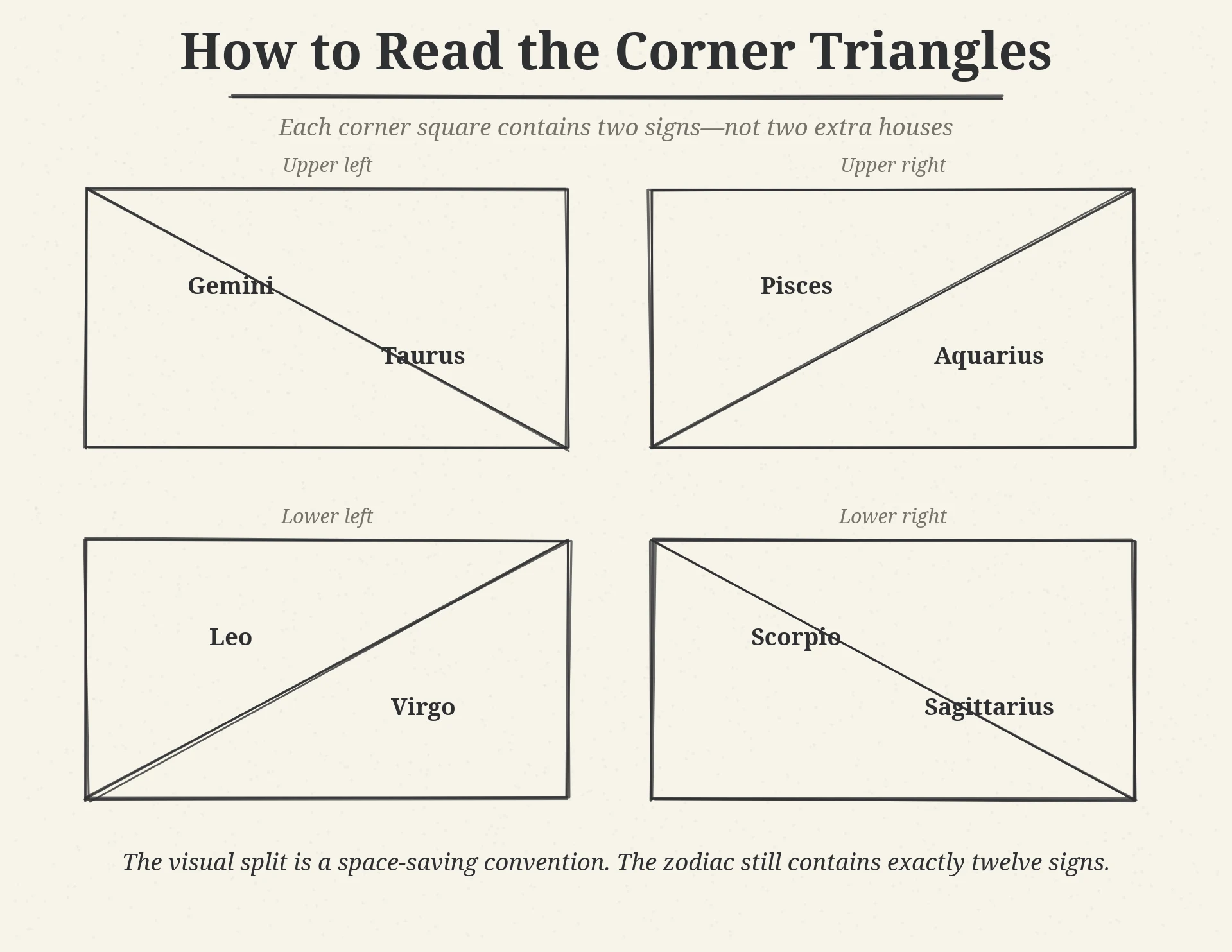
Figure 3. Four corner squares contain eight separate fixed sign fields.
5. Read the sample chart without changing its story
The same factual ledger used in the previous articles applies:
- Cancer / House 1: Ascendant and Ketu
- Libra / House 4: Moon
- Sagittarius / House 6: Saturn
- Capricorn / House 7: Mars, Venus and Rāhu
- Aquarius / House 8: Mercury
- Pisces / House 9: Sun
- Gemini / House 12: Jupiter
Mars is still exalted in Capricorn. The Moon is still in Libra and Svātī. Jupiter still rules Houses 6 and 9 while occupying House 12. The chart’s Lordship (the houses governed by a planet through sign ownership) structure is unchanged.
This is the best test of whether a learner understands regional formats: after redrawing the chart, every planet should still have the same sign and house. If the result changes, the conversion has failed.
6. A worked sentence in the eastern format
Begin with Jupiter in the upper-left Gemini triangle.
- The fixed field is Gemini.
- Cancer is lagna.
- Counting counter-clockwise makes Gemini House 12.
- Jupiter rules Sagittarius and Pisces, which are Houses 6 and 9.
- The complete statement is:
Jupiter, lord of Houses 6 and 9, is in Gemini in House 12.
The next questions concern Jupiter’s sign condition, dispositor Mercury, aspects, varga positions and daśā. The chart style has done its job once the factual structure is clear.
Now take Saturn. It is in the Sagittarius field, House 6. Saturn rules Capricorn and Aquarius, Houses 7 and 8. That network is more informative than the isolated phrase “Saturn in the sixth.”
7. Regional practice is internally diverse
“East Indian” is a convenient umbrella, not a claim that Bengal, Odisha, Mithila and Assam have one uniform manuscript or interpretive tradition. Printed almanacs, family records and software may vary in typography, abbreviations, diagonal orientation and whether signs are named, numbered or assumed from their fixed position.
A careful primer therefore teaches the underlying invariants:
- the sign map used by the document;
- the lagna mark;
- the direction of house counting;
- the planetary longitudes and abbreviations;
- the adopted calculation settings.
When examining an unfamiliar family horoscope, do not assume that every mark follows the convention used in modern software. Check the legend, language and surrounding tables. Older documents may place degrees, nakṣatras or divisional charts in adjacent panels.
8. House lords in the fixed-sign frame
Because signs remain fixed, dignity and ownership can be scanned quickly. For the Cancer lagna teaching chart:
| House | Fixed sign | Lord |
|---|
| 1 | Cancer | Moon |
| 2 | Leo | Sun |
| 3 | Virgo | Mercury |
| 4 | Libra | Venus |
| 5 | Scorpio | Mars |
| 6 | Sagittarius | Jupiter |
| 7 | Capricorn | Saturn |
| 8 | Aquarius | Saturn |
| 9 | Pisces | Jupiter |
| 10 | Aries | Mars |
| 11 | Taurus | Venus |
| 12 | Gemini | Mercury |
The table is identical to the South Indian article. That is intentional. The two fixed-sign drawings differ in geometry and reading direction, not in the house-sign relationship generated by a Cancer lagna.
9. Navāṃśa and divisional charts
An East Indian Navāṃśa (the ninth divisional chart, D9) preserves the fixed eastern sign map while placing the D9 ascendant and grahas in their derived signs. In the teaching chart the navāṃśa lagna is Leo. Therefore Leo becomes D9 House 1 when whole-sign houses are used in that varga.
The same cautions apply:
- Do not copy planets from the rāśi chart into the same boxes.
- Do not treat D9 as a separate biography.
- Do not use a varga without first establishing the relevant question and main-chart foundation.
- Do not assume a varga placement is stable when the birth time is uncertain near a divisional boundary.
A Varga (a divisional chart or change of resolution) is a change of resolution. More detail is useful only when the underlying data are sound.
10. Daśā and the limits of the static diagram
The chart captures structure; the Daśā (a rule-governed planetary period) supplies a sequence. Ananya begins with a remaining portion of Rāhu mahādaśā because the Moon is in Svātī. Subsequent periods bring different planetary networks to the foreground.
The diagram itself does not show biography, education, medical history, family decisions or economic opportunity. It does not know which culturally available expression a person will choose. A practitioner combines symbolic structure with the actual person and maintains a boundary around high-stakes claims.
This is especially important for inherited eastern family charts, which may be consulted during marriage, health or property decisions. A beautifully preserved document deserves careful reading, not automatic authority over the living person.
11. Converting all three formats safely
Use a neutral ledger before redrawing:
House → rāśi → grahas
Do not attempt to rotate one picture mentally into another. The South Indian chart fixes signs and counts houses clockwise. The North Indian chart fixes houses and inserts signs counter-clockwise. The East Indian chart fixes signs and counts houses counter-clockwise. The ledger bypasses these visual differences.
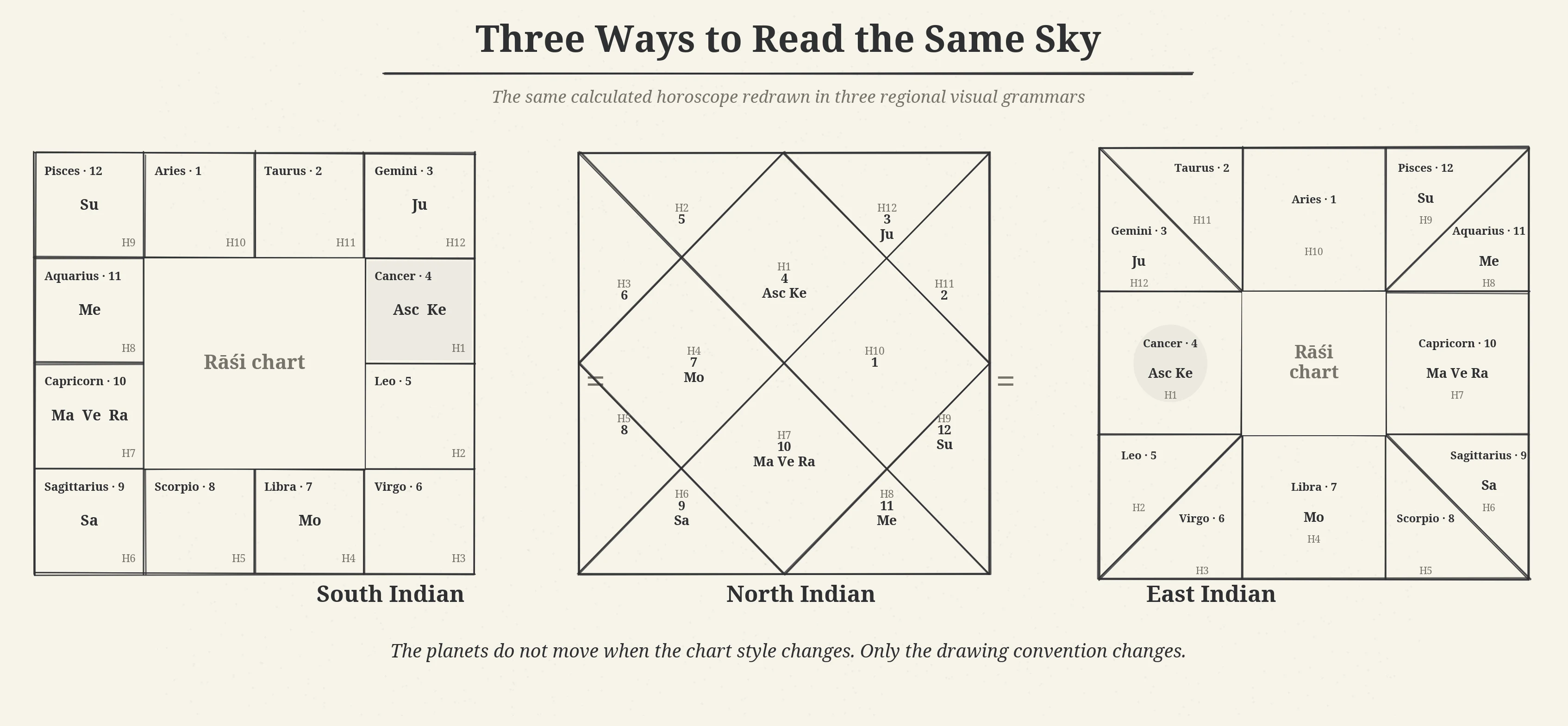
Figure 4. The same horoscope in South, North and East Indian formats.
A second check is useful: verify the lagna lord, seventh lord and tenth lord after conversion. If any of them changes, a sign or house has been misplaced.
12. A five-minute East Indian reading
- Identify the fixed sign map used on the page.
- Find the lagna mark.
- Count houses counter-clockwise from that sign.
- Treat each corner triangle as its own sign field.
- State relevant placements as graha + rāśi + bhāva.
- Find house lords and their locations.
- Add condition, conjunctions and Dṛṣṭi (an aspect or formal line of influence).
- Consult relevant vargas and daśā.
- Compare the symbolic reading with actual life evidence.
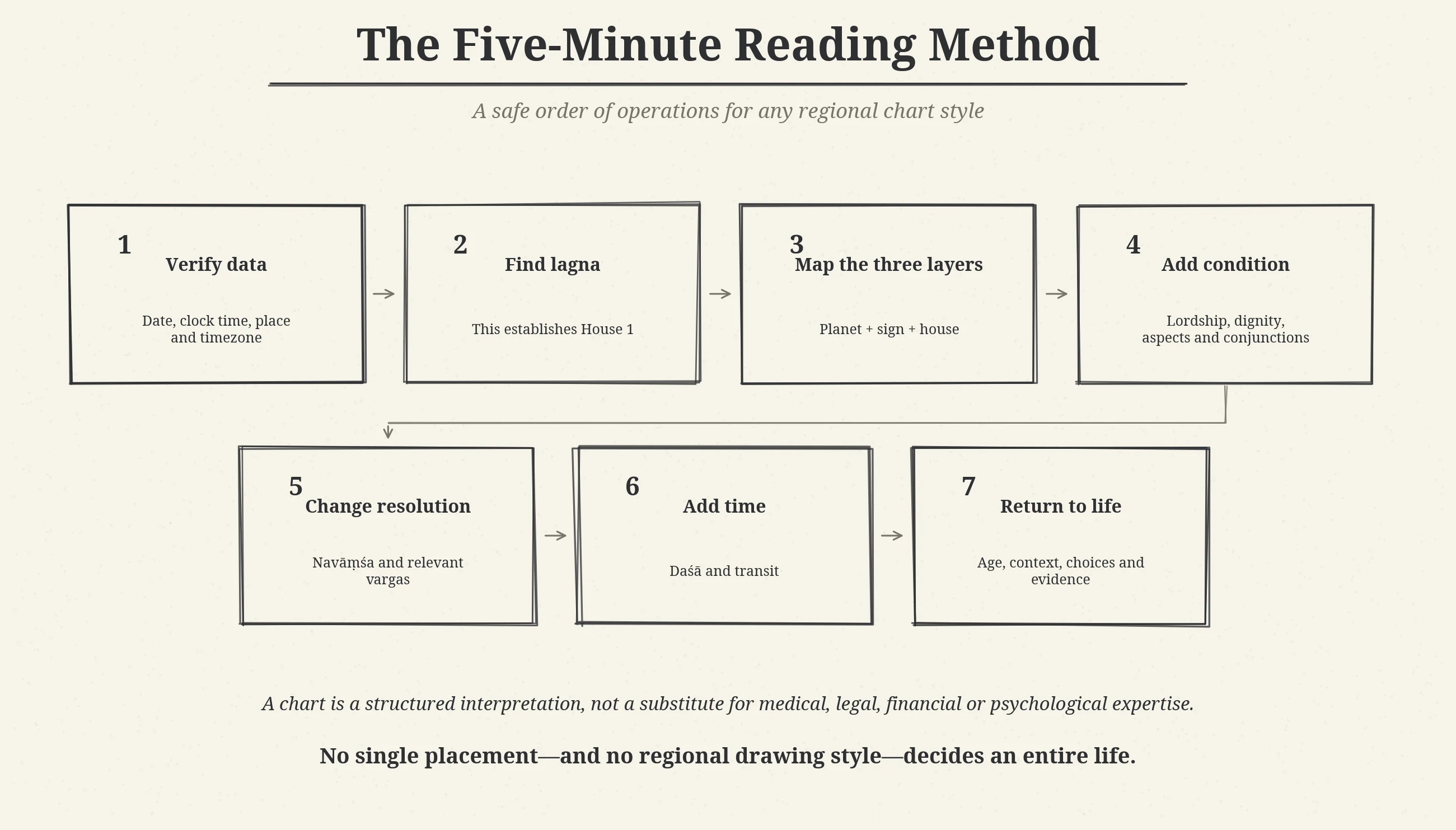
Figure 5. The same reading discipline, adapted to the eastern chart.
13. Common mistakes
Following the South Indian direction
Both charts fix signs, but the East Indian house sequence is followed counter-clockwise in the convention used here.
Treating a corner square as one sign
Each corner is diagonally split into two separate sign fields.
Assuming every eastern manuscript uses identical typography
Confirm the legend and fixed sign map before interpreting an old or regional document.
Equating chart shape with predictive school
An eastern drawing does not prove that the astrologer used one specific textual lineage.
Allowing the regional label to become a cultural stereotype
Bengali, Odia, Maithili and Assamese practice contain internal diversity. The primer teaches a common display convention, not an exhaustive ethnography.
Reading a chart as fate rather than evidence within a tradition
The diagram supports an interpretive conversation. It should not close that conversation or override competent professional advice.
Practice exercise
Using the blank East Indian chart:
- Write the twelve fixed sign names in their correct fields.
- Mark Cancer as lagna.
- Number the houses counter-clockwise.
- Place Jupiter in the Gemini triangle and explain why it is in House 12.
- Place Saturn in Sagittarius and identify its two house lordships.
- Place Mars, Venus and Rāhu in Capricorn and write one complete factual sentence about each.
- Redraw the result in the South Indian blank chart and verify that no planet changed sign or house.
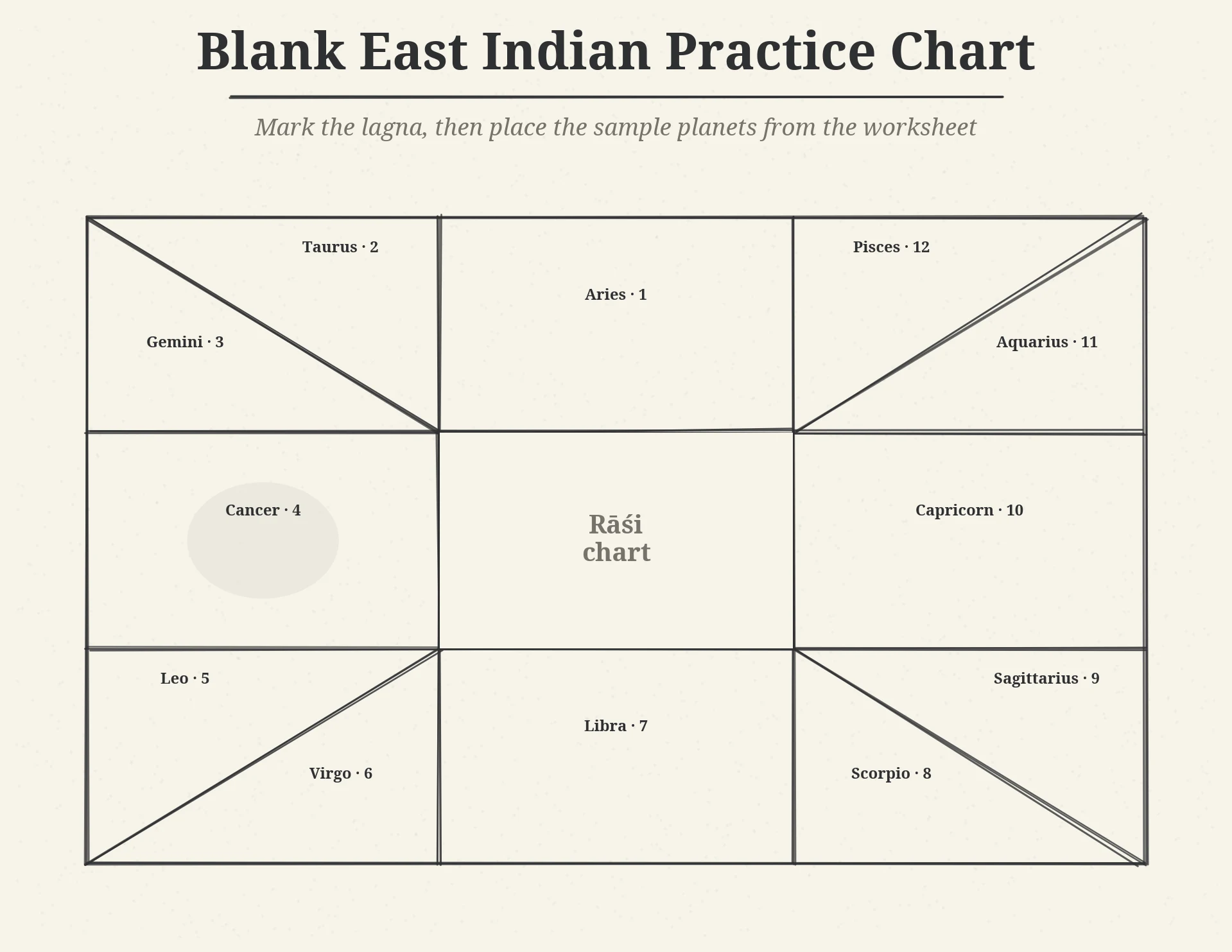
Practice sheet. A blank East Indian fixed-sign chart.
Closing thought
The East Indian chart is not a hybrid curiosity or a difficult code. It is a compact fixed-sign language with a counter-clockwise house sequence. Learn the sign map, respect the corner divisions and preserve the neutral ledger. Once those habits are in place, the chart becomes as readable as the other two—and tells the same sky.
Notes and sources
[1] Varāhamihira. Bṛhat Jātaka. English translation and notes by V. Subrahmanya Sastri, especially Chapters I–II on signs, divisions and planets, and Chapters X and XX on livelihood and planets in houses. Internet Archive edition.
[2] Mantreśvara. Phaladīpikā. English translation by V. Subrahmanya Sastri, especially the opening chapters on signs, planets, vargas and bhāvas. Internet Archive edition.
[3] Kalyāṇavarma. Sārāvalī. English translation available through the Internet Archive.
[4] K. S. Charak. Elements of Vedic Astrology, Volumes I–II. A modern instructional work on chart construction, houses, planets, vargas, yogas and daśās.
[5] P. V. R. Narasimha Rao. Vedic Astrology: An Integrated Approach. Free author-distributed textbook, VedicAstrologer.org.
[6] P. V. R. Narasimha Rao. “Features of Jagannatha Hora Software.” The official documentation confirms South Indian, North Indian and East Indian display styles and a mixed mode that shows the same chart in two styles.
[7] Astrodienst. Swiss Ephemeris Documentation, Version 2.10 series, for sidereal positions, ascendant and house calculations.
Methodological note
The articles explain the internal grammar of a living interpretive tradition. They do not claim that a chart can replace medical, legal, financial or psychological expertise. The example is synthetic, and no life prediction is being made about an actual person.