What We Carry, What Has Begun, What We Still Choose
Sanchita, prarabdha and agami: understanding karma without pretending to know another person’s past
By Vamsikrishna Sankarayogi ·
A person can live reasonably, work sincerely, care for a family, and still find that life has become difficult. Someone else appears to move through the same world with fewer obstacles. The difference is troubling because effort and outcome do not always seem to belong to the same account.
Sooner or later, the question becomes personal: Why is this happening to me?
Karma often enters the conversation at precisely this point. Sometimes the word offers comfort. Sometimes it closes a conversation that needed to remain open. “It is your karma” can mean that life has a history larger than we can see. It can also become a careless way of telling someone that their suffering has been explained.
Before accepting such an explanation, we should ask what has actually been understood.
Knowing the names of three kinds of karma is one thing. Knowing which unseen action produced a particular event in someone’s life is a much larger claim.
The distance between those two kinds of knowledge is where a careful discussion must begin.
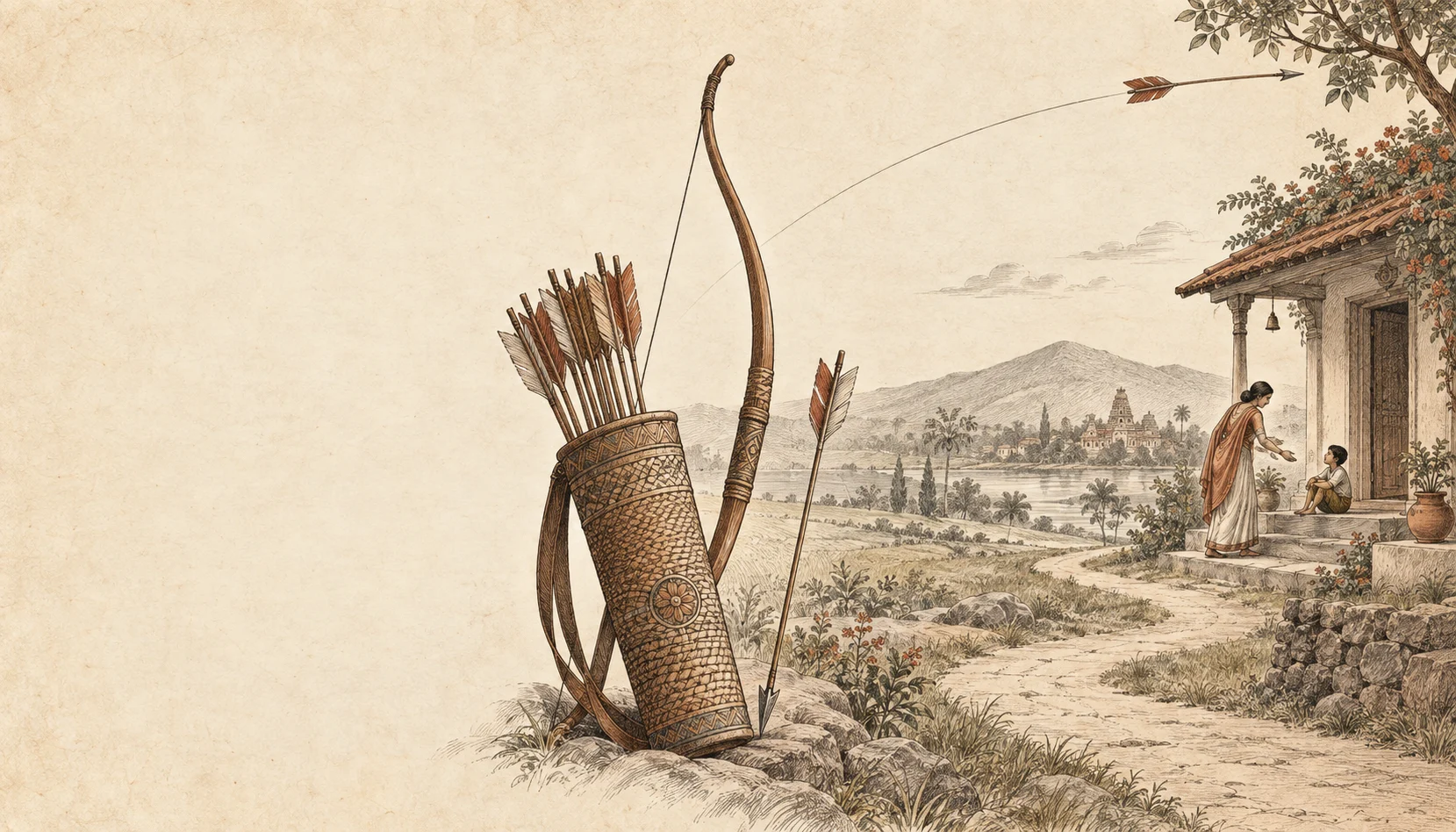
What has accumulated, what is already underway, and the possibility of a different response. The illustration is a metaphor, not a map of an individual’s destiny.
Three ways of looking at action through time
The familiar threefold account, found in Vedantic teaching, distinguishes sañcita, accumulated karma; prārabdha, the portion already bearing fruit; and āgāmi, karma arising from present action whose results are still to come. In Swami Sivananda’s presentation, current action is also described through the term kriyamāṇa. These terms provide a way of thinking about action across time: what has accumulated, what has begun to unfold, and what is being added.[1]
Their value becomes clearer when we stop treating them as three labels to attach to three separate events.
Consider an ordinary argument.
A father comes home tired. His child asks a question. He responds more sharply than he intended. The child becomes quiet. Later, he regrets it.
Several histories meet in that small moment. There is the exhaustion of the day, the pressure of work, perhaps a habit of speech learned in his own childhood. There is also the child’s experience, which the father cannot fully know. Then there is the next decision: whether he ignores what happened, justifies it, or returns to the child and apologises.
We can examine much of this directly. We can ask what happened, what contributed to it, and what might repair the harm.
We cannot establish, from this scene, which previous life supplied its hidden cause.
The example is an analogy for how past conditions and present choices meet. It is not evidence of rebirth. Keeping that distinction intact allows us to think seriously about karma without making every ordinary observation carry more than it can support.
Sanchita: the history we cannot simply read
Sanchita is perhaps the easiest of the three terms to define and the hardest to claim knowledge of.
Within the traditional account, it reaches beyond remembered experience into an accumulated history across births.[1] That makes it different from a list of childhood experiences, habits, or unresolved emotions. Those may be available to memory and inquiry. Sanchita, as a metaphysical category, extends beyond them.
This matters whenever someone claims to recognise a past-life debt from a present difficulty.
A person may fear abandonment. The fear is real. Its effect on relationships may be visible. But the observation does not establish that the person abandoned someone in a previous birth. That additional story requires its own grounds.
The story may feel persuasive because it gives a shape to something painful. It supplies a beginning, a reason, perhaps even a promise of resolution. Yet a satisfying explanation can still be mistaken.
There is room here for faith. Someone may accept rebirth and karmic continuity as part of their religious understanding. Such acceptance does not automatically grant another person access to the details of that continuity.
A belief that actions leave consequences is considerably broader than a claim to know exactly whose action, in which life, caused today’s loss.
Prarabdha: what has already begun
Prarabdha brings the discussion closer to the life already underway.
Sivananda illustrates it through an arrow that has left the bow, while the arrows held in reserve represent sanchita and the arrow ready to be released represents agami. The image distinguishes stored possibility, consequences already in motion, and action at the point of being undertaken.[1]
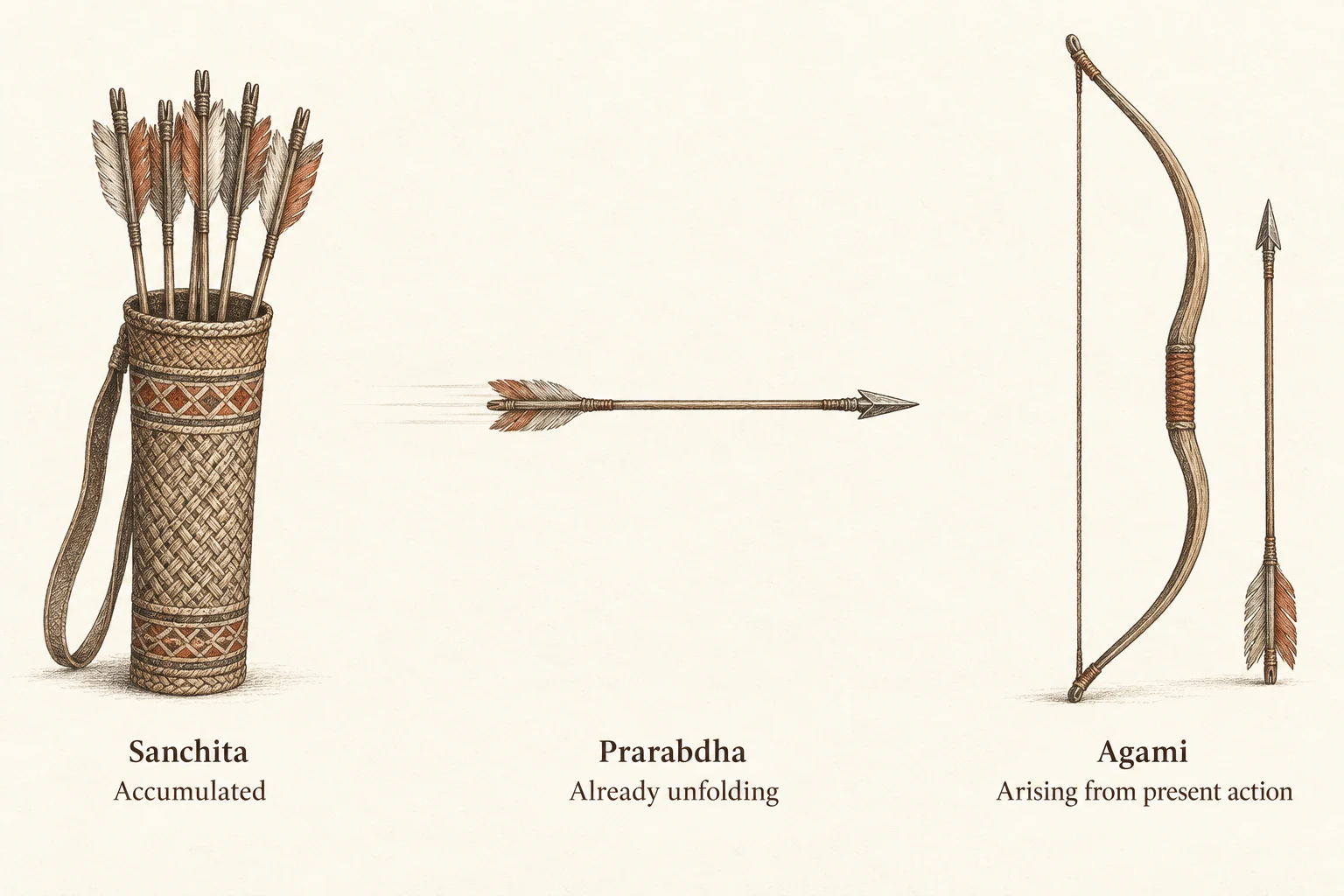
Figure 1. The three-arrow analogy distinguishes accumulated karma, what is already unfolding, and what arises from present action. It explains the categories; it does not identify the unseen cause of a particular life event.
The image is memorable because everyone knows something about irreversibility.
A sentence has been spoken. A decision has been acted upon. Years have passed. We can respond to what follows, but we cannot return to the untouched moment before it happened.
The difficulty begins when this recognition is extended into a claim that everything about the future is settled.
There is a considerable difference between acknowledging that an event has occurred and declaring that no response can matter. A damaged friendship may never return to its earlier innocence, but an honest conversation can still change its course. An opportunity may have been lost, while another remains possible.
We rarely know in advance the full extent of what can change.
For this reason, calling a difficulty prarabdha should not become permission to stop investigating its practical causes. A failed harvest still deserves an examination of rainfall, soil, irrigation and access to resources. A workplace conflict still deserves attention to conduct and conditions. Naming a spiritual category does not complete those inquiries.
Sivananda himself places effort alongside prarabdha and explicitly uses taking medicine during illness as an example. Acceptance of karma, in that account, leaves room for action.[1]
This also places a limit on what we should say about other people.
“I am trying to accept what I cannot undo” can be a hard-earned personal understanding. “You must accept this because it is your karma” is an assertion made over someone else’s life.
The speaker may know very little about the circumstances. The person suffering is left to bear both the difficulty and the explanation imposed upon it.
Compassion does not require access to an invisible history. The suffering in front of us is sufficient reason to respond.
Agami: our participation in what follows
Agami directs attention towards the part of this discussion that is closest to our own participation.
Return to the father and the child.
The father cannot withdraw the words from the child’s memory. He can, however, acknowledge what he said. He can avoid making the child responsible for his temper. He can notice that this is becoming a pattern and take steps to interrupt it.
None of these actions guarantees a particular result. An apology may be accepted, doubted, or understood only much later. The child has a life and a freedom of their own.
Still, the apology matters.
This is a useful place to consider the distinction between responsibility and control. We can be responsible for how carefully we act without controlling everything that follows.
The Bhagavad Gita addresses this tension in 2.47, placing emphasis on action while warning against attachment to its fruits and against attachment to inaction. The final part is easy to overlook: uncertainty about results does not release a person from the work of acting.[2]
In everyday terms, a teacher prepares the lesson even though learning cannot be forced. A friend offers help without being able to decide how it will be received. A person tells the truth although honesty cannot guarantee approval.
These situations do not need a visible karmic balance sheet to have moral weight.
They ask for attention to motive, conduct and consequence. They also ask for humility, because even sincere intentions can miss something important. We may need to listen, revise, apologise, or begin again.
What a birth chart can establish
Where, then, does a birth chart enter this inquiry?
For someone approaching Jyotisha through a karmic worldview, the horoscope may be read in relation to the circumstances and possibilities of a life. But we should examine each step of the interpretation.
Calculating where a planet stood at birth is one operation. Interpreting that position according to a particular astrological tradition is another. Claiming that it reveals a specific deed from a previous incarnation adds a further assertion.
Accuracy in the first operation does not, by itself, establish the third.
A precisely calculated Saturn position cannot supply the missing evidence for a story that someone betrayed a sibling in another life. Even if the story seems to fit a present relationship, that fit does not establish its historical truth. Many different stories can be made to fit an experience after it has happened.
This is especially important when the person listening is distressed. A confident explanation can become part of how they understand themselves. They may begin to treat an imagined debt as an obligation, or an interpretation as a sentence they must serve.
A careful reader should therefore be willing to ask where a statement comes from. Is it a calculation? A rule from a named text? A practitioner’s interpretation? A personal spiritual belief?
Those distinctions give the listener room to think.
The Gita itself describes the course of karma as profound and difficult to understand in 4.17. The verse discusses action, wrong action and inaction; it is not a direct listing of sanchita, prarabdha and agami. Its acknowledgment of difficulty is nevertheless relevant to the confidence with which we speak about another person’s life.[3]
We should be particularly cautious when an explanation becomes more detailed than the grounds offered for it.
Returning to the life in front of us
There is a useful inquiry available even when the hidden history remains unknown.
Take one recurring difficulty and describe it without immediately explaining it. What happened? What did someone actually say? What did you assume? Which part was within your influence? Which part belonged to another person or to circumstances neither of you controlled?
Then look at what followed. Did your response reduce the harm, prolong it, or make it harder to understand?
This can be uncomfortable work. “A karmic pattern” is sometimes easier to say than “I avoid difficult conversations until I become resentful.” The first may be meaningful within a spiritual worldview. The second gives us something specific to examine tomorrow morning.
Nor should every difficulty be turned inward. Sometimes the relevant discovery is that we have been accepting conduct we need to challenge. Sometimes the next action is a boundary, a request for help, or a refusal.
Reflection becomes useful when it makes experience clearer. It becomes burdensome when it makes us responsible for everything that happens to us.
A person who believes in karma can leave some causes unknown. There is no need to invent a previous life to take the present one seriously.
Tonight, the father may still have no answer to why anger comes so easily to him. He may need time, help and repeated effort to understand it. But he knows where the child is sitting. He remembers the words he used.
He can go back into the room.
Notes
[1] Swami Sivananda, Self-Knowledge, especially “Sanchita, Purushartha and Prarabdha Karmas.” The threefold account and arrow analogy here follow this Vedantic presentation; the essay does not present it as a uniform formulation of every Indian tradition. The father-and-child example and the discussion of what an interpretation can establish are the author’s explanatory arguments.
[2] Bhagavad Gita 2.47, Sanskrit text, translation and commentary by Swami Mukundananda. The everyday examples following the verse are illustrations offered in this essay.
[3] Bhagavad Gita 4.17, Sanskrit text, translation and commentary by Swami Mukundananda. Its three terms are karma, vikarma and akarma; they should not be conflated with the threefold temporal account discussed here.