How a Birth Chart Became a Biography
Lagna, graha, bhāva and the Indian architecture of a life
By Vamsikrishna Sankarayogi ·
The first difficulty posed by a horoscope is not interpretation. It is construction.
A child is born at a particular place and time. The eastern horizon cuts the ecliptic at one point; the Sun, Moon and visible planets occupy calculable longitudes; the lunar nodes are obtained from the geometry of the Moon’s orbit; and the local sky is changing continuously. None of this arrives as a square, a diamond or a circular chart. Those familiar diagrams are later graphic conventions. Before the jyotiṣin can speak about character, work, family, illness, fortune or the future, the astronomical event must be translated into a stable intellectual object.
That translation is easy to overlook because a completed horoscope appears self-evident. Twelve compartments are drawn, signs are entered, grahas are placed and the chart seems to present a person at a glance. Yet nearly every feature on the page is the result of a prior decision: which instant counts as birth, how local time is corrected, which sidereal reference is used, how the ascendant is calculated, whether a sign and a house are treated as coextensive, how house boundaries are determined, which aspect doctrine is followed, which strengths are computed and which divisional scheme is considered relevant.
The chart is therefore neither a photograph of the heavens nor a free poetic portrait. It is a rule-governed transformation of a transient sky into a layered model of a life.
The central question of this article is:
How did Indian horā literature convert one astronomical moment into a biography extending across decades?
The answer lies neither in a single planet nor in a list of twelve houses. Biography emerges through a sequence of operations. The sky is first situated by the local horizon. Planetary positions are organized by rāśi. The horizon gives the chart an orientation through lagna and bhāva. Grahas acquire changing functions through lordship. Their capacity is assessed through dignity, strength and state. Their relations are read through conjunction and dṛṣṭi. Repeated configurations become yogas. The same planetary longitude is examined at several resolutions through varga. Finally, a static birth configuration is unfolded through daśā, transit, age, place, circumstance and action.
This procedure is already visible in compact form in Varāhamihira’s Bṛhat Jātaka. Later works such as Kalyāṇavarma’s Sārāvalī, Śrīpati’s Śrīpati Paddhati, Vaidyanātha’s Jātaka Pārijāta and Mantreśvara’s Phaladīpikā enlarge particular parts of it. They do not speak with one perfectly uniform voice. They differ over subdivisions, aspect rules, strengths, house calculation and the weighting of competing indications. The disagreement is not incidental. It shows that horoscopy was a field of technical argument rather than a finished code transmitted without revision.[1]
The interpretive difficulty begins precisely here. A modern reading often detaches one item from the architecture: “Saturn in the seventh,” “Moon in Rohiṇī,” “Mars in the tenth,” “a strong ninth lord.” Classical judgment is rarely so isolated. The result of a placement depends on what the graha is, what it owns, where it stands, how strong it is, who sees it, which divisions support it, when its period operates and what kind of life is actually available to the person.
A horoscope becomes biographical only through synthesis.
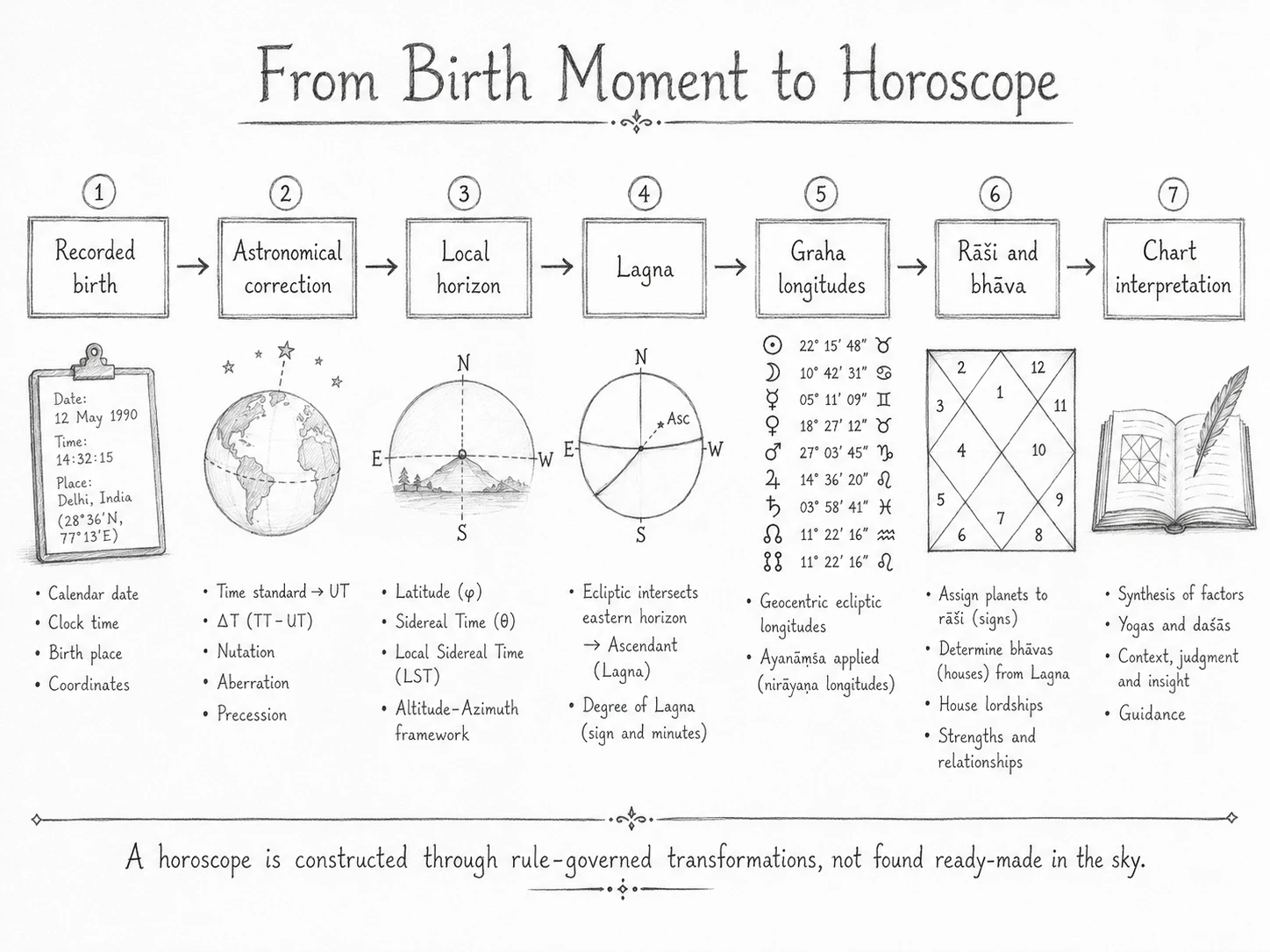
Figure 1. A horoscope becomes personal through an ordered chain: astronomical position, local orientation, textual classification, relation, synthesis and contextual judgment.
The chart is made, not discovered
Indian astronomical texts treat lagna as a calculable point. Bhāskara II’s Siddhānta Śiromaṇi, in the discussion of rising signs, describes the ascendant as the intersection of the ecliptic with the horizon at a given time and supplies a procedure for deriving it from solar position, elapsed time and the conditions of the locality.[2] The language may be expressed through traditional units and tables, but the conceptual point is exact: the ascendant depends upon time and place.
The grahas, by contrast, have celestial longitudes that are not generated by the native’s horizon. Their positions belong to the wider sky at that instant. A birth chart combines these two orders:
- the relatively shared celestial positions of the Sun, Moon, planets and nodes;
- the local orientation created by the eastern horizon, meridian and latitude of the birthplace.
The first order answers, “Where are the grahas?” The second asks, “How does that sky stand in relation to this place?”
This distinction makes lagna far more than an additional symbol. It turns a universal configuration into a situated one. Two children born at the same absolute instant in distant locations may share nearly the same planetary longitudes, but they need not share the same ascendant or house orientation. Two children born in the same town several hours apart may share the slower-moving grahas but receive different lagnas and different house placements. The birth chart is thus an encounter between cosmic recurrence and local circumstance.
Accurate construction requires several mundane operations that are often absent from popular explanations:
- establish the recorded civil time and date;
- determine the geographical coordinates of birth;
- correct for the applicable time standard;
- convert the instant into the astronomical time required by the computational procedure;
- obtain sidereal or otherwise specified graha longitudes;
- calculate the local horizon and lagna;
- divide or orient the chart according to the chosen bhāva method;
- record the result in a conventional chart form.
Each step is a possible source of error. Hospital clocks may be rounded. Family memory may preserve “about six in the morning.” Historical time zones and daylight adjustments may be misunderstood. Village names may be assigned the coordinates of a nearby city. An error of a few minutes may leave a slow-moving graha unchanged while shifting a fast ascendant degree, a bhāva boundary or a divisional position.
This is why rectification developed as a specialized practice. The practitioner compares reported life events with possible birth times and adjusts the chart until the sequence appears coherent. Rectification can be technically disciplined, especially when bounded by a narrow documented interval and tested against events not used in the adjustment. It can also become circular: the chart is altered until it explains the biography, and the resulting explanation is then cited as proof that the chart was correct.
A research-oriented practice must distinguish the two. Rectification should record the original time, permissible interval, rules used, events used for fitting and events reserved for independent checking. Without that audit trail, correction becomes retrospective authorship.
The chart’s graphic appearance should also not be confused with its astronomical content. Different Indian regions use different visual layouts. In one, signs occupy fixed boxes while the ascendant is marked within the appropriate sign. In another, the first house occupies a fixed place and the signs rotate through the diagram. The same positions can therefore appear in differently shaped charts. The diagram is an interface; the underlying structure is a set of calculated relationships.
That observation has a larger consequence. A chart does not explain itself. It is closer to a compressed technical notation. A reader must know which conventions produced it before interpreting what it displays.
Lagna: the local horizon enters biography
The Sanskrit term lagna carries the sense of attachment or contact. Astronomically, it is the point of the ecliptic attached to the eastern horizon at the relevant instant. In natal Jyotiṣa it becomes the first orientation of the chart and one of the principal bases from which the houses are counted.
The importance of lagna is easy to state and difficult to exhaust. It gives the chart a bodily and terrestrial centre. Classical texts use it in judgments concerning constitution, appearance, vigour, circumstances of birth and the general capacity of the native to sustain the indications of the horoscope. Varāhamihira includes the strength of the rising sign among the technical conditions to be known before judgment.[3] Later works repeatedly examine the lord of lagna, grahas placed there, aspects received by it and the condition of the relevant divisions.
The lagna is not simply “personality.” That modern shorthand narrows a much broader field. It can signify embodiment, orientation, visibility, vitality, self-presentation, the condition through which other houses are experienced and the point from which the world of the horoscope is ordered.
A useful analogy is architectural rather than psychological. A building plan may contain rooms of identical size, but their function changes according to entrance, direction, access and relation to the site. Lagna is the entrance through which the twelvefold order becomes a particular inhabited structure.
The rising sign also changes at an unequal rate. Because the ecliptic is inclined to the celestial equator and because the horizon differs with latitude, signs do not necessarily take equal civil time to rise. The familiar statement that one sign rises every two hours is only an average produced by dividing twenty-four hours by twelve. The actual rising duration varies by sign, season and latitude. A serious horoscope therefore depends on astronomical calculation rather than on a uniform clock approximation.
The local dependence of lagna gives a clear answer to a common question: why do two people born on the same day differ? The horā tradition does not regard a date as sufficient. The Moon may move significantly within a day; the ascendant moves far more rapidly; bhāvas rotate; divisional positions can change; and the resulting network of lordships and placements may be reorganized.
But lagna should not be made into an absolute monarch. Classical texts regularly compare it with the Moon and, for some judgments, the Sun or another relevant reference. Varāhamihira’s discussions of professional activity, bodily formation and planetary periods sometimes ask which among lagna, Moon or Sun is stronger, or examine a house from more than one base.[4] This is not redundancy. It permits the same life topic to be viewed through embodied circumstance, mental-experiential orientation and solar authority or vitality.
The chart is therefore polycentric. Lagna gives it local embodiment, but other centres disclose different dimensions of the native’s experience.
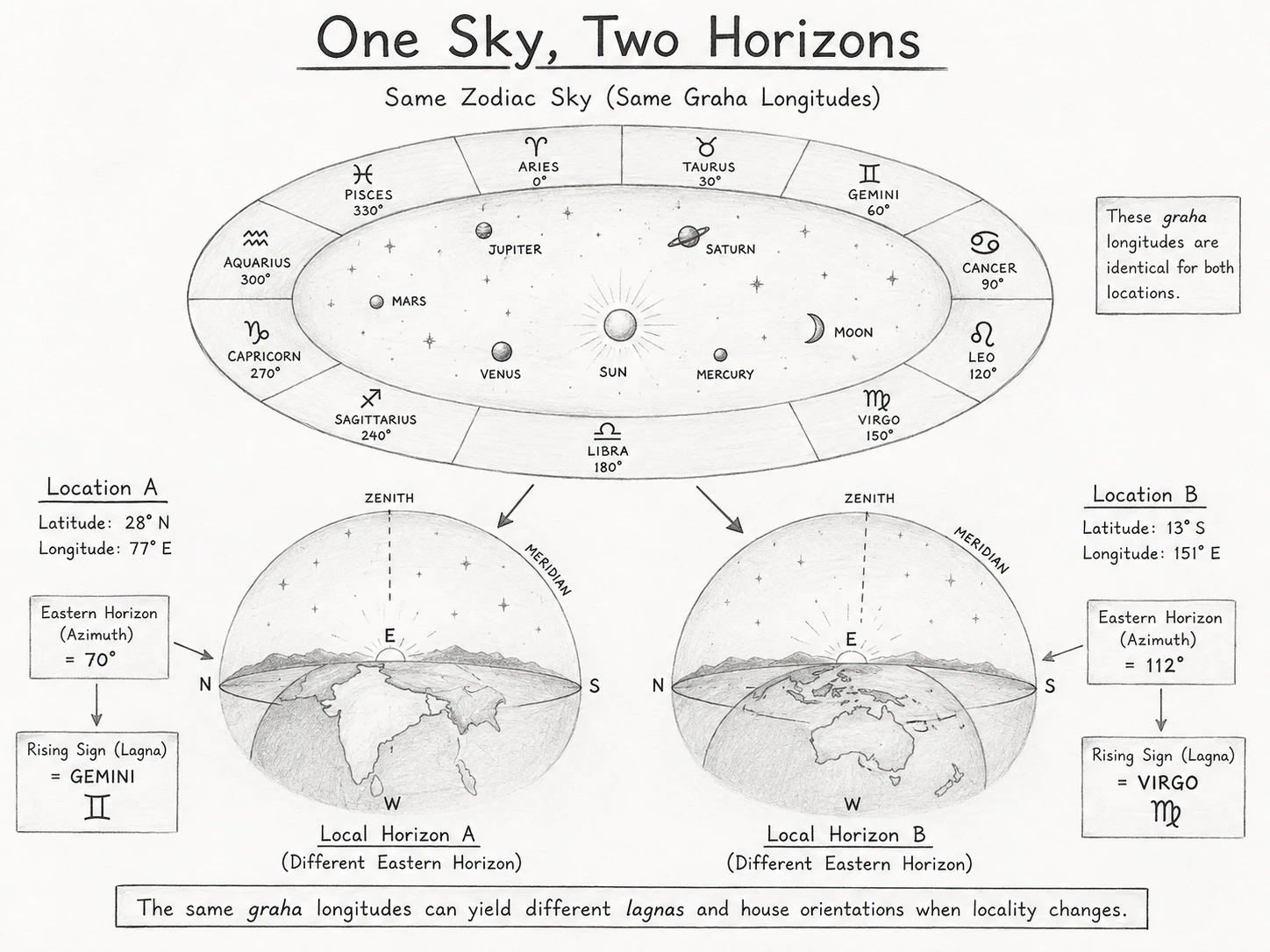
Figure 2. Planetary longitudes describe where the grahas stand along the ecliptic. Lagna describes where that ecliptic meets the eastern horizon of this place at this time.
Rāśi and bhāva are related, but they are not the same object
A rāśi is a thirty-degree division of the ecliptic. Twelve rāśis complete the circle. They provide a regular coordinate framework within which graha longitudes can be stated and interpreted.
A bhāva is a field of lived concern oriented from the local chart: body and emergence, resources and speech, siblings and initiative, home and foundations, children and intelligence, illness and service, partnership, vulnerability and inheritance, teaching and pilgrimage, work and public action, gains and association, expenditure and release. Lists vary in vocabulary and emphasis, but the twelvefold structure organizes experience into recurring domains.
In many practical charts, the rising rāśi is treated as the first bhāva and each subsequent sign as the next house. This whole-sign mapping is coherent and widely used. It should not lead us to assume that rāśi and bhāva were always theoretically identical.
The Phaladīpikā preserves a degree-sensitive conception. It states that a graha at the middle of a bhāva gives its effect fully and that the effect diminishes as the graha approaches the junction between houses.[5] The Śrīpati Paddhati develops an explicit method for deriving house centres and boundaries from the ascendant, midheaven and intermediate arcs.[6] Such procedures treat the bhāva as a locally determined spatial field whose centre need not coincide with the centre of the corresponding sign.
The distinction produces three separate questions:
- In which rāśi is the graha? This concerns the graha’s zodiacal environment, lordship and dignity.
- In which bhāva does it act? This concerns the domain of life in which its indications are expressed.
- How close is it to the bhāva centre or boundary? This concerns the intensity or clarity of its house effect within some traditions.
Different schools answer these through different computational conventions. A responsible article should not conceal the plurality by declaring one later method to be the single original system. Nor should it treat plurality as evidence that calculation is irrelevant. On the contrary, the existence of competing methods shows that the relation between the ecliptic and the local horizon was recognized as a technical problem.
This distinction also changes interpretation. Suppose a graha lies late in one sign but, under a degree-based bhāva calculation, falls within the next house. Its sign-based qualities and house-based field may diverge. The graha may receive dignity from one rāśi while acting most directly in a bhāva conventionally associated with the following domain. A practitioner who does not declare the adopted house system may produce a judgment that cannot be reproduced.
The issue is not solved by choosing between “sign chart” and “bhāva chart” as though one were true and the other false. They answer different analytic questions. The sign chart preserves the graha’s place in the twelvefold ecliptic. A bhāva calculation models its relation to the locally oriented fields of life.
The distinction is particularly important for research. A study claiming that “Mars in the tenth house” correlates with a particular outcome must state how the tenth house was defined. Whole-sign, equal-house and centre-based methods can classify boundary cases differently. Without computational specification, the hypothesis is not stable enough to test.
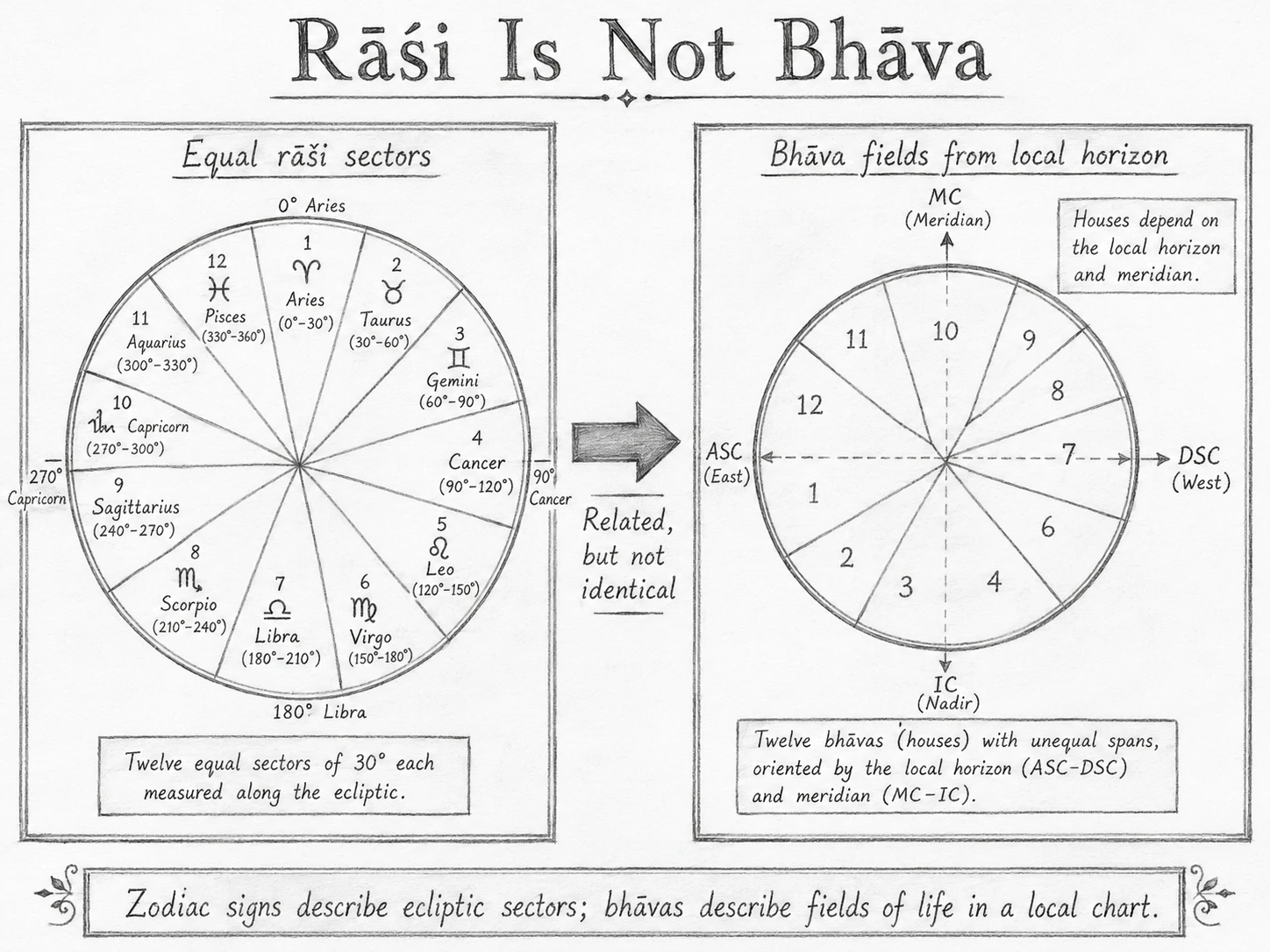
Figure 3. Rāśi divides the ecliptic into twelve equal sectors. Bhāva organizes the locally oriented fields of life. The two can be mapped together, but some Indian traditions calculate distinct bhāva centres and junctions.
What is a graha inside a horoscope?
The usual English translation “planet” is convenient but incomplete. Jyotiṣa counts the Sun and Moon among the grahas and includes Rāhu and Ketu, the lunar nodes, although they are not physical planets. Graha is therefore a technical category defined by its role in calculation and interpretation, not by one modern astronomical class.
Classical texts attribute an intrinsic field of qualities to each graha. The Sun is associated with sovereignty, heat, visibility, authority and the organizing self. The Moon with mind, nourishment, receptivity and fluctuation. Mars with force, cutting, conflict, courage and technical action. Mercury with speech, calculation, exchange and adaptability. Jupiter with knowledge, counsel, expansion and beneficence. Venus with desire, union, art, comfort and reproduction. Saturn with endurance, delay, labour, age, deprivation and persistence. Rāhu and Ketu acquire their own complex fields in later systematic practice.
Vaidyanātha’s Jātaka Pārijāta condenses a familiar anthropocosmic correspondence: the Sun as the soul of Kālapuruṣa, the Moon as mind, Mars as strength, Mercury as speech, Jupiter as knowledge and happiness, Venus as desire and Saturn as misery or affliction.[7] Such verses do not provide a complete prediction. They establish a semantic vocabulary.
A graha’s intrinsic nature is only the first layer. In a particular horoscope, the same graha also acquires a functional role by owning one or more houses from the lagna. Mars may signify force in general while becoming lord of a house concerned with siblings, property, partnership, work or loss in a specific chart. Jupiter remains Jupiter, but the domains it administers change with the ascendant. A naturally benefic graha can govern a difficult house; a naturally severe graha can govern an important supportive house. The tradition therefore distinguishes, explicitly or implicitly, between what a graha is by nature and what it is required to do in this chart.
Its sign placement adds another layer. A graha may occupy its own sign, an exaltation, a friendly or inimical sign, or a region associated with debility. These conditions do not switch the graha on or off. They describe the resources, compatibility or constraint through which it acts.
Its bhāva placement identifies the field in which its presence becomes especially visible. Its conjunctions and aspects connect it with other actors. Its motion, combustion, brightness, retrogression and other states may modify capacity. Divisional placement tests whether the same graha receives support or contradiction at another scale. Daśā determines when its network becomes temporally prominent.
The result is a relational definition:
A graha in a horoscope is an intrinsic field of qualities performing a chart-specific office, from a particular condition, within a particular domain, in relation to other grahas, under changing periods of activation.
This is why isolated placement statements are unreliable. “Saturn in the seventh” has no single classical meaning before we ask:
- Which lagna makes Saturn lord of which houses?
- In which rāśi and degree is it placed?
- Is it strong, weak, combust, retrograde or otherwise conditioned?
- Which grahas join or aspect it?
- What is the condition of the seventh lord and Venus?
- What do the relevant vargas show?
- Which daśā is operating?
- What are the native’s age, circumstances and actual choices?
A short interpretation can be useful as an educational entry point. It becomes misleading when presented as the chart’s verdict.
Lordship turns the chart into a network
House lordship is one of the principal devices by which a static diagram becomes a network of agency.
Each rāśi has a ruler in the classical scheme. When a rāśi occupies a bhāva, its ruler becomes responsible for that field. If the ruler is placed elsewhere, it carries the affairs of the owned house into the house it occupies. The interpretive sentence is therefore not simply “the lord is in another house.” It describes a connection among domains.
A lord of the second placed in the tenth may link resources and speech with public work. A lord of the fourth in the ninth may connect home, property or inner foundations with teaching, pilgrimage or inherited doctrine. A lord of the seventh in the sixth may bring partnership into the field of obligation, conflict, illness or service. These are not outcomes by themselves. They are routes through which topics become related.
The network is complicated because most grahas own two signs. One graha may therefore carry two house agendas at once. Those agendas can support each other, compete or become activated differently according to context. The house occupied by the lord, the condition of that house, the grahas associated with it and the lord’s own strength determine how readily the connection can operate.
Mantreśvara’s chapter on assessing bhāvas is valuable because it refuses a one-factor judgment. A house can prosper when supported by its lord, benefic occupation or aspect and other strengthening conditions; it can decline through a weak or afflicted lord, destructive occupation, adverse aspects or placement at a junction; mixed conditions produce mixed results.[8] The text’s exact classifications belong to its historical system, but the methodological principle is broader: house judgment is cumulative.
This cumulative method can be represented as a series of questions:
- What does the bhāva signify in the present inquiry?
- What occupies it?
- Who owns it, and where is that lord placed?
- How strong is the bhāva lord?
- What aspects the bhāva and its lord?
- What is the condition of the natural significator?
- Do relevant vargas repeat or contradict the indication?
- Is the relevant network activated by daśā or transit?
- Does the person’s deśa, kāla, pātra and action permit the indicated form to manifest?
The order matters. A graha can promise a topic but lack the capacity to deliver it fully. It can possess strength but connect to a field that is not currently activated. A bhāva can receive one supportive and one damaging influence. A natural significator may be strong while the house lord is weak. The task of judgment is to weigh converging and competing evidence.
This also explains why classical interpretations often sound conditional. Phrases translated as “if strong,” “if unafflicted,” “if joined by,” “if seen by,” “in its own division,” or “during its period” are not decorative qualifications. They are the grammar of the method.
Strength is the difference between indication and capacity
A chart contains many possible indications. Classical authors therefore developed methods of assessing bala, strength or effective capacity.
Strength is not one quantity. Texts discuss positional strength, directional strength, temporal strength, motional strength, natural strength and strength derived from aspect or association. Later computational systems aggregate several components into ṣaḍbala. Other passages use simpler qualitative criteria: own sign, exaltation, angularity, brightness, freedom from combustion, support from benefics, or strength in relevant divisions.
The purpose is not only to rank grahas. Strength mediates between semantic meaning and lived result.
A weak graha does not become meaningless. It may indicate a field that is difficult to sustain, delayed, dependent, internalized or vulnerable to competing influences. A strong graha does not automatically become beneficent. Strength describes the ability to act; the nature and office of that action still require judgment.
This point is explicit in yoga literature. Kalyāṇavarma repeatedly conditions the manifestation of important yogas upon the strength of the grahas producing them.[9] Varāhamihira likewise allows divisional dignity and the strength of the relevant lord to modify results derived from sign position or aspect.[10] A celebrated combination formed by exhausted, combust or unsupported grahas cannot be read as though its components were operating at full capacity.
The chart thus distinguishes at least four states:
- indication without capacity: the topic is present but weakly supported;
- capacity without benign direction: the graha acts forcefully but may produce strain;
- supportive indication with capacity: promise and ability reinforce each other;
- mixed capacity: the result varies by period, context or competing relation.
The vocabulary of avasthā, planetary state, adds another dimension. A graha may be described through conditions analogous to age, wakefulness, satisfaction, agitation, victory or defeat. These classifications vary by text. They should not be homogenized into one universal table. Their shared function is to represent a graha as something more dynamic than a point at a longitude.
This is a characteristic feature of Indian horoscopy. The chart is not composed of inert symbols. Grahas are treated as agents with office, environment, relation, state and varying capacity.
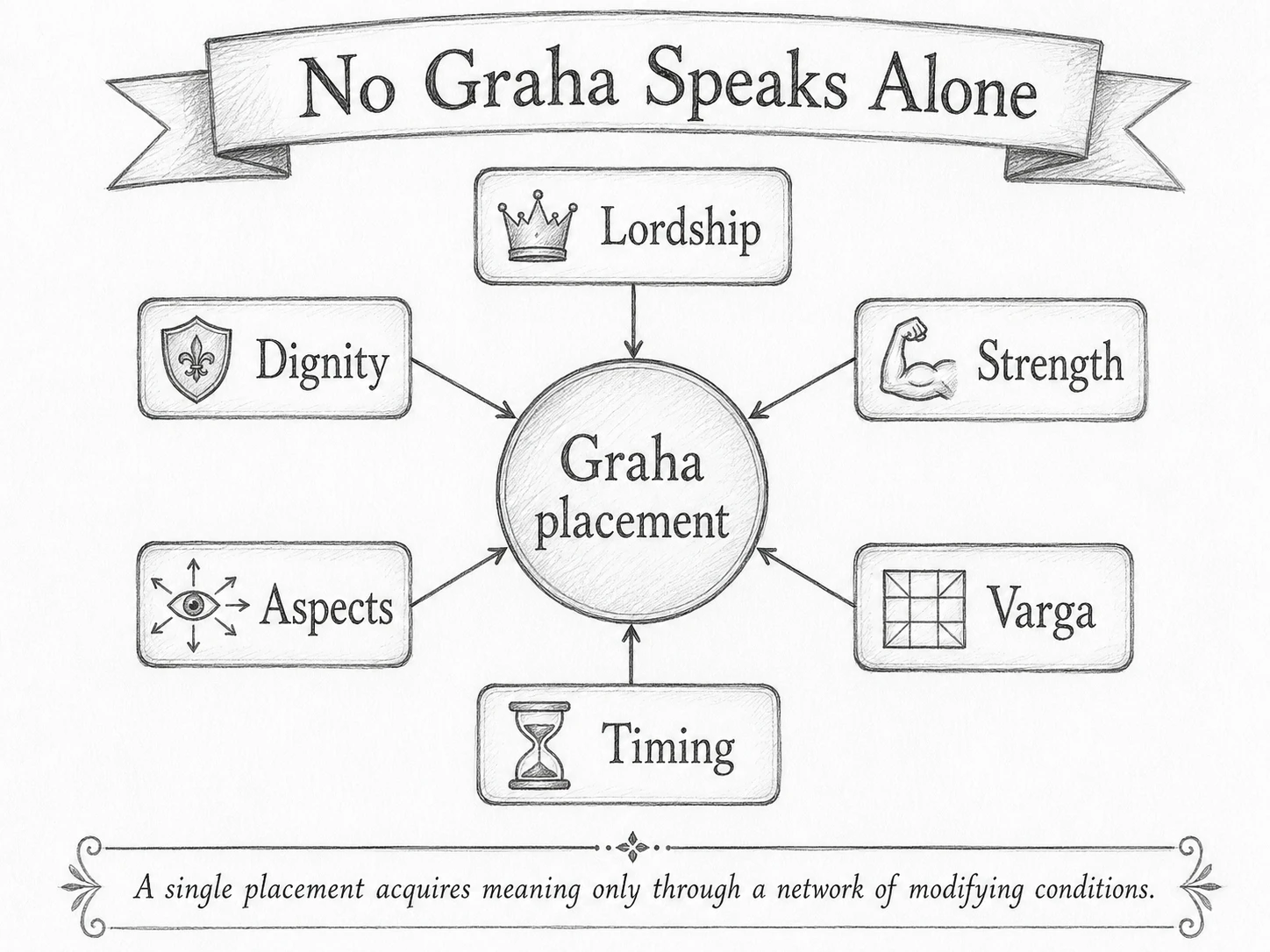
Figure 4. The same graha changes function through natural nature, house lordship, occupation, dignity, relation, bala, varga and timing. Strength is capacity, not moral goodness.
Dṛṣṭi: a geometry of relation
The Sanskrit dṛṣṭi means sight or seeing. In horoscopy it provides a formal language for relations among grahas, signs and houses.
Different Indian texts and schools do not use one perfectly uniform aspect doctrine. Some passages emphasize planetary aspects of graded or special strength. Others use sign-based relations. Some calculate exact angular influence; others operate by house or sign position. A scholarly account should state which convention is being used instead of merging every form of dṛṣṭi into a single timeless system.
The conceptual function, however, is clear. Dṛṣṭi prevents placement from being isolated. A graha acts not only where it stands but through the fields it regards. A bhāva may be empty and still be strongly configured because its lord and aspectors connect it to the rest of the chart.
Varāhamihira devotes a chapter of the Bṛhat Jātaka to planetary aspects and their results. His treatment also shows that an aspect judgment can be modified by the condition of the receiving sign and its subdivisions.[11] The relation is therefore not a line drawn between two points alone. It is an encounter between an acting graha, a receiving location and the rulers or qualities of that location.
Conjunction produces another kind of relation. Two grahas in the same region combine their fields, but combination does not imply equality. Strength, speed, proximity, lordship and context determine which graha dominates or how the two alternate. Some classical rules state explicitly that when several grahas compete in one operation, the strongest becomes decisive.[12]
This relational approach gives the horoscope a syntax. Grahas are the principal terms; houses provide domains; lordship creates reference; dṛṣṭi and conjunction create predicates and modifiers. A placement is closer to a word than to a complete sentence. Yoga is the level at which the sentence begins to take shape.
Yoga: when a placement becomes a configuration
In natal literature, yoga means a configuration produced by specified relations among grahas, houses, lords or signs. It does not refer to a general feeling of harmony. A yoga has conditions.
Some yogas are simple conjunctions. Others require lords of particular houses to exchange, join or aspect each other. Some depend on the Moon, the lagna or the distribution of grahas among angular and succedent houses. Some concern learning, wealth, adversity, authority, renunciation, illness or forms of livelihood. Large compendia preserve hundreds of named and unnamed configurations.
The number of possible combinations creates an interpretive problem. Nearly every substantial chart contains several yogas, including mutually contradictory ones. If every named yoga is read literally, one person may simultaneously be promised sovereignty, poverty, scholarship, exile, longevity, early death and renunciation.
Classical authors respond through hierarchy and qualification:
- Does the yoga satisfy all its stated conditions?
- Are the producing grahas strong?
- Are they damaged by competing conditions?
- Does a stronger yoga cancel, redirect or limit a weaker one?
- Is the yoga supported in relevant divisions?
- Does its daśā occur during a life stage in which the result is possible?
- What does the historical vocabulary mean in the native’s actual social world?
The last question is essential. A rāja-yoga arose in societies where kingship, court, land grant, command and patronage had concrete institutional meanings. Translating every such configuration into “the native will be a king” is not fidelity to the text. The interpreter must identify the underlying structure: authority, access to institutions, command over resources, public visibility, protection by powerful people, or responsibility for collective decisions.
Contextual translation should not become unlimited improvisation. The structural elements of the yoga must remain explicit. But historical vocabulary must be interpreted rather than mechanically repeated.
Yoga also demonstrates why biography cannot be inferred from one graha. The meaningful unit is often the relation among several offices: the lord of self with the lord of work, the lord of learning with the lord of fortune, the Moon with its dispositor, or the angular and trinal lords with each other. Biography arises from organized connection.
Varga: the same longitude at another resolution
A varga is a subdivision of a rāśi. The thirty degrees of a sign may be divided into halves, thirds, ninths, twelfths or other fractions, with the resulting segment assigned to a sign, ruler or interpretive domain according to a specified scheme.
The best-known is the navāṃśa, the ninth division. Each navāṃśa measures 3°20′. A graha’s navāṃśa does not indicate that the physical graha has moved to another place in the sky. It is a transformation of the same longitude according to a finer division.
This distinction is often obscured when divisional charts are displayed as independent diagrams. The graphic form is useful, but the underlying operation is a change of scale.
Varāhamihira defines several divisions early in the Bṛhat Jātaka and uses them throughout his judgments.[13] He also records variant doctrines concerning the assignment of subdivisions, evidence that the subject was debated.[14] Later texts expand the number and application of vargas.
Varga serves at least three purposes:
- resolution: it distinguishes grahas that share one rāśi but occupy different portions of it;
- condition: it tests whether a graha receives compatible or adverse rulership at the finer scale;
- domain-specific reading: later practice associates particular divisions with marriage, siblings, children, work, ancestry and other topics.
The first two functions are visible in early horā literature. The full historical development of domain-specific divisional charts is more layered and should not be projected uniformly into every early text.
The navāṃśa is especially important because classical rules repeatedly consult the lord of the navāṃśa occupied by a graha or by the lagna. Varāhamihira’s discussion of livelihood, for example, examines the tenth place from lagna or Moon and then the lord of the navāṃśa occupied by the relevant tenth lord.[15] Elsewhere bodily form or disposition may be inferred from the navāṃśa-lagna lord or the strongest graha.[16]
Varga therefore turns the horoscope into a multi-resolution model. A broad sign placement supplies one level of meaning; the subdivision can confirm, refine or complicate it.
The method also increases sensitivity to birth-time accuracy. A graha near a varga boundary can change subdivision with a small longitude correction. The ascendant changes more rapidly still. Any interpretation heavily dependent on fine divisions should disclose the reliability of the recorded birth time.
A worked example: how a bhāva is actually judged
A schematic example can show the difference between a placement slogan and a classical method. The example is intentionally incomplete. It illustrates the grammar of judgment, not a real person.
Assume:
- Taurus lagna;
- Aquarius as the tenth whole-sign house;
- Mercury occupying Aquarius;
- Saturn, lord of Aquarius and Capricorn, placed in Capricorn;
- Jupiter placed in Gemini and, under a commonly used graha-dṛṣṭi convention, casting its ninth aspect toward Aquarius;
- no severe combustion or other condition introduced for the purpose of the example.
A superficial reading might say, “Mercury in the tenth gives an intellectual career.” That is a possible thematic clue, not a sufficient judgment.
A fuller analysis proceeds in layers.
1. Define the question
The tenth bhāva can concern action, office, public responsibility, reputation and livelihood, but those topics are not identical. A question about employment during one year differs from a lifelong inquiry into vocation or public authority. The object of judgment must be specified.
2. Examine the tenth from more than one base
Varāhamihira’s professional rules consider the tenth from lagna or Moon, often giving priority to the stronger reference.[17] The tenth from the Sun may also be relevant in questions of authority or visible duty. The example cannot be completed without the Moon and Sun positions.
3. Examine the occupant
Mercury brings its field of speech, writing, calculation, mediation, commerce, analysis or adaptive intelligence into the tenth. But Mercury’s result depends on its own houses, condition, conjunctions, aspects and strength. For Taurus lagna, Mercury governs the second and fifth signs, connecting resources, speech, learning, counsel or creativity with public action.
4. Examine the tenth lord
Saturn rules Aquarius and stands in Capricorn, its own sign, in the ninth from Taurus. This links the tenth with a field of teaching, doctrine, institutions, long journeys, law, inherited knowledge or counsel. Saturn’s own-sign position may increase capacity, but the result remains Saturnian in pace and demand: responsibility, structure, endurance, delay or work with systems.
5. Examine support and interference
Jupiter’s aspect toward the tenth can add counsel, legitimacy, learning or expansion, depending on Jupiter’s functional role and strength. Other unlisted grahas could alter the picture. A severe aspect to Saturn, a damaged Mercury or an afflicted tenth bhāva could change the outcome substantially.
6. Examine significators and divisions
The Sun, Saturn, Mercury and Jupiter may each be relevant to different forms of public action. Navāṃśa and other accepted divisions can confirm or weaken their condition. If a career-specific divisional method is used, its textual and computational convention should be stated.
7. Examine time
The network becomes biographically prominent when the periods and subperiods of Mercury, Saturn, the tenth-house occupants, aspectors or connected lords operate. Transits may provide shorter windows. Without activation, a strong configuration may remain latent or appear through background capacity rather than a visible event.
8. Examine the actual person
Education, family resources, language, health, location, social opportunity, technology and deliberate effort determine the available form. The same configuration cannot produce an identical profession in a courtly city, an agricultural village, a modern software company and a monastic institution.
The example may support a broad hypothesis of work involving analysis, systems, communication, teaching, administration or institutional responsibility. It does not justify selecting one job title from the chart alone.
This is the difference between symbol matching and structured prognosis.
From a static chart to a life in time
Even the most carefully constructed birth chart remains static. A biography is not.
The horā tradition solves this problem through systems of temporal activation. Daśā assigns successive periods and subperiods to grahas or other factors. Gocara reads the moving sky in relation to the natal configuration. Annual and other derived methods provide additional scales. The exact systems vary by text and lineage, but their shared purpose is to answer a question the natal chart cannot answer by itself:
When does a potential relationship become prominent?
A daśā does not introduce a new graha. It changes the temporal emphasis of an existing network. When Saturn’s period operates, Saturn’s intrinsic field, house lordships, natal placement, aspects, conjunctions, strength and divisional condition become more active in the reading. Its subperiod with Mercury brings the Saturn-Mercury relation forward. A transit may coincide with or trigger the natal promise, but it is judged against the chart rather than in isolation.
Mantreśvara’s timing rules repeatedly connect events with the periods of a house occupant, aspector or lord, sometimes adding relevant transits.[18] Varāhamihira’s daśā material similarly ranks periods by planetary strength and relation.[19] The biography is produced through the interaction of natal structure and temporal sequence.
This architecture permits the same configuration to appear differently across life.
A fourth-house indication may manifest in childhood as family conditions, later as education or residence, and still later as property, caregiving or inner withdrawal. A tenth-house network may first appear through schooling and authority figures, later through profession and eventually through public reputation or responsibility for others. A seventh-house configuration can concern early experiences of negotiation long before marriage.
Age is therefore not an external nuisance variable. It changes the available expression of a bhāva.
Place also matters. Classical interpreters frequently invoke deśa, kāla and pātra: place, time and the nature or capacity of the person. These terms prevent a textual result from being applied without regard to context. “Elephants, horses and royal favour” cannot be read literally for every modern native. Their underlying functions—mobility, assets, institutional support, rank or access—must be translated into the person’s social world.
Action matters as well. Jyotiṣa literature contains strong karmic assumptions, but karma is not adequately represented as helpless fatalism. A chart can be read as the structure of tendencies, constraints, capacities and timing within which action becomes consequential. Counsel about education, health discipline, relationship conduct or financial restraint only makes sense if action can alter the lived result.
A useful model is agricultural:
- the natal chart is the field and seed condition;
- daśā is the season in which particular seeds become active;
- transit is the passing weather;
- social context is the available soil and infrastructure;
- action is cultivation;
- phala is the fruit, not a mechanically printed label.
The analogy has limits, but it preserves two truths. Outcomes are conditioned; they are not arbitrary. Outcomes are also not produced by one cause.
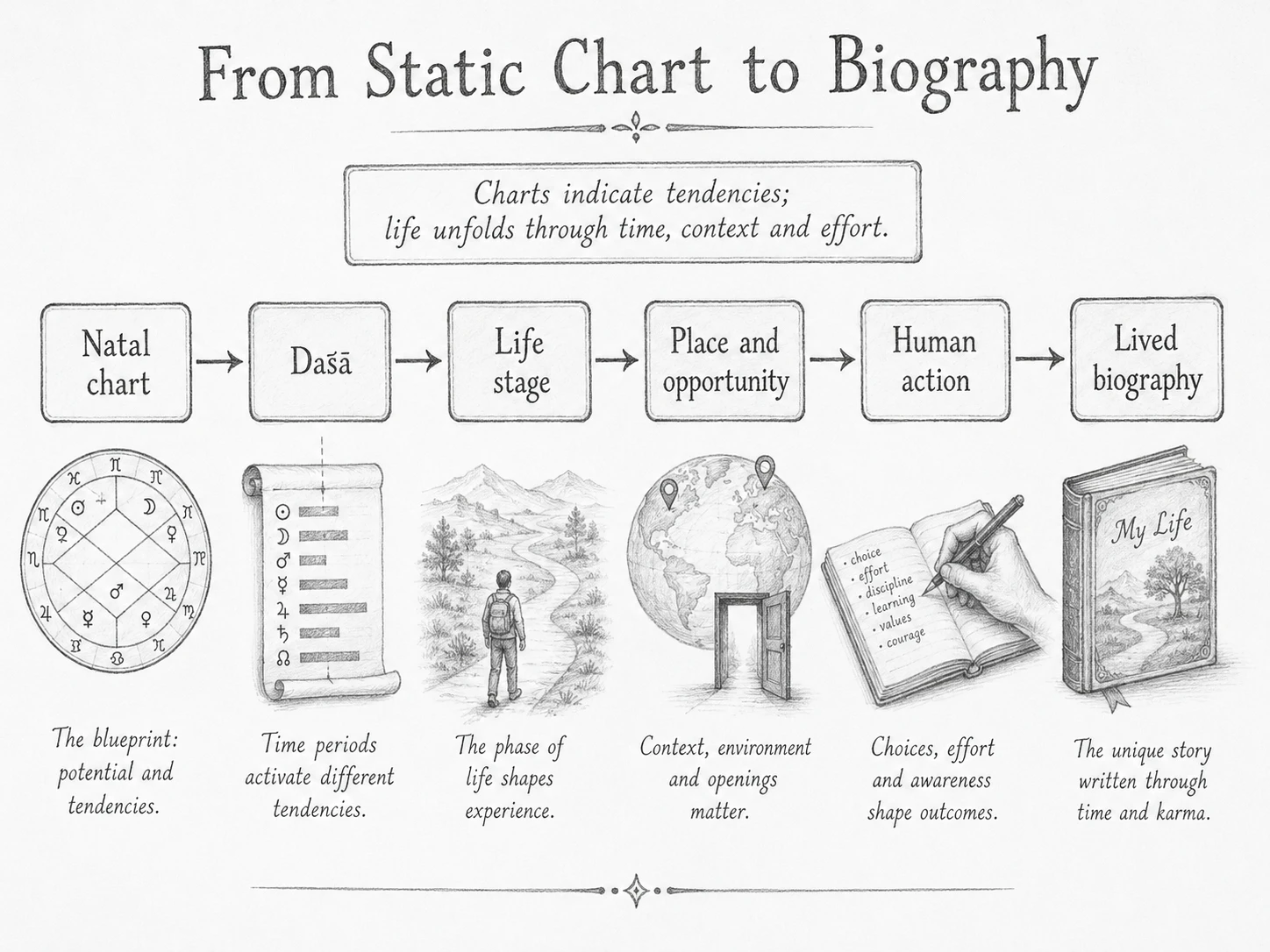
Figure 5. Calculation, classification, synthesis, activation, contextual translation and lived action are different stages. Precision in the first does not automatically validate the last.
Past, present and future in horā
The chart’s biographical reach is often explained through karma. The birth configuration is treated as an index of causes already in motion, the present as their current field of expression and the future as the anticipated ripening of tendencies under approaching periods.
This model should be stated carefully.
A horoscope is not a historical recording device. It does not contain photographs of previous births or an independently verifiable archive of past actions. When a text interprets a configuration as the fruit of prior karma, it is making a metaphysical and ethical claim about continuity, not presenting documentary evidence of a specific former biography.
The present is more accessible. A chart can be compared with current constitution, family circumstance, habits, education, relationships and work. Yet retrospective agreement is easy to overestimate. Rich symbolic systems can generate several plausible descriptions after the facts are known. The strongest test is whether interpretive rules were fixed before the outcome and whether another trained reader can reproduce the reasoning.
The future is a prognosis. It identifies periods in which certain domains and grahas are expected to become prominent. Prognosis can be useful without claiming certainty. A physician may distinguish risk from diagnosis; an agriculturalist may distinguish seasonal probability from guaranteed rainfall. Horā likewise becomes more responsible when it distinguishes:
- tendency from event;
- activation from outcome;
- opportunity from achievement;
- vulnerability from inevitable harm;
- symbolic correspondence from physical mechanism.
The Sanskrit phala, fruit, remains an appropriate term. Fruit depends upon a prior structure, but its quality varies with season, water, damage, care and environment.
The chart reader as an analyst of competing evidence
The classical jyotiṣin is sometimes imagined as a person who memorizes rules and retrieves the correct one. Memory is indispensable, but the texts demand more.
The reader must:
- calculate or verify the chart;
- identify the relevant bhāva and reference points;
- distinguish natural and functional graha roles;
- assess strength and state;
- compare supportive and damaging relations;
- select the relevant vargas;
- determine the active periods;
- translate historical vocabulary into present context;
- and communicate uncertainty without making the consultation useless.
This is a form of constrained interpretation. The constraints are technical, textual and ethical.
Varāhamihira opens the Bṛhat Jātaka by presenting his compact work as a boat for crossing the extensive ocean of horā.[20] The metaphor is modestly revealing. The field is too large to be reduced to one mnemonic. A text supplies a vessel, not the entire sea.
Kalyāṇavarma makes a related scholarly gesture in the Sārāvalī. He acknowledges earlier authorities and describes his work as an expansion or clarification of compressed teachings.[21] Vaidyanātha’s compilation preserves multiple readings and cites earlier doctrines, occasionally noting disagreement.[22] The tradition advances through condensation, comparison and reorganization.
A competent reader therefore needs textual judgment. A verse should be located within its genre and argument. A rule concerning longevity should not be applied as though it were a general house rule. A yoga described in one text should not be silently combined with cancellation conditions from a much later manual unless the synthesis is declared. A modern psychological paraphrase should not be attributed to a Vedic source simply because both mention the Moon.
The horoscope is already layered. Scholarship should not add another layer of hidden borrowing.
Where classical biography becomes ethically difficult
The natal texts preserve extraordinary intellectual labour. They also preserve the social assumptions and anxieties of their periods.
Chapters discuss caste, gender, servants, kingship, bodily difference, sexuality, legitimacy, disease, poverty, imprisonment, widowhood, lifespan and manner of death. Some descriptions are observational or symbolic. Others reproduce hierarchical judgments that should not be presented today as timeless moral truths.
A historically faithful reading is not the same as uncritical repetition.
Three areas require particular restraint.
Medical claims
A chart may be used to discuss periods of vulnerability or the symbolic relation among body, season and habit. It should not replace examination, diagnosis or treatment. Predicting a specific disease from a placement can delay care, intensify anxiety and create confirmation bias. High-stakes medical claims require clinical evidence beyond textual authority.
Death and longevity
Classical works devote substantial space to lifespan and modes of death. Contemporary practice should treat exact death prediction as ethically hazardous. It can produce fear, coercion and self-fulfilling behaviour, while birth-time uncertainty and divergent methods make precision especially doubtful. Historical study of longevity techniques is legitimate; declaring a client’s death date is another matter.
Social identity and moral worth
No person’s dignity can be inferred from caste, gender, disability, fertility, marital status or economic condition. Textual categories should be contextualized. A rule describing “low birth,” “servitude” or “unchaste conduct” may disclose the hierarchy of its society more clearly than the destiny of a contemporary individual.
Indian ethical vocabulary already supplies standards for practice. Satya requires honesty about what is known and uncertain. Ahiṃsā prohibits avoidable harm. Hita asks whether speech serves the person’s welfare. Deśa-kāla-pātra demands contextual fitness. Puruṣakāra preserves the meaningful place of effort.
A consultation that destroys agency in the name of fate has misunderstood its own purpose.
Can horoscopic synthesis be studied today?
The complexity of chart interpretation is often used to avoid testing. A failed prediction is attributed to an overlooked varga, an unexamined daśā, an incorrect birth time or the reader’s lack of intuition. Complexity is real, but it should increase methodological discipline rather than eliminate it.
A serious contemporary research programme could proceed in stages.
1. Build a critical rule corpus
Rules should be extracted from dated textual witnesses and tagged by:
- source and chapter;
- Sanskrit technical terms;
- chart factors required;
- stated conditions and exceptions;
- predicted domain;
- time rule;
- and degree of textual uncertainty.
This would reveal which widely repeated claims have early support, which belong to later synthesis and which appear to be modern inventions.
2. Make chart construction reproducible
Every computational choice should be declared:
- birth-time source and uncertainty;
- coordinates;
- time-zone conversion;
- astronomical ephemeris;
- sidereal reference or ayanāṃśa;
- node calculation;
- bhāva method;
- aspect convention;
- varga algorithm;
- daśā system.
Without this metadata, two researchers may think they are testing the same rule while constructing different charts.
3. Separate rule selection from outcome knowledge
Readers should interpret charts without access to the native’s biography beyond variables required by the protocol. Predictions should be time-stamped and specific enough to evaluate. Broad statements such as “a major change involving responsibility” are too flexible unless the acceptable outcomes are defined in advance.
4. Measure agreement among readers
If a method is transmissible, trained readers following the same textual rules should agree at least moderately on:
- which factors are relevant;
- which grahas are strongest;
- whether a bhāva is supported, damaged or mixed;
- which periods are activated;
- and what range of outcomes is predicted.
Low agreement would identify where rules are ambiguous or where tacit intuition dominates.
5. Use longitudinal designs
A biography unfolds over time. Studies should collect predictions before the period begins and follow outcomes prospectively. Daśā changes, transits and life-stage variables can be modelled without relying entirely on retrospective memory.
6. Publish failures
A tradition of prognosis cannot improve if unsuccessful judgments disappear. A failure archive should include incorrect predictions, ambiguous rules, birth-time sensitivity and cases in which different methods produced incompatible results.
7. Test layers separately
The full horoscope may be too complex for an initial test. Research can begin with narrower questions:
- Does a declared lagna-based rule classify outcomes above chance?
- Do fine vargas add predictive value beyond rāśi placement?
- Do daśā periods improve timing compared with age and social baselines?
- Does a strength measure improve a yoga’s performance?
- Can independent readers reproduce bhāva assessments?
This approach respects the tradition’s architecture. It does not demand that one experiment prove or disprove all Jyotiṣa.
8. Protect participants
Consent, privacy, data security and limits on high-stakes advice are essential. Birth data are identifying information. Biographical datasets can contain health, fertility, finances, relationships and trauma. Research should not expose individuals in the name of validating a doctrine.
The most valuable outcome may not be a binary verdict. A rigorous programme could distinguish:
- computationally exact components;
- interpretive rules with reproducible agreement;
- context-sensitive correlations;
- symbolic frameworks valuable for reflection;
- and claims that fail under testing.
Such differentiation would be more informative than either blanket belief or blanket dismissal.
A primary-source map of the chart’s architecture
| Text | Approximate historical position | Contribution to the architecture | Research caution |
|---|
| Siddhānta Śiromaṇi and related siddhāntic astronomy | Classical-medieval mathematical astronomy | Calculation of time, solar position, rising signs and local celestial geometry | Astronomical procedure should not be confused with natal interpretation |
| Varāhamihira’s Bṛhat Jātaka | Sixth century CE | Compact definitions of rāśi, graha, strength, varga, yoga, aspect, profession and daśā | Its compression generated extensive commentary and later expansion |
| Kalyāṇavarma’s Sārāvalī | Early-medieval; exact date debated | Expanded combinations, graha conditions, yogas and natal results | Surviving text is large and layered; dating requires caution |
| Śrīpati’s Śrīpati Paddhati | Eleventh century CE | Bhāva calculation, aspects, strengths and systematic natal procedure | Later practice does not use one uniform house method |
| Vaidyanātha’s Jātaka Pārijāta | Late-medieval compilation | Synthesis of signs, grahas, houses, yogas, strength, longevity and daśā | Preserves inherited and divergent doctrines; compilation is not uniform origin |
| Mantreśvara’s Phaladīpikā | Late-medieval; exact date debated | Explicit method for assessing bhāvas, strengths, yogas, daśās and transits | Common modern use can obscure textual variants and historical context |
Glossary
Avasthā — A classified state or condition of a graha, represented through various technical schemes.
Bala — Strength or effective capacity; may be assessed through several positional, directional, temporal, motional and relational measures.
Bhāva — A locally oriented field of life experience, conventionally arranged in twelve houses.
Bhāveśa — Lord or ruler of a bhāva, normally determined through the ruler of the rāśi associated with that house.
Daśā — A system of periods and subperiods used to unfold natal indications through time.
Deśa-kāla-pātra — Place, time and the nature or capacity of the person; a principle of contextual interpretation.
Dṛṣṭi — Aspect, sight or formal relation among grahas, signs or houses.
Gocara — Transit; the movement of grahas through the current sky in relation to the natal chart.
Graha — A technical Jyotiṣa category including Sun, Moon, visible planets and lunar nodes as interpreted celestial agents.
Lagna — Ascendant; the point of the ecliptic rising at the eastern horizon for a given place and time.
Navāṃśa — The ninth division of a rāśi; each segment measures 3°20′.
Phala — Fruit, result or experienced consequence of a configuration.
Puruṣakāra — Human effort, initiative or intentional action.
Rāśi — One of the twelve thirty-degree divisions of the ecliptic.
Varga — A subdivision of a rāśi used to refine planetary condition and, in later systems, particular life domains.
Yoga — A specified configuration formed by relations among grahas, houses, lords or signs.
Conclusion: biography is a synthesis, not a label
The birth chart begins with an instant, but it does not remain an instant.
Astronomy supplies graha positions and the local horizon. Rāśi gives the ecliptic a regular structure. Lagna situates that structure. Bhāva turns orientation into fields of life. Lordship connects those fields. Strength distinguishes presence from capacity. Dṛṣṭi and conjunction create relation. Yoga identifies recurring configurations. Varga changes resolution. Daśā and transit unfold the network through time. Deśa, kāla, pātra and action determine the available form of the result.
No single layer is the biography.
The finished life account is produced by their ordered synthesis. That is both the sophistication and the vulnerability of horā. Its richness permits contextual judgment; the same richness can conceal inconsistency when rules are selected after the event. The intellectual task is therefore double: understand the classical architecture faithfully and make the process of inference visible.
A horoscope is most defensible when it is treated neither as a celestial command nor as an unrestricted story. It is a structured language of conditioned possibility. Its value depends on the accuracy of its construction, the discipline of its interpretation, the honesty of its uncertainty and the agency left to the person whose life it attempts to read.
The chart becomes a biography only when the reader joins sky, text, time and lived circumstance. Whether that biography becomes insight or confinement depends upon how responsibly the joining is done.
Notes and sources
[1] The article uses “horā literature” for the Indian natal and predictive corpus without assuming that all surviving texts belong to one date, school or perfectly uniform doctrine. For a compact early architecture, see Varāhamihira, Bṛhat Jātaka, especially chapters 1–2, 10, 19, 23 and 25–26. Later expansions include Kalyāṇavarma, Sārāvalī; Śrīpati, Śrīpati Paddhati; Vaidyanātha, Jātaka Pārijāta; and Mantreśvara, Phaladīpikā.
[2] Bhāskara II, Siddhānta Śiromaṇi, astronomical sections on the computation of lagna. See the Sanskrit edition edited by Bāpūdeva Śāstrī and the Bibliotheca Indica rendering prepared from the same mathematical tradition. The rule treats lagna as a calculable relation between the ecliptic, local horizon and elapsed time.
[3] Varāhamihira, Bṛhat Jātaka 1.19, on conditions of strength associated with lagna and related factors. Verse numbering can differ slightly among editions.
[4] See Bṛhat Jātaka 10.1 on livelihood from the tenth from lagna or Moon and the relevant navāṃśa lord; see also the work’s use of lagna, Sun and Moon as alternative or ranked reference points in daśā and bodily judgments.
[5] Mantreśvara, Phaladīpikā 15.12–14, on the full effect of a graha near bhāva-madhya and the progressive diminution of effect toward bhāva-sandhi.
[6] Śrīpati, Śrīpati Paddhati, sections on bhāva construction, aspects and sixfold strength. V. Subrahmanya Sastri’s English edition remains a useful access point, although computational terminology should be checked against the Sanskrit.
[7] Vaidyanātha, Jātaka Pārijāta 2.1 and accompanying commentary in V. Subrahmanya Sastri’s translation. The passage assigns the Sun, Moon, Mars, Mercury, Jupiter, Venus and Saturn differentiated functions within Kālapuruṣa.
[8] Mantreśvara, Phaladīpikā, chapter 15, “Method of studying the effects of the Bhāvas.” The chapter brings together occupancy, aspect, lordship, strength, benefic and malefic relations, bhāva-sandhi and daśā consequences.
[9] Kalyāṇavarma, Sārāvalī, chapters on yogas and planetary strength. Important combinations are repeatedly conditioned by the strength, dignity and support of the producing grahas.
[10] Varāhamihira, Bṛhat Jātaka 19.9 in editions that place the rule in the aspect chapter: the strength and divisional condition of a sign lord can modify results stated from a planetary sign relation.
[11] Bṛhat Jātaka, chapter 19, on planetary aspects. The chapter should be read with the technical definitions in chapter 1 and with awareness that later aspect systems do not all reproduce the same weighting.
[12] Compare Jātaka Pārijāta 5.9 and related strength rules, where the strongest among several grahas can become decisive in a shared operation; similar hierarchy appears in other classical computations.
[13] Bṛhat Jātaka 1.9 and surrounding verses define horā, drekkāṇa, navāṃśa, dvādaśāṃśa and related divisions.
[14] Bṛhat Jātaka 1.12 records more than one doctrine concerning subdivision assignments. The passage is important evidence against treating every varga table as historically uncontested.
[15] Bṛhat Jātaka 10.1. The rule examines the tenth place and the lord of the navāṃśa occupied by the relevant factor in judging livelihood.
[16] Bṛhat Jātaka 5.23 in several editions, where bodily form is associated with the lord of the navāṃśa-lagna or the strongest graha. Translation and verse divisions vary.
[17] Bṛhat Jātaka 10.1. The rule’s compactness has produced different practical explanations; its methodological value lies in combining house, reference point and subdivision rather than reading one placement alone.
[18] Mantreśvara, Phaladīpikā, chapters 10, 15, 19–26. Timing is linked with house occupants, aspectors, lords, planetary periods and relevant transits.
[19] Bṛhat Jātaka, daśā chapters, especially the sequencing of periods according to angular position and relative strength. The daśā method in Varāhamihira should not be silently identified with every later popular daśā system.
[20] Bṛhat Jātaka 1.2. Varāhamihira describes his concise work through the image of a boat capable of crossing the extensive ocean of horā.
[21] Kalyāṇavarma, Sārāvalī, opening chapter. The author places his work in relation to earlier teachers and presents expansion and clarification as scholarly purposes.
[22] Vaidyanātha, Jātaka Pārijāta, chapter 1 and translator’s notes. The work compiles prior doctrines and preserves alternate readings or divergent authorities in several technical matters.
[23] Varāhamihira, Bṛhat Jātaka, chapter 1, for rāśi rulerships, exaltations, divisions, angular houses and strength terminology.
[24] Bṛhat Jātaka, chapter 2, for natural properties, directions, substances, bodily associations and other graha characteristics.
[25] Vaidyanātha, Jātaka Pārijāta, chapters 1–2, for the properties of signs and grahas and the distinction between bodily divisions reckoned from the lagna and inherent qualities inferred from grahas.
[26] Mantreśvara, Phaladīpikā, chapters 2, 4, 6 and 15, for vargas, strength, yoga formation and cumulative bhāva assessment.
[27] Śrīpati, Śrīpati Paddhati, on the sequence: calculate bhāvas, investigate aspects, and assess the six kinds of strength before judgment.
[28] Varāhamihira, Bṛhat Jātaka 23.1 and following verses, where judgment combines lagna or Moon, house occupancy, aspect and lordship.
[29] Bṛhat Jātaka 17.13 in editions of the text, illustrating the dependence of a stated result on the strength of the Moon and sign lord.
[30] Bṛhat Jātaka 19.4 and 19.9, where sign-aspect results are read through divisional placement and the strength of rulers rather than as unconditional statements.
[31] Kalyāṇavarma, Sārāvalī, chapters on rāja-yogas. The text’s repeated use of dignity, angularity, aspect and strength demonstrates why the historical term should not be reduced to one modern status label.
[32] Mantreśvara, Phaladīpikā, chapter 15, also distinguishes a prospering bhāva, a destroyed bhāva and mixed conditions. The categories are useful methodologically even when individual results require historical contextualization.
[33] Bhāskara II’s lagna computation and Śrīpati’s house procedure belong to mathematical and technical traditions that make chart construction independently reproducible in principle. Interpretation begins after, not instead of, that computation.
[34] The exact historical dates of Kalyāṇavarma and Mantreśvara remain debated. This article therefore uses broad relative positions rather than asserting a false precision.
[35] The surviving Jātaka Pārijāta is a compilation that draws on earlier horā works. Its value lies partly in synthesis; individual doctrines should not automatically be dated to the compiler’s period.
[36] Birth-time rectification is discussed in several later traditions. For research purposes, any rectification should distinguish fitting events from validation events and preserve the original recorded time.
[37] Fine vargas are highly sensitive to longitude and, in the case of the ascendant, to birth-time error. An interpretation that depends on them should report uncertainty rather than display a false exactness.
[38] Classical chapters on disease, lifespan and death are important historical sources but do not provide a substitute for contemporary medical assessment or an ethical warrant for deterministic death prediction.
[39] Deśa, kāla and pātra appear across Indian interpretive disciplines as conditions of appropriate judgment. In horā they provide a principled basis for translating historical results into the native’s actual social and material setting.
[40] A contemporary research programme should treat chart construction, rule extraction, reader agreement, prediction and ethics as separate but connected problems. Testing one narrow rule does not validate or invalidate the entire Jyotiṣa corpus.