Jyotiṣa Before the Horoscope
Time, observation and the lunar body in early Indian thought
By Vamsikrishna Sankarayogi ·
Any account of the origins of Indian astrology encounters a problem of vocabulary before it encounters a problem of evidence. The English word astrology usually directs attention toward the horoscope: a chart erected for a birth, a question about the future, or a claim that a particular planet produces a particular event. The Sanskrit word jyotiṣa has a wider historical field. In its earlier technical settings it includes the ordering of calendars, the determination of ritual time, the computation of celestial positions, the observation of eclipses and seasonal change, and only then the interpretation of what those configurations might signify for a kingdom, a harvest or an individual life.
That breadth matters. If the history is begun with the birth chart, the discipline appears to have emerged as a system of prediction to which astronomy was later attached. The surviving texts suggest almost the reverse. The first durable problem was calendrical: how to know the time accurately enough for ritual, agriculture and social coordination. Mathematical astronomy developed in response to that problem. Prognosis grew within the same temporal culture, but it was neither the whole of Jyotiṣa nor its earliest surviving form.
This essay follows one strand through that history: the Moon. The Moon is useful precisely because it cannot be confined to a single register. It is a visible celestial body whose phases can be explained geometrically. It is a moving marker against the nakṣatras. Its relation to the Sun defines the tithi. Its light changes the nocturnal environment. It is associated in Vedic and later texts with manas, Soma, nourishment, receptivity and fluctuation. It also appears in claims about bodily and mental rhythms. Some of those claims can now be framed as empirical questions; others belong to a symbolic and prognostic language whose validity cannot be settled by physiology alone.
I use Jyotiṣa here in this historically broad sense. I do not assume that every layer of the tradition arose at the same time, used the same method, or carried the same standard of proof. Nor do I treat meditation as an alternative to astronomical measurement. The more interesting possibility is that disciplined observation, calculation, ritual attention and contemplative interpretation developed in conversation with one another. Modern physiological research enters the discussion only where a physiological claim is being made. It is not being used to explain the Indian tradition through another astrological lineage.
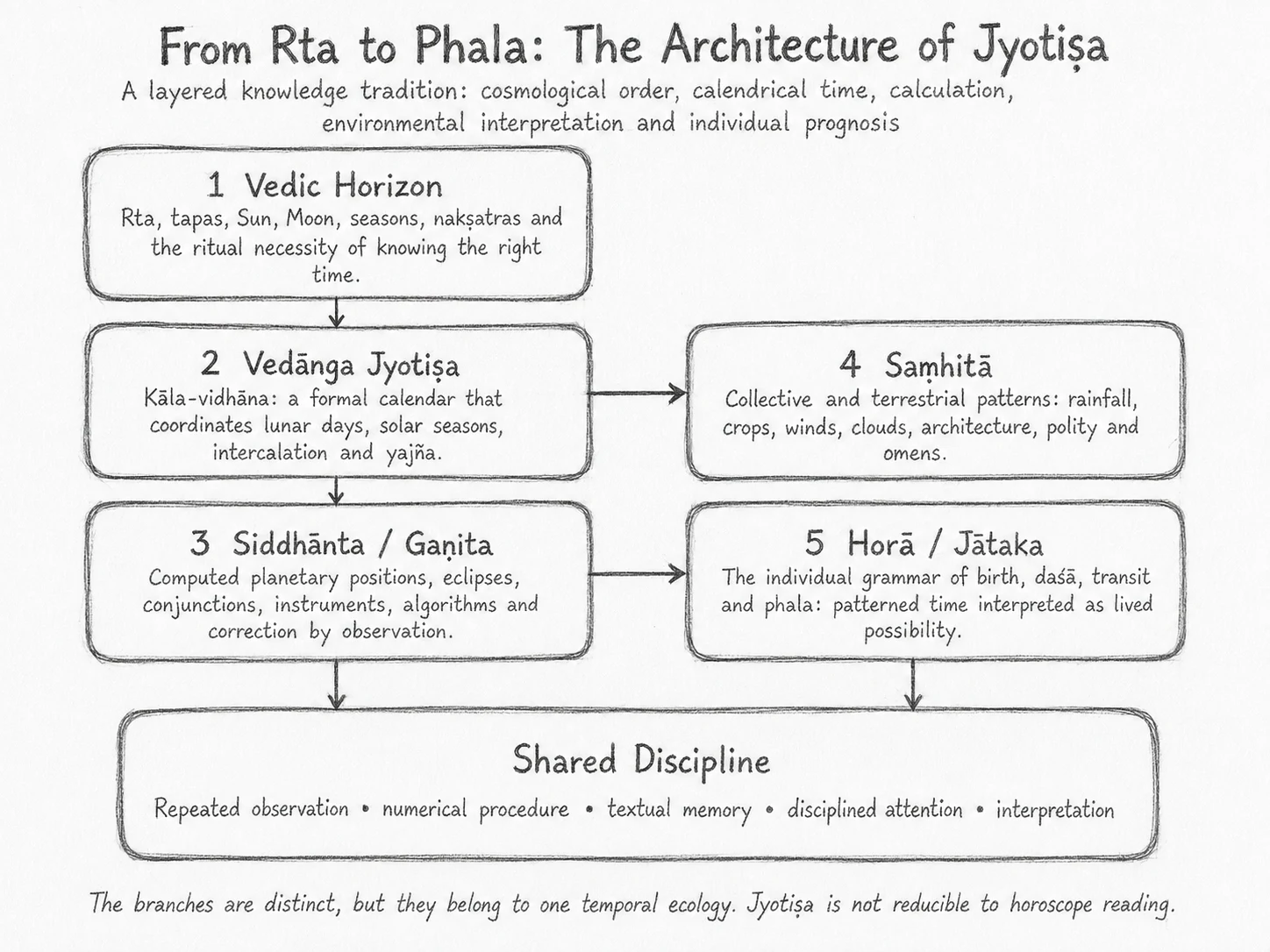
Figure 1. A schematic, not a strict chronology. The branches of Jyotiṣa differentiated over time, while retaining a shared concern with the ordering and interpretation of kāla.
The calendar was not a secondary matter
The Vedāṅga Jyotiṣa, attributed to Lagadha and preserved in recensions associated with the Ṛgveda and Yajurveda, is generally treated as the earliest surviving compact Sanskrit manual devoted specifically to calendrical astronomy. Its date has been argued over for more than a century, and the range of proposed dates is too wide to be concealed behind a single confident number. The uncertainty, however, does not obscure the function of the text. It is concerned with the determination of time for ritual performance.[1]
One of its opening statements calls the work a kāla-vidhāna-śāstra, a discipline for the arrangement or determination of time:
tasmād idaṃ kālavidhānaśāstraṃ yo jyotiṣaṃ veda sa veda yajñān
The reasoning is practical. Sacrificial action is prescribed for particular temporal conditions; therefore the person who understands the ordering of time is able to understand when the sacrifice is to be undertaken.[2] This is not yet the language of an individual horoscope. It is the language of synchronization.
The synchronization problem is not trivial. A lunar month and a solar year do not fit together in whole numbers. Left unattended, a calendar based on lunar months drifts through the seasons. The Vedāṅga Jyotiṣa works with a five-year yuga, intercalation, seasons, half-years, lunar days and nakṣatras in order to maintain a workable relation among several measures of time. The system is not identical to the later siddhāntic astronomy of Āryabhaṭa or Varāhamihira, but it already displays the habit that remains characteristic of Indian calendrical science: several clocks must be reconciled rather than reduced to one.
The tithi is a particularly revealing example. In current technical usage, a tithi is determined by each twelve-degree increase in the angular separation of the Moon and the Sun. Fifteen tithis make the waxing half of the month, śukla pakṣa; fifteen make the waning half, kṛṣṇa pakṣa. Because the boundary is angular, it can occur at any civil clock time. The date on a wall calendar changes at midnight. A tithi does not. It changes when the geometry changes.
This is why the Indian lunar calendar cannot be dismissed as a poetic sequence of bright and dark nights. It is built upon a measurable relation. Amāvasyā is the conjunctional end of one cycle and beginning of another; pūrṇimā is the condition of approximate opposition. Between them the visible portion of the lunar disc changes because the relative positions of Sun, Earth and Moon change. Later astronomical texts explain this physical appearance, while calendrical practice uses the same motion to organize ritual and social time.
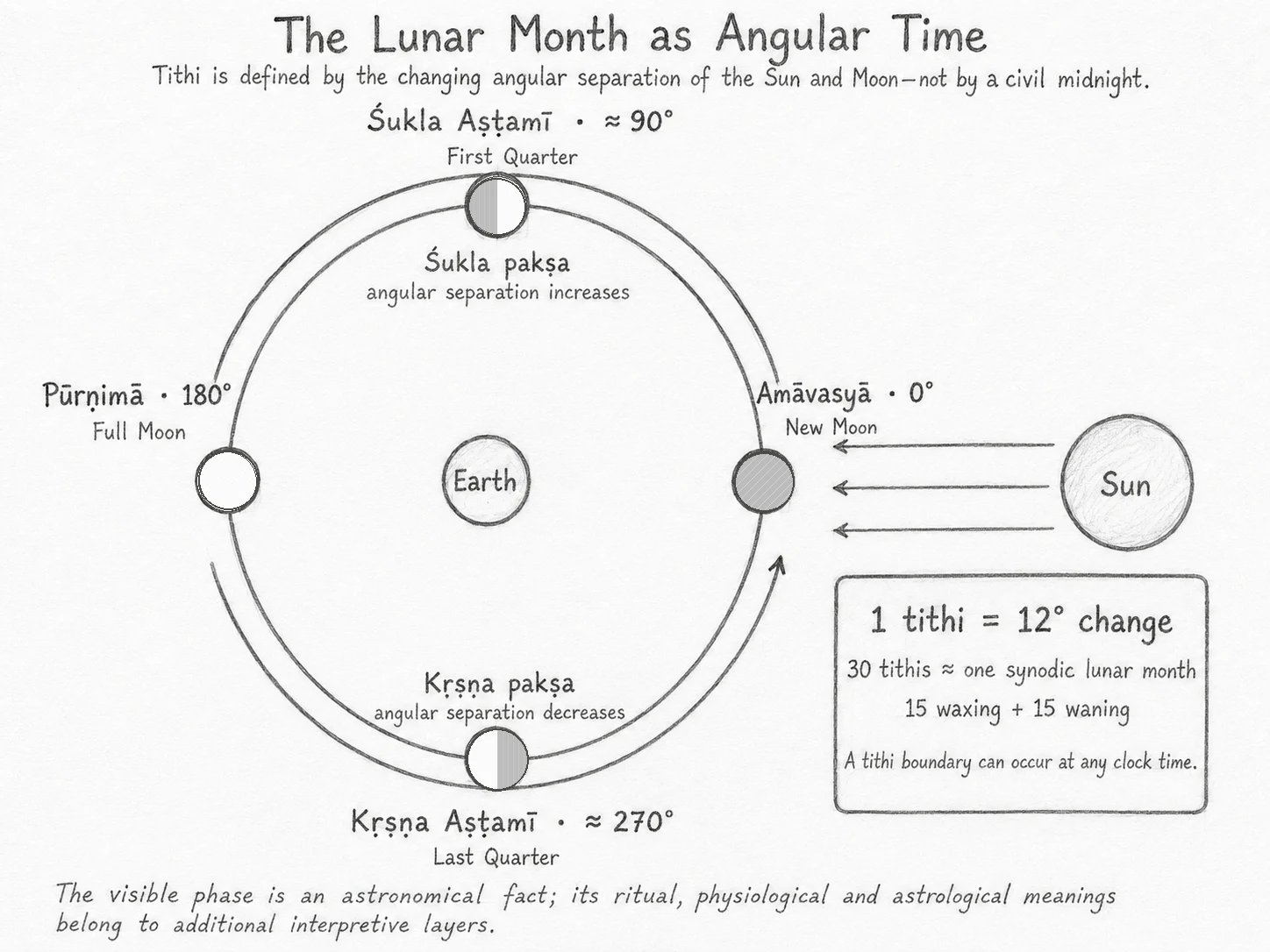
Figure 2. A tithi is defined by relative angular motion. The figure distinguishes astronomical geometry from the further ritual, physiological and astrological meanings attached to the cycle.
The nakṣatra system adds a second lunar coordinate. Vedic sources preserve lists of the lunar mansions and, in several cases, their presiding deities. The Moon’s movement against these stellar fields made it possible to locate a night not only within a waxing or waning fortnight but also within a sidereal sequence.[3] The later interpretive qualities of individual nakṣatras did not arise from a blank sky. They were attached to an older observational map in which the Moon’s nightly displacement was immediately visible to a trained observer.
Seen in this context, the earliest surviving Jyotiṣa is less concerned with predicting a private destiny than with preventing collective time from falling out of order. The calendar links the altar to the season, the lunar month to the solar year, and human action to a sky that does not conform to convenient numerical divisions. The intellectual labour lies in managing the mismatch.
Ṛta, tapas and the discipline of the observer
The technical calendar presupposes a more general Vedic conviction: the world possesses order. The most important term here is ṛta. It is often translated as cosmic order, but no single English equivalent is adequate. Ṛta includes regularity, right arrangement, truth in enactment and the fitting relation among things. Dawn returns according to ṛta; the seasons turn within it; truthful speech and properly performed ritual also participate in it.
Ṛgveda 10.190 offers a compact account of ordered emergence. Ṛta and satya arise from tapas; the year is generated and distributes day and night; the Sun and Moon are established in their proper order.[4] This is not an astronomical algorithm. It is a cosmological reason for believing that an algorithm is possible. A world without recurrence cannot sustain a calendar. A world governed only by caprice cannot be measured through repeated observation.
The role of tapas requires some care. The word can indicate heat, austerity, concentrated effort and the generative intensity of disciplined practice. It is tempting to translate this immediately into the modern claim that the ṛṣis obtained astronomy by meditation. That formulation is too loose. Meditation does not by itself yield the length of a synodic month, calculate an eclipse or correct a planetary longitude. Those achievements require counting, comparison and technical procedure.
At the same time, the contemplative element should not be removed simply because it does not resemble an instrument. Sustained attention is itself a condition of observation. A person who watches the sky intermittently may notice a bright star or an unusual eclipse; a tradition that watches it over generations notices recurrence, deviation and seasonality. Memory, restraint and the ability to attend without prematurely forcing a conclusion are not substitutes for measurement, but they influence the quality of the measurements and the classifications built from them.
Historical precision also requires a distinction among the people involved. The Vedic ṛṣi is a seer associated with mantra. Lagadha appears as an early authority of calendrical astronomy. Āryabhaṭa is a mathematical astronomer. Varāhamihira is an ācārya whose works move across mathematical astronomy, environmental prognosis and horoscopy. The later gaṇaka or daivajña belongs to yet another professional setting. To call all of them “rishis” is reverential, but historically unhelpful. It makes a long intellectual development appear as one undifferentiated revelation.
The continuity is not that every author used the same method. It is that each inherited a world in which temporal order was worth studying and in which observation carried practical, ritual and interpretive consequences. The observer was expected to be disciplined, but discipline did not mean passive obedience to an old table. As the classical literature shows, inherited calculation could be corrected against the sky.
Varāhamihira and the differentiated field of Jyotiṣa
By the sixth century, Varāhamihira could describe Jyotiṣa as an internally differentiated field. In the second chapter of the Bṛhat Saṃhitā, the qualified jyotiṣin is expected to know astronomical computation, saṃhitā and horoscopy. The same chapter requires familiarity with divisions of time, intercalary months and days, eclipses, planetary motions and instruments. It also states that when the astronomical canons give discrepant results, the positions should be determined through actual observation using shadow, water and astronomical instruments.[5]
This passage deserves more attention than it usually receives. Varāhamihira does not present textual authority and observation as enemies. The text preserves the accumulated methods of a tradition; observation adjudicates when methods diverge. Canon is not discarded, but neither is it insulated from correction.
His Pañcasiddhāntikā is itself evidence of this comparative disposition. It preserves and summarizes five astronomical systems, unevenly and sometimes obscurely, because no single inherited canon exhausted the available knowledge.[6] The work is valuable partly because several of the source traditions it records are otherwise lost. More importantly for the present argument, it shows astronomy being practised through collation: procedures are compared, parameters are retained or rejected, and computation remains central.
Āryabhaṭa’s Āryabhaṭīya, composed in an earlier part of the same intellectual period, provides a different example. In the Golapāda, the apparent westward movement of the fixed stars is compared to the apparent backward movement of stationary objects seen by a person travelling in a boat. The analogy explains an observed appearance by reference to the motion of the observer’s frame.[7] Whatever disagreements later astronomers had with particular features of Āryabhaṭa’s system, the reasoning is unmistakably astronomical. An appearance is not accepted at face value; it is re-described through a model.
The saṃhitā branch presents another kind of evidence. Varāhamihira’s Bṛhat Saṃhitā ranges over rainfall, winds, clouds, crops, groundwater, architecture, royal affairs, comets, eclipses, animals and bodily signs. The range can appear bewildering to a modern reader because subjects now divided among meteorology, agriculture, natural history, statecraft and divination occur in one encyclopaedic work. Yet the arrangement reflects a coherent concern: how does a changing sky relate to the inhabited world?
The chapter on Rohiṇī-yoga is useful because it shows what such inquiry could look like in practice. The time of the Moon’s entry into Rohiṇī is to be calculated. The observer then attends to the Moon’s appearance, the direction and quality of winds, clouds, meteors and other atmospheric signs; seed germination is also brought into the field of observation. These signs are interpreted in relation to rainfall and agricultural conditions. Varāhamihira cites earlier authorities, among them Garga, Parāśara, Kāśyapa and Nārada, but the procedure is not reduced to citation. It requires a timed observation.[8]
A modern researcher will immediately see limitations. The variables are numerous, the classifications are partly qualitative, and the surviving text does not provide the kind of sampling protocol or error model expected today. Selective memory and retrospective interpretation could easily strengthen an apparent association. Those limitations should be stated. They do not make the procedure random. The chapter combines a computed celestial event, a prescribed observation window, environmental variables and an outcome of practical consequence. It belongs to an early science of correlations, even though its criteria of validation differ from those of contemporary statistics.
The distinction among siddhānta, saṃhitā and horā is therefore more than a convenient classification. Siddhānta asks where a body is and when a configuration occurs. Saṃhitā examines collective and terrestrial correspondences. Horā applies temporal configurations to an individual life. The branches share data and vocabulary, but they do not make identical claims. Confusion begins when the certainty of a computed eclipse is transferred without argument to the interpretation of a birth chart.
How patterns became knowledge
The history of Jyotiṣa is often narrated through two unhelpful extremes. In one account, ancient seers possessed complete insight and later texts merely recorded it. In the other, all prognostic material is treated as undisciplined superstition appended to otherwise respectable astronomy. Neither account explains the texts very well.
A more plausible reconstruction begins with different kinds of recurrence. Some are immediate and stable: the Moon moves eastward against the stars; its visible phase follows a sequence; shadows vary with the Sun’s altitude; the seasons recur. Some are less stable but still observable over repeated years: monsoon onset, wind direction, crop response, animal behaviour. A third class concerns human events and individual lives, where the number of interacting causes is much greater and recurrence is harder to establish.
Ancient authors did not possess one uniform method for all three classes. Mathematical astronomy developed algorithms and correction procedures. Environmental prognosis relied on accumulated observations, local experience, transmitted classifications and analogy. Horā added a formal grammar of houses, planetary strengths, combinations, periods and transits. Once written, these systems also acquired the authority of teachers and lineages. The existence of a rule in a text could preserve a genuine long-term observation, a regional convention, a symbolic association, or some mixture of the three.
That ambiguity is precisely why textual criticism matters. A statement must first be located by genre. Is it an astronomical description, a ritual rule, a medical analogy, an environmental forecast or a natal interpretation? A verse about the Moon as mind is not a laboratory measurement. A geometrical account of phase is not a prediction about temperament. A rule concerning rainfall cannot be transferred to individual psychology without an additional argument.
Meditation enters this history most plausibly as a discipline of attention and synthesis. It may enable an observer to remain with a phenomenon, hold a long sequence in memory and examine correspondences between external cycles and internal states. It may also create confidence in analogies that are meaningful without being mechanically causal. What it cannot do is exempt an astronomical claim from calculation or a physiological claim from measurement.
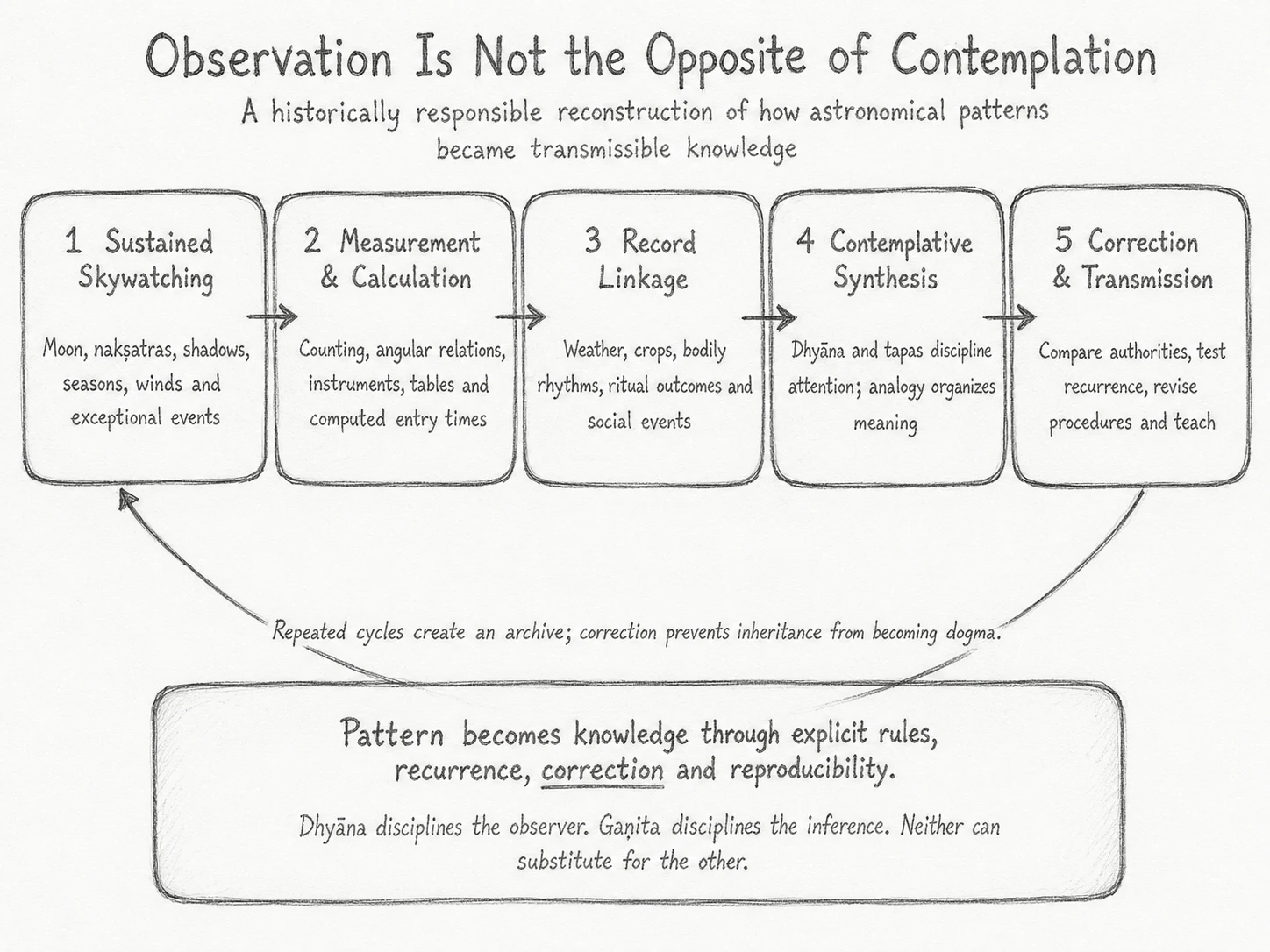
Figure 3. The sequence is an analytical reconstruction rather than a claim that every ancient school followed an identical protocol. Its purpose is to show where observation, calculation, contemplation and correction perform different functions.
This is not a diminished account of the ṛṣis and ācāryas. On the contrary, it takes their labour more seriously. A civilization that maintained calendars, compared canons, calculated eclipses and transmitted observational rules over long periods did not need to be protected by the claim that every conclusion arrived fully formed in meditation. Its achievement lay in joining several modes of knowing without reducing them to one.
The Moon as clock, light, mind and Soma
The Moon occupies a privileged position in Indian thought because it belongs to several systems at once. It is the most visibly changing object in the night sky. It provides a month-scale clock. Its movement through the nakṣatras can be followed without elaborate instruments. Its rise time changes over the month, altering the hours during which moonlight is available. Its full and dark phases organise fasts, observances, festivals and social activity. It is therefore both an astronomical object and a participant in lived time.
Varāhamihira’s account of lunar illumination in the Bṛhat Saṃhitā makes the physical register clear. The Moon is spherical; one half is illuminated by the Sun and the changing appearance follows from relative position.[9] The same text also gives meanings to lunar colour, size, course and conjunctions. This coexistence is important. A physical explanation of phase did not require the author to abandon prognostic interpretation. He understood the two as answers to different questions: how does the appearance arise, and what has the tradition learned—or believed—about the circumstances associated with it?
The association of Moon and mind appears much earlier. In the Puruṣa Sūkta, candramā manaso jātaḥ: the Moon arises from manas.[10] The verse belongs to a cosmological anatomy in which features of the cosmic person become features of the world. It should not be translated into the anatomical claim that the Moon produces the human brain. Its form is correspondence. The mental and the lunar are placed in relation because both are receptive, reflective, mobile and subject to alternation.
Varāhamihira’s Bṛhat Jātaka retains the association in the compact language of horā: kālātmā dinakṛn manas tuhinaguḥ—the Sun is the self of time; the cool-rayed Moon is mind.[11] Here manas is not equivalent to the modern category of cognition. Across Indian philosophical and medical settings it refers to the coordinating faculty involved in attention, sensory integration, affect, intention and fluctuation. The image of a waxing and waning luminary offered a powerful vocabulary for a faculty that receives impressions and does not remain fixed.
Soma provides a second bridge between the celestial and bodily registers. Soma is not one thing throughout the literature. It is a Vedic sacramental substance, a deity, the Moon, sap, nourishment, cooling potency and replenishment. The semantic field matters more than a forced one-to-one equivalence. In medical literature, lunar and solar principles can function as models of opposing yet complementary processes.
Suśruta compares the sustaining functions of kapha, pitta and vāta in the body with Soma, Sun and wind in the world: release or nourishment, taking or transformation, and movement.[12] Caraka also associates kapha with Soma and the water principle, pitta with fire, and vāta with movement, while refusing the idea that health can be explained by one doṣa alone.[13] The relation is systemic. Soma corresponds to cohesion, lubrication, cooling, stability and nourishment; it is not a primitive theory that the ocean inside the body is pulled up and down by lunar gravity.
This distinction is worth making because a popular modern defence of lunar influence rests on the statement that the human body contains a large proportion of water. The analogy is scientifically weak. Human tissue is not an open ocean basin, and the existence of water does not specify a physiological pathway. Classical Āyurvedic correspondence is subtler than that argument. It compares functions and qualities across the macrocosm and the organism.
Within this symbolic physiology, waxing and waning can be interpreted as different temporal tendencies. Waxing lends itself to images of accumulation, visibility, nourishment and outward movement. Waning lends itself to reduction, withdrawal, inwardness and release. Pūrṇimā marks plenitude of visible light; amāvasyā marks darkness, conjunction and latency. These meanings are culturally and ritually consequential. They are not universal clinical diagnoses. A person does not become uniformly more nourished at full moon or physiologically depleted at new moon.
The Moon’s importance, then, cannot be reduced to a single causal claim. It is simultaneously a celestial body, a calendar, a changing light environment, a ritual marker, a cosmological correspondence and a component of horoscopic interpretation. The task of scholarship is to identify which register is active in a given passage.
What can be said about lunar effects on physiology?
The physiological question should begin at the level where the evidence is strongest. The lunar cycle certainly changes the physical environment. Natural nocturnal illumination varies dramatically across the month, although cloud, latitude, season and local horizon modify what is actually experienced. The alignments associated with new and full moon also structure tidal conditions. Many marine and terrestrial organisms use lunar light, tides or endogenous circalunar timing. It is therefore reasonable to ask whether human physiology retains any sensitivity to a month-scale environmental rhythm.
Reasonable does not mean already proved. Human studies have produced a mixed record, and the size of any effect appears small compared with the effects of artificial light, work schedules, age, illness, season and ordinary individual variation.
A widely discussed laboratory reanalysis published in 2013 found changes near full moon in electroencephalographic delta activity, sleep latency, total sleep duration, perceived sleep quality and melatonin. The participants and investigators had not been thinking about lunar phase when the data were originally collected, which reduced expectation bias; the sample, however, was small, and the analysis was retrospective.[14] Subsequent reanalyses of larger sleep datasets did not reproduce the reported pattern and raised the possibility of publication bias.[15] A population-based study of more than two thousand participants likewise found no significant general effect of lunar phase on subjective or objective sleep measures.[16]
The matter was not closed by those null findings. A 2021 field study observed that sleep tended to begin later and last for less time during the nights preceding full moon. The effect was strongest where moonlight was available in the evening, but a related pattern was also found in an urban population.[17] The timing—before full moon rather than simply on the calendar date of full moon—is relevant because the waxing Moon is then above the horizon during the hours after dusk. This offers a plausible behavioural pathway: additional evening light may delay sleep, especially in settings with less artificial illumination.
Research on menstruation is similarly suggestive and unsettled. A 2021 analysis of long individual records reported intermittent synchronization between menstrual cycles longer than twenty-seven days and lunar luminance or gravimetric cycles. The synchrony was not permanent and weakened with age and nocturnal artificial light exposure.[18] A much larger 2024 dataset found a statistically significant lunar rhythm in menstrual onset, but it was small and less pronounced than a weekly rhythm; the phase of the lunar association also varied by season.[19] A 2025 follow-up comparing long-term records from different periods reported stronger coupling in records before widespread LED and smartphone exposure, with more limited coupling in recent data. Its proposed gravitational interpretation remains a hypothesis and requires independent testing.[20]
The correct conclusion is neither that the Moon has no possible physiological relevance nor that classical lunar doctrine has been experimentally confirmed. The studies support a narrower proposition: under some environmental and individual conditions, human sleep and reproductive timing may show weak or intermittent associations with lunar timing. Moonlight is a plausible mechanism for some sleep findings. Endogenous month-scale timing remains possible but unestablished as a universal human rhythm. Claims about mood, behaviour or disease require their own evidence and cannot be inferred from sleep or menstrual data.
The comparison of full and new moon is useful here. Both are alignment conditions, but the night-light environment is opposite. If a response occurs near both, moonlight alone is unlikely to explain it. If it clusters in the evenings before full moon, illumination and altered behaviour become more plausible. The astronomical structure itself can therefore help distinguish competing mechanisms.
Culture adds another pathway. In India, pūrṇimā and amāvasyā may alter fasting, meal timing, worship, travel, social gatherings, sexual activity and sleep. These are not mere contaminants in the data. They are ways in which a celestial calendar becomes embodied through practice. A study that treats all such behaviour as noise may remove the very mechanism by which the lunar date affects physiology.
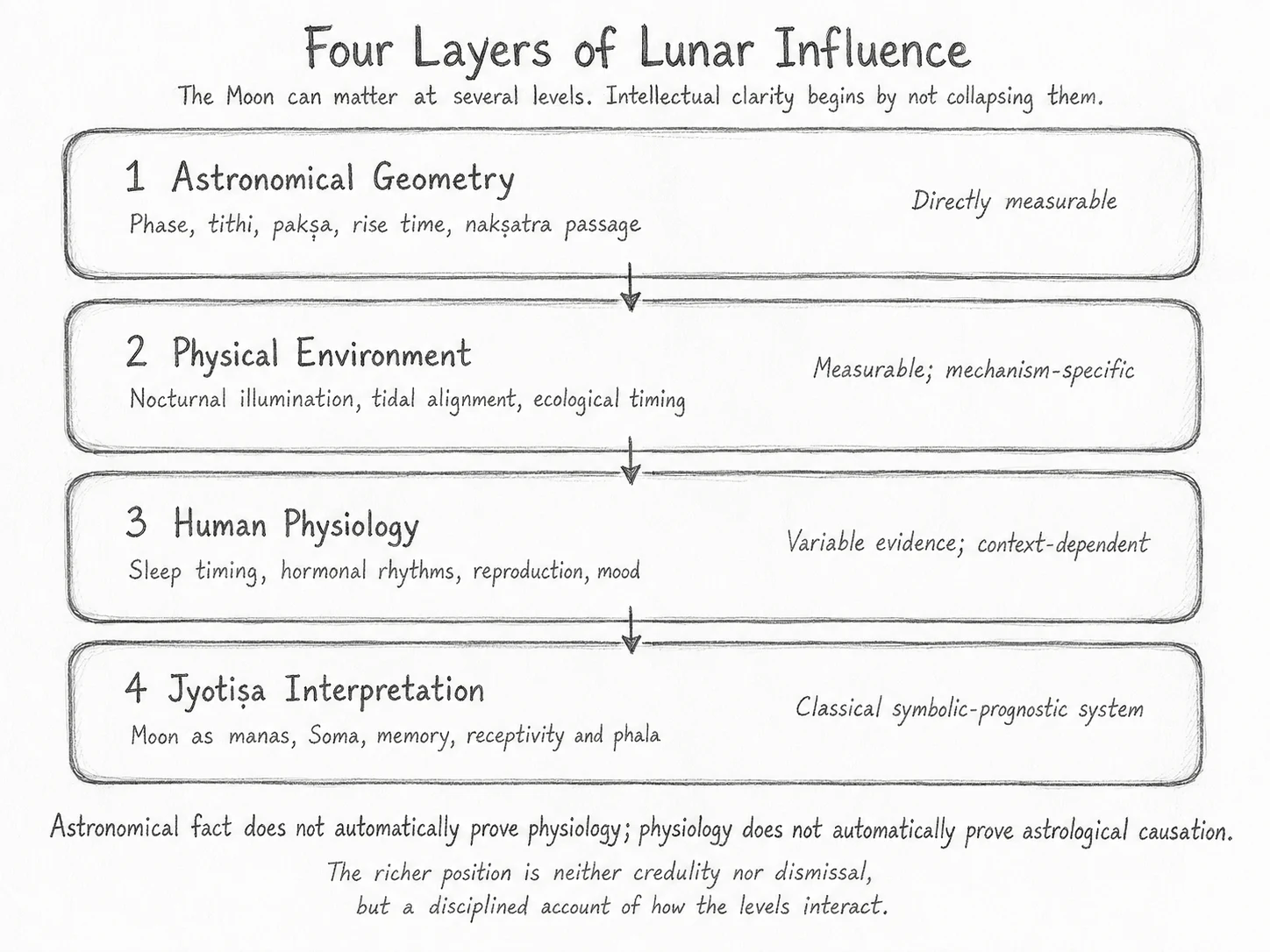
Figure 4. Astronomical geometry, environmental exposure, physiological association and Jyotiṣa interpretation are related but methodologically distinct. Evidence at one level does not automatically establish a claim at another.
For that reason, the phrase “the Moon affects us” is too imprecise for research. It may refer to changing light, tidal ecology, ritual behaviour, sleep timing, a symbolic association with mind, or a natal rule. Each statement needs its own exposure variable, outcome and standard of evidence. Intellectual respect for Jyotiṣa does not require these distinctions to be blurred. It requires them to be made carefully.
Past, present and future as forms of qualified time
Horā literature introduces a question that astronomy alone does not answer. Even if celestial positions can be calculated, why should a configuration at birth carry information about an individual life?
The classical answer belongs to a broader Indian understanding of kāla and karma. Time is not treated merely as an empty container in which unrelated events occur. A moment has a determinate structure: it belongs to a tithi, nakṣatra, season and larger period; the planets occupy particular relations; and the person entering that moment carries bodily constitution, lineage, circumstances and prior action. The horoscope records the celestial component of that moment and becomes a reference for interpreting later periods and transits.
This should not be confused with a simple mechanical model in which a remote planet fires a force at a passive human being. Classical Jyotiṣa often operates more like a clock, an ecology and a mirror at the same time.
As a clock, the grahas and lunar divisions mark phases. A clock does not cause noon; it makes a temporal condition legible. Daśā systems extend this logic by organising life into planetary periods and sub-periods, while gocara compares the moving sky with the natal configuration. Varāhamihira’s horoscopic work includes planetary strengths, lunar combinations, periods and other rules for deriving phala.[21]
As an ecology, celestial cycles are entangled with seasons, light, rainfall, agriculture, ritual calendars and collective behaviour. Some pathways are physical, some social, and some interpretive. Human beings do not simply observe a calendar; they alter their behaviour because of it.
As a mirror, the chart formalises correspondences among cosmic and embodied qualities. Sun and Moon, fire and Soma, movement and stability are read across scales. This is not the same as physical causation, though later interpreters may speak causally. The chart becomes a representation of patterned relations within a particular cosmology.
These models also clarify what is meant by past, present and future. The past appears not as a recoverable film of previous lives but as accumulated tendency. Within a karmic framework, the natal configuration may be interpreted as the condition under which prior causes have ripened into a present birth. The chart does not provide a documentary archive of those causes. Claims to reconstruct specific past lives from it go beyond what can be defended historically or empirically.
The present is the intersection of natal configuration, current daśā, transit, age, place, bodily condition, family circumstance and action. This is why serious practitioners do not expect the same transit to produce an identical event in every life. The rule is interpreted through a context.
The future is expressed as phala, fruit. The metaphor is more useful than the language of deterministic prediction. A fruit presupposes a seed, but it also depends on soil, season, water, damage and care. The future is neither wholly arbitrary nor mechanically fixed. Jyotiṣa becomes, at its most defensible, a practice of conditional prognosis: an attempt to identify periods in which certain tendencies are more likely to ripen and in which particular forms of caution or effort may be appropriate.
This reading preserves agency. It also introduces an ethical limit. A prediction that paralyses action or presents suffering as unavoidable may be faithful to neither good scholarship nor good counsel. The classical language of timing can be used to prepare, choose and respond. It need not become a doctrine of helplessness.
What a serious research programme would require
A doctoral-level study of lunar knowledge in India cannot begin with the question “Is astrology true?” The question is too large and combines claims that belong to different genres. The first task is to construct a textual map.
Every lunar statement in the relevant corpus should be classified by source, date, genre and function. Vedic hymns, Brāhmaṇa ritual passages, the Vedāṅga Jyotiṣa, siddhāntic astronomy, saṃhitā forecasts, horoscopic rules and Āyurvedic correspondences should not be entered into one undifferentiated database. Variant readings and commentaries matter. A word such as Soma may carry a sacramental sense in one passage, a celestial sense in another and a medical analogy in a third. The research question must follow the text rather than forcing all occurrences into a prior theory.
The second task is astronomical reconstruction. Historical rules should be translated into explicit variables: Sun–Moon elongation, tithi, local moonrise, lunar altitude, nakṣatra position, illumination, distance, season and latitude. Broad cultural labels such as “full-moon period” are inadequate when a claim depends on the hours during which the Moon is actually above the horizon. The Indian tithi system may provide a more precise exposure variable than a three- or four-phase calendar, but only if it is computed for the participant’s place and time.
A physiological study should be longitudinal. The same participants should be followed across many lunar cycles, because intermittent synchronization may disappear in a cross-sectional average. Sleep onset, sleep stages, light exposure, melatonin, core temperature, heart-rate variability, mood and menstrual onset could be recorded together. Artificial light, work schedule, age, medication, latitude, cloud cover and season would have to be modelled rather than mentioned after the results are known.
An Indian study must also record observance. Fasting, pūjā, temple attendance, night vigil, altered meals and family gatherings may change on pūrṇimā or amāvasyā. These variables should not simply be “controlled away.” The analysis should ask whether the observed effect is direct, environmentally mediated or culturally mediated. That distinction would be particularly valuable because Jyotiṣa historically belongs to a lived calendar, not an isolated astronomical laboratory.
The hypotheses should be registered before data analysis. If a classical text predicts increase, instability, depletion or mental disturbance, the investigator must define the outcome and the time window in advance. Otherwise a complex symbolic vocabulary can be fitted retrospectively to almost any dataset. Null results must be published. Varāhamihira’s instruction to compare canons and correct them by observation offers an indigenous precedent for this discipline of revision.
Such a programme would not “prove Jyotiṣa” in one experiment. It would do something more useful: determine which claims are astronomical, which are ecological, which are culturally embodied, which have measurable physiological correlates, and which remain interpretive propositions within a classical theory of time.
The question that survives the history
The origins of Indian astrology do not lead back to a single founder or a single revelation. They lead into a layered archive. Vedic texts supply ṛta, ritual time, the Sun, Moon, seasons and nakṣatras. The Vedāṅga Jyotiṣa turns calendrical coordination into a technical problem. Siddhāntic astronomers develop numerical procedures and models of celestial motion. Varāhamihira places computed astronomy beside environmental prognosis and horoscopy. Medical texts use Soma, Sun and wind to think about nourishment, transformation and movement in the body.
The Moon passes through all of these layers. It is a reflective sphere and an angular clock; a traveller through the nakṣatras and a changing source of night light; a marker of ritual time and an image of manas; a form of Soma and a factor in horoscopic judgment. The mistake is not in recognising these multiple roles. The mistake is in pretending that they are one and the same claim.
The old literature becomes more interesting when it is allowed to retain its internal differences. Its astronomers were capable of physical explanation and numerical correction. Its medical authors reasoned through systemic correspondence rather than a crude theory of bodily tides. Its prognostic texts attempted to extract meaning from recurrence, sometimes with careful observation and sometimes with rules whose evidentiary basis can no longer be recovered.
A mature engagement with Jyotiṣa does not require either automatic belief or automatic dismissal. It requires philology, astronomy, history of science, physiology and a willingness to leave some questions open. The ancient inquiry was not only whether the heavens caused events. It was whether time had structure, whether that structure could be measured, and whether human life became more intelligible when placed within it. That question has not disappeared. It has merely become harder to ask well.
Notes and sources
[1] Lagadha, Vedāṅga Jyotiṣa, Ṛg and Yajus recensions. See T. S. Kuppanna Sastry and K. V. Sarma, eds. and trans., Vedāṅga Jyotiṣa of Lagadha in Its Ṛk and Yajus Recensions (New Delhi: Indian National Science Academy, 1985). The editors discuss the wide disagreement over dating and the text’s ritual-calendrical purpose.
[2] Vedāṅga Jyotiṣa, opening verses, especially the description of Jyotiṣa as kāla-vidhāna-śāstra and its relation to the timing of yajña.
[3] Atharvaveda 19.7; Taittirīya Saṃhitā 4.4.10; Taittirīya Brāhmaṇa 3.1. These sources preserve nakṣatra lists and deity associations in different textual settings.
[4] Ṛgveda 10.190.1–3.
[5] Varāhamihira, Bṛhat Saṃhitā, chapter 2, especially the qualifications of the jyotiṣin, the three branches of knowledge, the measures of time and the instruction to resolve discrepant calculations through observation with shadow, water and instruments. See M. Ramakrishna Bhat, trans., Bṛhat Saṃhitā of Varāhamihira (Delhi: Motilal Banarsidass, 1996), and the earlier translation of N. Chidambaram Iyer.
[6] Varāhamihira, Pañcasiddhāntikā. See T. S. Kuppanna Sastry, trans., and K. V. Sarma, ed., Pañcasiddhāntikā of Varāhamihira (Adyar, 1993).
[7] Āryabhaṭa, Āryabhaṭīya, Golapāda 9–10. See K. S. Shukla and K. V. Sarma, eds. and trans., Āryabhaṭīya of Āryabhaṭa (New Delhi: Indian National Science Academy, 1976).
[8] Varāhamihira, Bṛhat Saṃhitā, chapter 24, Rohiṇī-yoga.
[9] Varāhamihira, Bṛhat Saṃhitā, chapter 4, on the Moon and its illumination.
[10] Ṛgveda 10.90.13: candramā manaso jātaḥ.
[11] Varāhamihira, Bṛhat Jātaka 2.1. See V. Subrahmanya Sastri, trans., Varāhamihira’s Bṛhat Jātaka, 2nd ed. (Bangalore: Sadhana Press, 1956).
[12] Suśruta Saṃhitā, Sūtrasthāna 21.8: the comparison of Soma, Sun and wind with kapha, pitta and vāta.
[13] Caraka Saṃhitā, Sūtrasthāna 12, especially the discussion of vāta, pitta and kapha through observation, inference and authoritative teaching, and Ātreya’s rejection of a single-doṣa explanation of health.
[14] Christian Cajochen, Songül Altanay-Ekici, Mirjam Münch, Sylvia Frey, Vera Knoblauch and Anna Wirz-Justice, “Evidence That the Lunar Cycle Influences Human Sleep,” Current Biology 23, no. 15 (2013): 1485–1488. DOI: 10.1016/j.cub.2013.06.029.
[15] Maren Cordi et al., “Lunar Cycle Effects on Sleep and the File Drawer Problem,” Current Biology 24, no. 12 (2014): R549–R550. DOI: 10.1016/j.cub.2014.05.017.
[16] José Haba-Rubio et al., “Bad Sleep? Don’t Blame the Moon! A Population-Based Study,” Sleep Medicine 16, no. 11 (2015): 1321–1326. DOI: 10.1016/j.sleep.2015.08.005.
[17] Leandro Casiraghi et al., “Moonstruck Sleep: Synchronization of Human Sleep with the Moon Cycle under Field Conditions,” Science Advances 7, no. 5 (2021): eabe0465. DOI: 10.1126/sciadv.abe0465.
[18] Charlotte Helfrich-Förster et al., “Women Temporarily Synchronize Their Menstrual Cycles with the Luminance and Gravimetric Cycles of the Moon,” Science Advances 7, no. 5 (2021): eabe1358. DOI: 10.1126/sciadv.abe1358.
[19] René Ecochard et al., “The Menstrual Cycle Is Influenced by Weekly and Lunar Rhythms,” Fertility and Sterility 121, no. 4 (2024): 651–659. DOI: 10.1016/j.fertnstert.2023.12.009.
[20] Charlotte Helfrich-Förster et al., “Synchronization of Women’s Menstruation with the Moon Has Decreased but Remains Detectable When Gravitational Pull Is Strong,” Science Advances 11, no. 39 (2025): eadw4096. DOI: 10.1126/sciadv.adw4096. The proposed mechanism remains a hypothesis and should not be treated as established.
[21] Varāhamihira, Bṛhat Jātaka, especially the chapters on planetary strength, lunar combinations and daśā; and Bṛhat Saṃhitā, chapters dealing with planetary transits.