Varāhamihira’s Living Earth
Rain, groundwater, plants and built space in the Bṛhat Saṃhitā
By Vamsikrishna Sankarayogi ·
The environmental chapters of the Bṛhat Saṃhitā are easily lost inside the scale of the book. A reader approaching Varāhamihira through astronomy usually notices the planets, eclipses and stellar configurations. A reader approaching him through astrology notices collective prognostication. A reader interested in architecture turns directly to house plans or temples. The result is that rain, soil, vegetation, groundwater and habitation are often encountered as separate curiosities.
They are more intelligible when read together.
The relevant chapters form an environmental archive. Clouds are observed over months rather than at a single dramatic instant. Rain is collected and measured. Wind direction, colour at twilight, thunder, lightning, birds, frogs, ants, plant flowering, soil texture, rock colour and the vigour of trees are all treated as signs through which the condition of a place may be inferred. Water is sought beneath the ground from surface evidence. Trees are propagated, spaced, watered and treated when diseased. A building site is judged partly by the soil, crops, trees and water that already belong to it.
This does not make the Bṛhat Saṃhitā a modern textbook of ecology, meteorology or hydrogeology. Those descriptions would be anachronistic. The text does not separate observation, ritual, analogy and prognosis in the manner expected of a contemporary research paper. A cloud may be described physically, poetically and prognostically within the same passage. A plant may function as a biological indicator in one chapter and as a bearer of social or ritual meaning in another. The task of historical analysis is not to force all these claims into one category.
The more useful question is narrower:
What kind of environmental reasoning becomes visible when Varāhamihira’s chapters on rain, water, plants and building are studied as parts of one knowledge system?
The answer developed here is that the Bṛhat Saṃhitā treats the inhabited world as a coupled field. Celestial timing establishes observation windows. The atmosphere provides changing forms. Soil and rock preserve the movement of water. Vegetation responds to moisture, season and disease. Human beings convert those relations into agriculture, settlement, storage, ritual and public decision.
The system is neither purely causal nor purely symbolic. Some rules begin from phenomena that can be measured directly. Others are inherited correlations whose reliability remains uncertain. Still others organize action through analogy, deity or omen. Varāhamihira’s intellectual achievement lies partly in preserving these materials and partly in arranging them into operational sequences.
The Earth in this text is “living” in a precise sense. It is not passive ground beneath an autonomous sky. It absorbs rain, changes water, sustains plant life, reveals subsurface conditions, receives buildings and returns consequences through food, health and social stability.
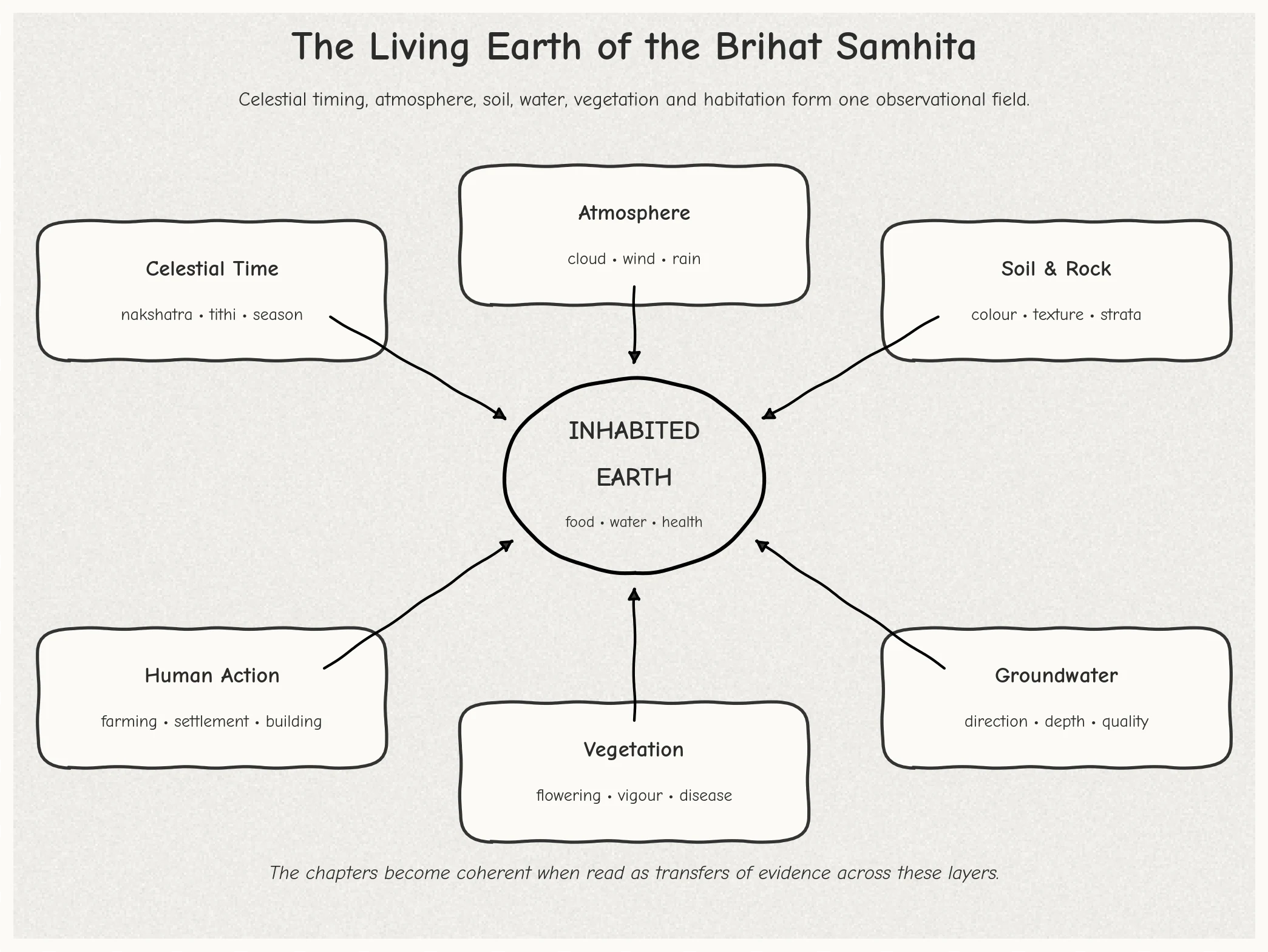
Figure 1. The environmental chapters form a connected field: celestial timing structures observation; atmosphere, soil, water and vegetation provide evidence; human action turns that evidence into agriculture, settlement and public decision.
Reading an environmental text without inventing one
Before examining particular chapters, a methodological distinction is necessary. The Bṛhat Saṃhitā is not a single-subject treatise. Its title announces a “great collection,” and the surviving text extends across astronomy, celestial and terrestrial prognostication, rain, crops, architecture, groundwater, gardening, temple building, materials, animals, gems, bodily marks, omens and ritual practice.[1]
The environmental material therefore appears in several literary modes:
- description, when the text records an appearance, measurement or material property;
- procedure, when it specifies when and how an observation or action is to be performed;
- correlation, when one observed condition is linked with a later outcome;
- prescription, when it recommends cultivation, construction or treatment;
- analogy, when one domain is made intelligible through another;
- prognosis, when the condition of crops, rainfall, health or polity is inferred;
- omen, when an unusual event is interpreted within a social or political field.
These categories often coexist. They should not be collapsed merely because they occur in the same śloka or chapter.
Varāhamihira himself signals that he is working within an inherited archive. In the chapter on rain-clouds he names Garga, Parāśara, Kāśyapa, Vajra and other predecessors. Elsewhere he compares authorities or records divergent views. The Bṛhat Saṃhitā is consequently both composition and compilation: a learned reorganization of older materials, many of whose independent sources no longer survive.[2]
That circumstance changes how originality should be understood. Varāhamihira need not have personally discovered every correlation for the book to represent a major intellectual achievement. Selection, comparison, compression and organization are themselves forms of knowledge production. An encyclopaedic text can create a new method by placing previously dispersed rules into a sequence that can be taught and used.
There is another caution. The word “scientific” is often applied indiscriminately to ancient texts either as praise or as dismissal. Both uses are imprecise. A better evaluation asks whether a given passage has:
- a specified observational object;
- a defined time and place;
- stable categories;
- a measurable outcome;
- an explicit rule connecting evidence and inference;
- provision for comparison across repeated cases;
- and a record of failure as well as success.
Some passages in the Bṛhat Saṃhitā satisfy several of these conditions. Few satisfy all of them. That is not a reason to ignore the text. It is a reason to examine its internal differences carefully.
The environmental chapters are strongest where they move from a recurring time marker to a standard observation, then to a material consequence. They are weakest where a highly specific social prediction is attached to an ambiguous natural appearance without a recoverable mechanism or testable rule.
This graded approach preserves historical dignity without requiring credulity.
Food, rain and the public purpose of observation
The rain-cloud chapter begins not with wonder at the sky but with food. Life depends upon food; food depends upon rain; therefore the laws of rain must be investigated.[3]
This opening establishes the public purpose of the inquiry. Monsoon observation is not presented as an isolated intellectual exercise. Rainfall governs sowing, crop survival, pasture, water storage, prices, taxation, famine risk and political stability. The astrologer’s attention to clouds is therefore connected to the material administration of a rain-dependent society.
The proposition also explains the unusually large space given to rainfall. Chapters 21 through 30 form a dense meteorological sequence: cloud “pregnancy,” support and maturation, rain, Rohiṇī-yoga, Svāti-yoga, Āṣāḍhī-yoga, winds, signs of immediate rain, plant flowering and twilight phenomena. Other chapters return to crops, prices, dust storms, halos and atmospheric anomalies.[4]
The sequence works at more than one temporal scale.
Long-range observation begins months before the rainy season. Clouds, winds and luminous phenomena are recorded during the period interpreted as cloud gestation.
Seasonal observation uses calendrical and stellar windows such as Rohiṇī-yoga or the Moon’s passage through specified nakṣatras.
Short-range observation attends to present heat, cloud form, animal behaviour, still air, thunder and other signs of immediate rain.
Retrospective measurement compares forecast, actual rainfall and crop outcome.
The presence of these scales is significant. It shows that Varāhamihira did not imagine “rain prediction” as one undifferentiated act. A seasonal outlook, a monthly estimate and a same-day judgment require different evidence.
The system also locates the observer. He must watch day and night, record direction, note the lunar station, distinguish months and seasons, and observe the same categories repeatedly. This is not the posture of someone waiting for a singular revelation. It is closer to disciplined field attention, even where the interpretive rules remain traditional or symbolic.
The text’s weakness lies in its variable transition from observation to consequence. The statement that thunder, dark cloud, wind and humidity-like conditions precede rain can be investigated through physical pathways. The statement that the same appearance predicts the fate of a ruler belongs to a different evidentiary order. A responsible reading does not allow the credibility of the first claim to be transferred automatically to the second.
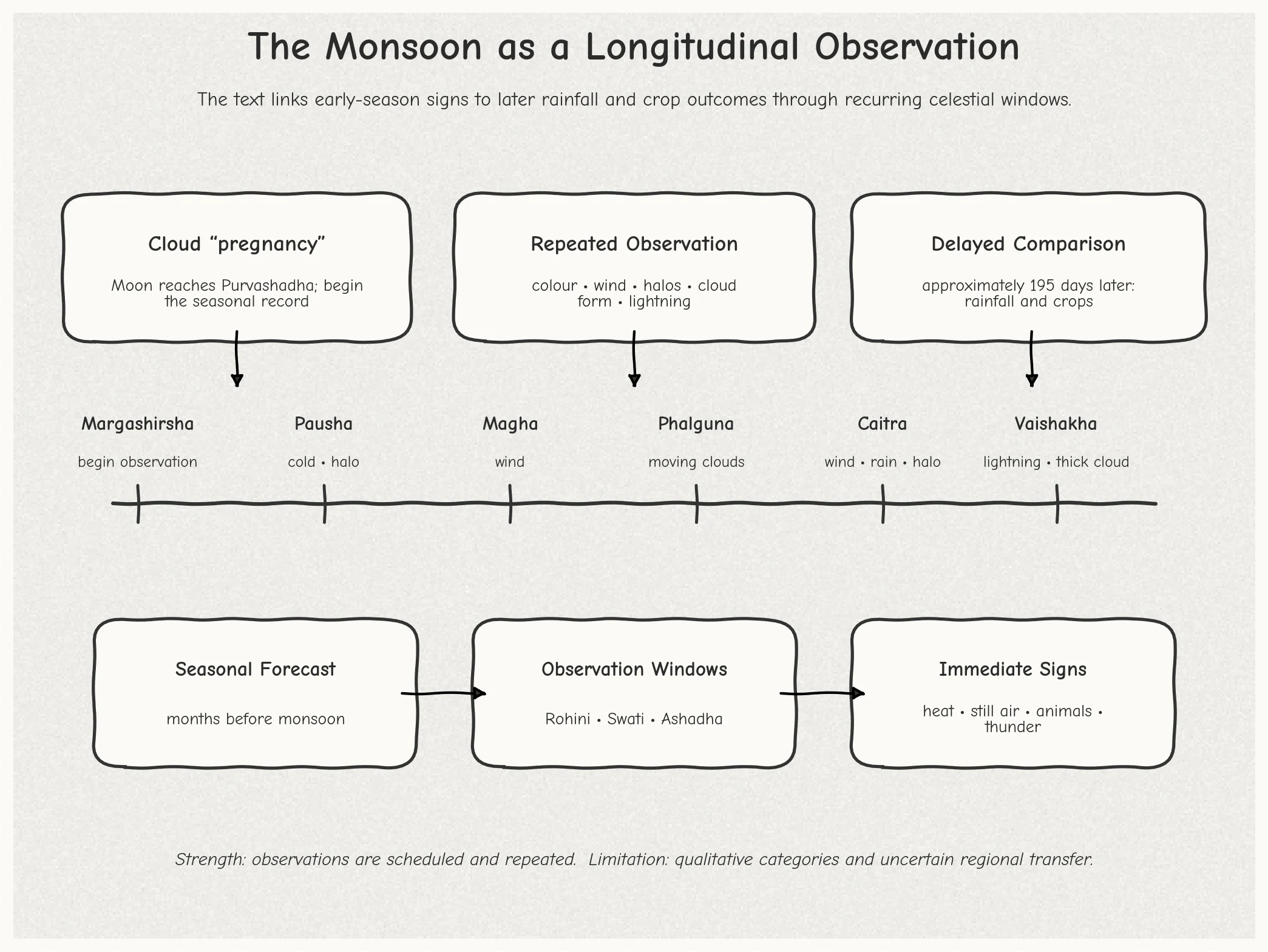
Figure 2. The rainfall chapters operate across several scales: early-season observation, calculated stellar windows, rainfall measurement, immediate signs and later comparison with crop outcomes.
Why celestial timing remains inside environmental observation
The presence of nakṣatras, lunar passages and planetary positions in the rainfall chapters can produce two opposite misreadings. One assumes that the celestial body must be exerting a direct physical force upon every cloud or crop mentioned in the text. The other assumes that any calendrical or astrological element makes the surrounding environmental observation worthless.
Neither conclusion follows.
A celestial configuration can serve at least three different functions.
First, it can act as a clock. The Moon’s return to Rohiṇī or Pūrvāṣāḍhā supplies a repeatable observation window. In a culture organized through lunar and stellar reckoning, this may be more operationally useful than a numbered date detached from the sky. The configuration tells the observer when to prepare, watch and record.
Second, it can act as a seasonal correlate. A star’s heliacal or nocturnal position, or the Sun’s passage through a sector, can recur at approximately the same part of the seasonal cycle. The correlation need not imply that the star causes the rain. It may preserve a relationship between celestial position and time of year.
Third, it can be treated as a prognostic agent within Jyotiṣa. Here the celestial configuration is not merely a date marker; it receives a quality and is interpreted as participating in terrestrial outcomes. This is the strongest astrological claim and requires evidence beyond the usefulness of the calendar.
The Bṛhat Saṃhitā does not always distinguish these functions explicitly. The historian must.
Suppose an observation performed when the Moon reaches Rohiṇī repeatedly coincides with a useful stage in the pre-monsoon season. The protocol may work as seasonal timing even if the Moon’s proximity to the stellar group has no independent meteorological force. Conversely, if a rule predicts different outcomes depending upon whether the Moon passes north or south of a particular yogatārā, the claim is no longer only calendrical; it requires a separate astronomical and statistical test.
This distinction also protects the Indian character of the system from being flattened. Jyotiṣa did not separate “calendar” and “meaning” as completely independent undertakings. A time marker could be simultaneously computational, ritual and prognostic. Historical analysis need not choose one and erase the others. It needs to identify which function is carrying the argument in a given passage.
The environmental chapters are most persuasive where celestial timing creates a stable schedule for observing terrestrial variables. They become more uncertain as the inference depends increasingly upon a unique celestial geometry without a specified environmental pathway.
Cloud “pregnancy” as a longitudinal model
The language of cloud pregnancy can sound mythic when detached from its procedure. In the text, however, garbha does practical work. It identifies an early atmospheric condition whose later “delivery” is rain. The metaphor makes a delayed relationship memorable.
Varāhamihira dates the beginning of the relevant observations from the Moon’s arrival in Pūrvāṣāḍhā during the bright fortnight of Mārgaśīrṣa. He records the rule that rain will be delivered 195 days after the cloud pregnancy associated with a given lunar station.[5]
The literal number should not be accepted uncritically. The monsoon does not obey one fixed gestation interval across every climatic region. Yet the structure of the rule is intellectually important. It asks the observer to connect conditions separated by months. This is a rudimentary longitudinal model:
a) identify a recurring calendrical window;
b) observe the atmosphere using an inherited set of variables;
c) preserve the date and classification;
d) compare it with rainfall during the later season.
The observational variables include cloud abundance and form, colour near sunrise and sunset, halos, cold, winds, lightning and rain in preceding months. The text is therefore not merely correlating a planet with rain. It is accumulating visible and sensible conditions across the transition from winter to the rainy season.[6]
The pregnancy metaphor also imposes a distinction among conception, healthy development, disturbance and delivery. The text speaks of a “healthy” cloud pregnancy when the expected seasonal signs appear in appropriate succession. Adverse or contradictory signs damage the prognosis.
From a history-of-method perspective, this is a notable attempt to organize atmospheric memory. A seasonal process too long and variable to grasp at once is broken into stages. The stages are indexed by lunar and stellar time so that observations made in different years can be compared.
But there are unresolved problems.
The categories are qualitative. “Beautiful,” “thick,” “red,” “violent” and “healthy” can vary among observers. The spatial scale is often unclear: does a cloud observed at one locality represent that locality, a wider region or an entire kingdom? The 195-day rule may combine observations from different ecological zones. Later copyists and commentators may preserve rules whose original geographical setting was forgotten.
Most importantly, the surviving text does not provide a systematic ledger of failed predictions. A rule without a failure archive tends to become self-sealing: any successful season is remembered, while an unsuccessful one can be attributed to an omitted sign or textual complication.
The proper response is not to discard the whole chapter. It is to recognize that its strongest contribution is the design of a seasonal observation protocol, not proof that every inherited coefficient is universally accurate.
The measured monsoon
The rainfall chapter contains one of the clearest transitions from qualitative observation to measurement. Rain is to be collected in a vessel with a circular mouth, one cubit in diameter, and measured using a vessel of specified capacity, the āḍhaka.[7]
This matters because it changes the status of rain. “Much” and “little” become quantities that can be compared. A measured record can support taxation, crop planning, storage and retrospective evaluation in ways that impression alone cannot.
The history of rainfall measurement in India extends beyond Varāhamihira, and the exact conversion of old capacity measures into modern depth units is contested because cubit, pala, āḍhaka and droṇa were not always uniform across place and period. T. M. Srinivasan’s historical study drew attention to these instruments and measures; R. N. Iyengar later examined the rainfall-variability model preserved in the Bṛhat Saṃhitā.[8]
The key conceptual point does not depend on choosing one modern conversion. The text specifies:
- the collector’s shape;
- the mouth diameter;
- the measuring unit;
- the observation period;
- and a relationship between observed rainfall and expected seasonal quantity.
That is an instrumented procedure.
At the same time, measurement and prediction must be separated. A standardized collector may measure actual rain with reasonable consistency. It does not follow that rainfall under one nakṣatra guarantees a fixed number of droṇas months later. The instrument can be sound while the predictive mapping remains uncertain.
This distinction is often missed in celebratory accounts. They cite the rain gauge and then imply that the whole meteorological system has been validated. The opposite dismissal is equally careless: because the forecast table includes astrological or omenological elements, the instrument is treated as meaningless.
A mixed text requires mixed judgment.
The measurement rule should be studied as an early attempt at standard data capture. The forecast table should be tested independently by region, season, sampling window and text-critical variant. The two questions are related historically, but they are not identical scientifically.
A useful reconstruction would place identical collectors at several sites, record rainfall during the specified lunar windows, and compare the later monsoon at local and regional scales. Such a design would tell us whether the rule contains a geographically restricted signal, a broad climatological tendency, or no predictive power beyond chance.
The ancient procedure supplies the hypothesis. It does not predetermine the result.
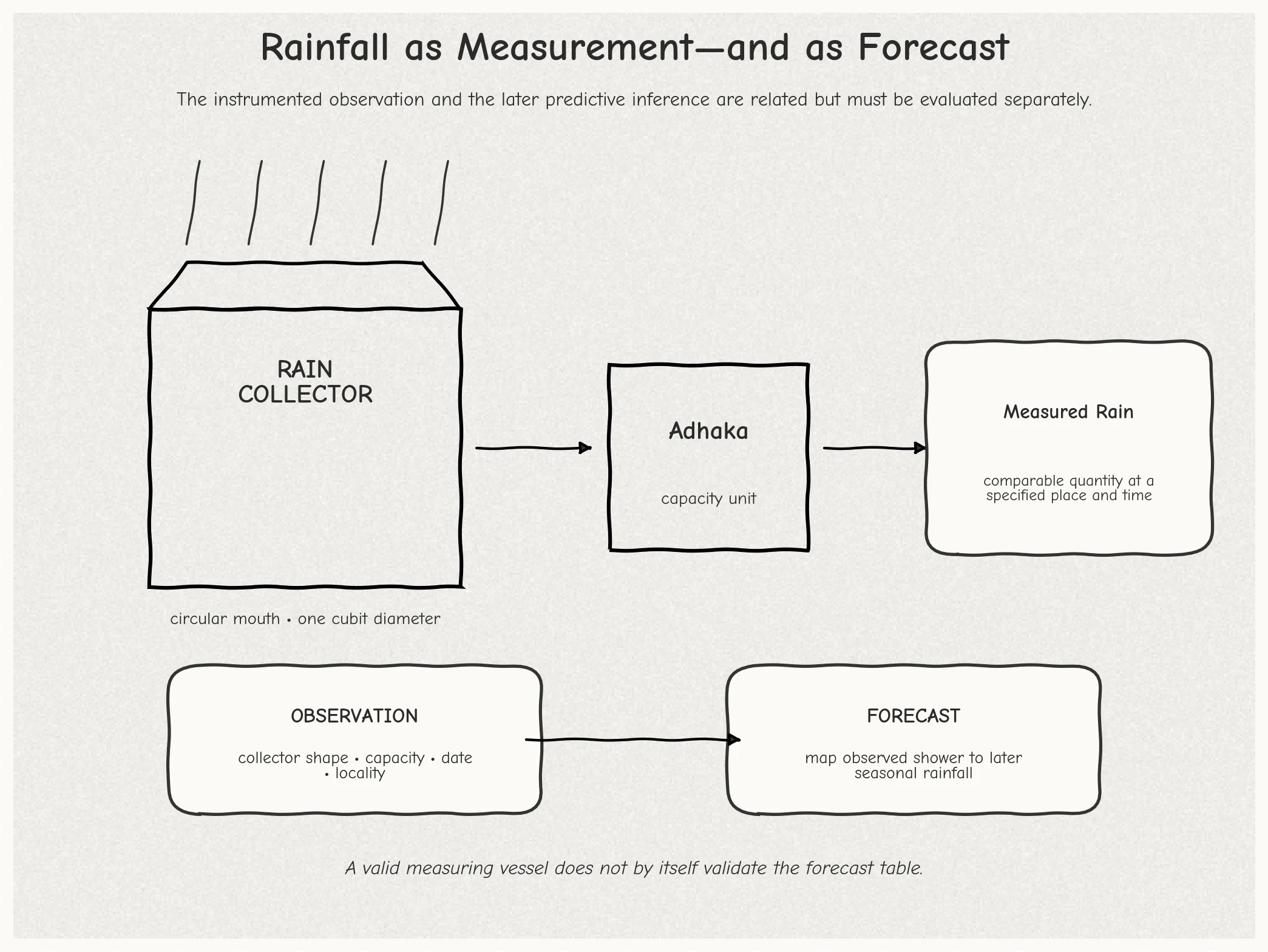
Figure 3. The collector and measuring vessel standardize observation. The later forecast is a separate inferential step and must be evaluated independently of the instrument.
Clouds as morphology, motion and memory
Varāhamihira’s clouds are rarely featureless masses. They twist, gather, break, darken, shine, carry lightning, resemble mountains, serpents, elephants or lotus colours, and move from particular directions. The descriptions can appear excessively poetic until one asks what the similes are doing.
In an oral or manuscript culture without cloud photography, a memorable morphology is useful. “Elephant-like,” “mountain-like” or “serpent-like” does not create a modern cloud classification, but it gives observers a shared visual vocabulary. Colour comparisons to conch, pearl, tamāla bark, bee or kiṃśuka flower encode brightness, darkness and hue through familiar materials.[9]
The Rohiṇī-yoga chapter is especially dense. The observation includes cloud form, lightning, thunder, bird and frog calls, duration of overcast, direction of cloud appearance, wind direction, lunar position and water retained in prepared pots. The procedure establishes a prescribed day and divides it into segments associated with the coming rainy months.[10]
This is an environmental ensemble rather than a single sign.
Its methodological strength is multivariable attention. Rain is not inferred from cloud colour alone. Wind, sound, moisture, animal response and direction are read together. The weakness is that the rules do not specify how conflicting variables should be weighted. A dark cloud from a favourable direction may coexist with dispersing wind or no thunder. The interpreter must decide which sign dominates.
The chapter’s famous images should therefore be read in two registers.
First, they are poetry. Varāhamihira is a technically trained author who writes with literary skill. The storm sky becomes a forest of elephants, lightning becomes golden rope, cranes become tusks and rainbow becomes a banner.
Second, the poetry helps stabilize observation. A vivid image preserves a combination of form, colour and movement that could otherwise be forgotten.
The two functions are compatible. Poetry need not be the enemy of exact attention. It becomes a problem only when the beauty of a description is treated as evidence for the accuracy of every prediction attached to it.
The same caution applies to animal signs. Frogs croaking, fish jumping, ants moving eggs, reptiles climbing trees and cattle raising their heads may respond to humidity, pressure, temperature, soil moisture or imminent weather. Some may also be ordinary behaviours noticed selectively before rain. Each claim requires species identification, behavioural definition and repeated observation.
To say that an animal can respond to atmospheric change is plausible. To say that every listed behaviour reliably predicts rain is a stronger claim.
The text preserves the question. Field research must determine the answer.
Plants as environmental archives
Chapter 29 begins from phenology: the growth of fruits and flowers may indicate which crops or commodities will be abundant. The chapter then links particular trees with rice, barley, sesame, cotton, mustard, livestock, metals, social groups, rain, famine, storm or disease.[11]
The list contains different kinds of correlation.
Some are environmentally plausible. Luxuriant vegetation with glossy, insect-free leaves may indicate adequate moisture and favourable growing conditions. The flowering of particular species can reflect temperature, rainfall and seasonal progression. Deep-rooted or moisture-loving plants can reveal subsurface water or soil character.
Other links may be economic. If two products share a season, habitat or trade route, the availability of one may correlate with the other.
Still others are symbolic, phonetic, ritual or socially classificatory. A blossom is associated with a ruler, minister, merchant, gem or class of person without a recoverable environmental mechanism.
The historical mistake is to treat the whole list as either botany or superstition. It is a mixed catalogue that preserves phenological observation, agrarian association and symbolic taxonomy in one place.
Phenology deserves special attention. A flowering event is not merely a property of the plant. It is the result of accumulated temperature, moisture, day length, stress and species-specific timing. Communities that observe the same plants over generations can use them as local seasonal indicators even without formal instruments.
Yet phenological knowledge is geographically sensitive. A species may flower at different times across altitude, latitude and rainfall regime. Taxonomic identification is also difficult. Sanskrit plant names can refer to more than one modern species, and later glossators may disagree. A predictive rule cannot be tested responsibly until the plant has been identified in its local botanical context.[12]
The final verse of the chapter is among the most defensible: where trees, shrubs and creepers grow luxuriantly, with glossy leaves undamaged by worms, good rain is expected; where vegetation is otherwise, rain will be less.[13]
Even here, direction of causation matters. Healthy vegetation may be predicting later rain, recording earlier moisture, or both. The sign could be useful without operating through the causal story assumed by the text.
This is a recurring lesson in environmental history. A traditional indicator can have practical value even when the inherited explanation is incomplete.
Dakārgala: reading water from the surface
The groundwater chapter begins with analogy. As channels carry blood through the body, watercourses run above and below the Earth. Rainwater is initially of one colour and flavour; after passing through the ground it acquires the qualities of the soils and rocks it encounters.[14]
The first statement supplies a model of hidden circulation. The second is an empirical claim about water–rock interaction.
The chapter then becomes extraordinarily specific. Trees, ant-hills, grasses, snake holes, soil colours, stones, odours, slope, distance and depth are combined into instructions for finding water. A tree of a named species in dry land may indicate a current a certain number of cubits away and a certain number of “men” deep. The sequence of soils and stones encountered while digging is expected to confirm or correct the prediction.[15]
Modern descriptions often call this “geobotany,” and the term is helpful if used cautiously. Vegetation can indeed indicate moisture regime, rooting depth, salinity and substrate. Termite or ant-hill distribution can be related to soil texture, drainage and subsurface conditions. Soil colour and rock type can bear on permeability and water chemistry.
But the chapter is not a modern hydrogeological survey manual.
Its rules are highly local. Plant–water relations differ by geology and climate. The translation of ancient depth units is uncertain. Several subterranean animal encounters are improbable when read literally and may reflect mnemonic, symbolic or conventional layers. The chapter’s directions are organized through the eight quarters and named currents, a cosmographic frame not equivalent to mapping aquifers.
The strongest way to read Dakārgala is as a surface-indicator decision system.
The observer begins with a landscape anomaly: a moisture-associated tree in dry ground, luxuriant grass, a mound, a change in soil or a plant–mound combination. The text gives a direction and offset. Digging generates a second sequence of evidence: colour, texture, stone and moisture. Water quality and persistence are then estimated.
This is not blind dowsing. It is an inference from visible and excavated indicators.
A 2013 study by Rajani Joshi, U. D. Kulkarni, A. V. Vartak and I. A. Khan examined selected Dakārgala rules as an ancient water-exploration technique. A broader 2020 review of hydrology and water management in ancient India also discussed the chapter’s use of plants, soils and other surface markers. Such studies establish that the material can be translated into field hypotheses. They do not yet validate all 125 verses across India’s geological diversity.[16]
A robust validation programme would require:
- a critical Sanskrit text and comparison of translations;
- secure botanical identification;
- georeferenced sites across distinct lithologies;
- control locations without the prescribed indicators;
- blinded prediction of direction, depth and water quality;
- electrical resistivity or borehole confirmation;
- and publication of unsuccessful predictions.
Without controls, any successful well can be remembered as confirmation. Without local geology, a rule may be tested in an environment for which it was never intended.
The chapter deserves neither automatic belief nor casual ridicule. It deserves fieldwork designed at the same level of specificity as its claims.
The problem of regional transfer
The portability of a rule is one of the central unanswered questions. India contains alluvial plains, basaltic plateaus, granitic terrains, coastal aquifers, arid zones, humid forests and mountain systems. The same tree can behave differently under these conditions, and different species can occupy comparable ecological niches.
A plant indicator may therefore have three possible levels of meaning. It may be species-specific, because that species has a characteristic rooting depth or moisture requirement. It may be functional, because any unusually vigorous deep-rooted tree in dry terrain points toward greater available moisture. Or it may be local and historical, preserving a relation observed in one geological setting but not elsewhere.
The text often states exact offsets and depths. Such precision is valuable because it makes failure visible, but it may also preserve conventional numbers rather than survey measurements. A “man” as a depth unit depends upon the standard assumed by the tradition and translator. A cubit is more stable conceptually than “nearby,” but its realised length may still vary.
Regional testing should therefore proceed in stages. The first stage asks whether the broad indicator class—plant anomaly, mound, soil change—has predictive value. The second tests direction and offset. The third tests depth and quality. A rule might succeed at the first level and fail at the third. Recording only “water was eventually found” would conceal that difference.
The same issue affects rainfall and phenology. A cloud direction associated with rain in one monsoon regime may be uninformative in another. A species that blossoms before rain in central India may respond to a different temperature or moisture threshold in the south or at altitude.
The Bṛhat Saṃhitā frequently speaks in the language of kingdoms and regions, but the ecological boundaries underlying its rules are rarely explicit. Recovering them is part of the research problem.
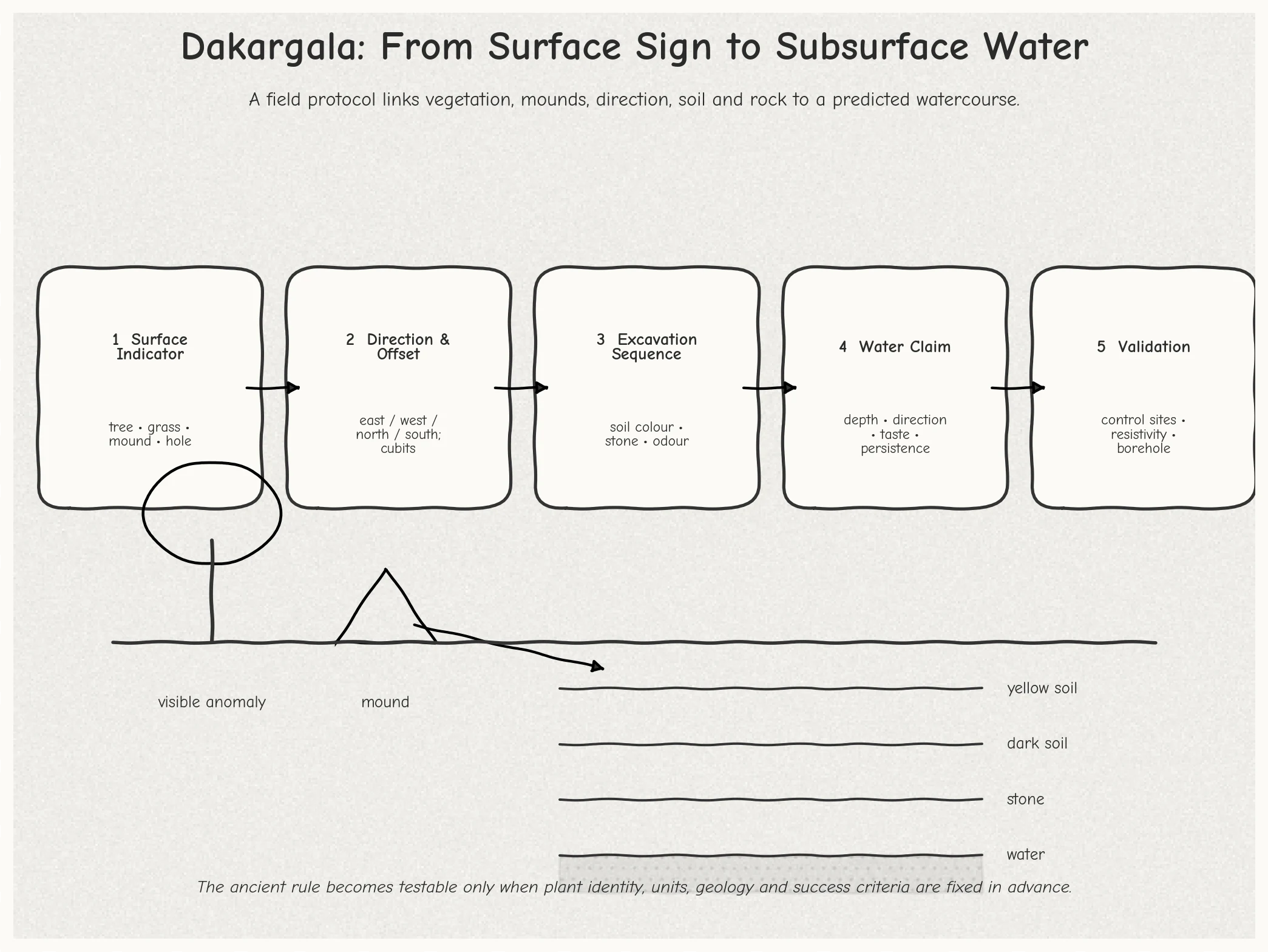
Figure 4. Groundwater inference proceeds from a visible indicator to direction and offset, then to an excavation sequence of soil, stone and moisture. Modern validation must add controls, geolocation and independent subsurface measurement.
Water changes as it moves through Earth
One of the most important sentences in Dakārgala is easy to overlook amid the many tree-and-anthill rules. Water falling from clouds is described as initially uniform; after contact with Earth, its colour and flavour vary according to the ground through which it flows, “as may be found on actual examination.”[17]
This is a process statement. The soil and rock are not inert containers. They modify water.
The observation can support several inferences without importing modern chemistry into the verse. Water acquires dissolved and suspended material. Colour, taste and odour can change. Different strata can therefore yield different qualities of water even under the same rainfall regime.
The chapter also correlates soil and rock colours with water quality. Some mappings may encode genuine local experience with minerals, salts and organic matter; others may be overgeneralized. A text-critical and hydrochemical study would need to distinguish the rule’s earliest recoverable form from later commentary.
This passage also complicates the frequent claim that ancient environmental thought regarded water as a universally pure essence corrupted only by human action. In Varāhamihira’s account, natural contact with Earth differentiates water. Place matters.
That insight links groundwater to settlement. Finding water is not enough. One must ask whether the supply is sweet, saline, mineral, persistent or seasonal. The text repeatedly classifies water by taste, quantity and duration.[18]
The observer is therefore engaged in more than locating a hidden stream. He is assessing habitability.
Vṛkṣāyurveda: the tree as cultivated life
The chapter called vṛkṣāyurveda shifts from plants as signs to plants as patients of cultivation. Soil is selected. Species are propagated by seed, root or branch. Cut surfaces are treated. Planting seasons differ by growth habit. Watering changes with season. Spacing is specified. Disease is diagnosed from leaf, shoot, branch and exudation, after which damaged tissue is removed and preparations are applied.[19]
The title is revealing. Āyurveda here is not used because the tree is metaphorically human in every respect. It signals a systematic concern with life, constitution, nourishment, disease and treatment.
Several rules are recognizably horticultural.
Soft soil is recommended. Sesame is first grown and then cut when flowering, a practice that may have served soil preparation or green manuring, though the exact agronomic rationale requires investigation. Trees are planted at intervals; twenty cubits is preferred, sixteen tolerated and twelve judged harmful. Watering is adjusted: morning and evening in dry weather, midday in cold weather, and in the rainy season only when the soil is dry.[20]
These are not merely auspicious prescriptions. They respond to moisture loss, root competition and seasonal stress.
Propagation methods are similarly practical. Some species are grown from seed; others from roots or branches with the cut portions protected by cow dung or other substances. Modern plant science should not be projected wholesale onto the mixtures, but the procedure shows awareness that wounds, moisture and season affect survival.
The chapter also describes disease. When trees suffer from cold, wind or heat, their leaves become diseased, shoots fail, branches dry and sap exudes. Treatment begins by cutting away dead tissue and applying a preparation before watering the roots.[21]
The diagnostic categories are broad, and several ingredients require botanical and chemical study. Yet the sequence—identify symptoms, remove damaged tissue, dress the wound, support the roots—is coherent.
Ritual elements accompany the horticulture. The planter bathes, the tree is washed and adorned, and certain species are linked with prosperity. These actions should not be stripped away as accidental superstition. They place cultivation within an ethic of attention and social value. At the same time, ritual respect does not prove the efficacy of every treatment mixture.
The chapter’s environmental importance lies in joining care with classification. A garden is not an ornamental afterthought. It is planned through soil, water, spacing, species, season and maintenance.
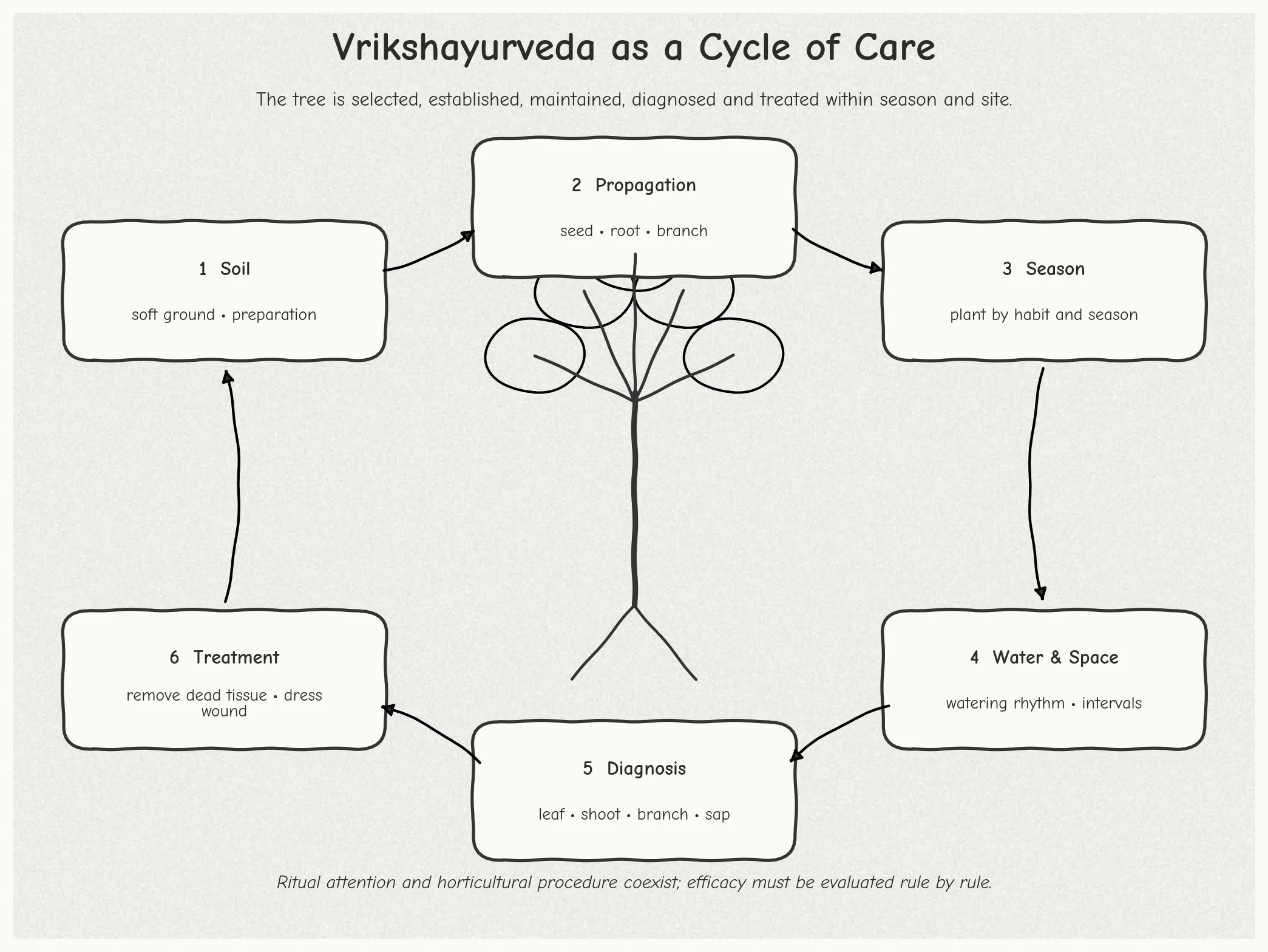
Figure 5. The gardening chapter treats cultivation as a cycle: assess soil, select and propagate species, plant by season, manage water and spacing, diagnose injury, and treat the tree.
From healthy site to habitable structure
The chapters on house-building, groundwater and gardening appear consecutively. Their sequence is intellectually suggestive even if it should not be overinterpreted.
A house requires a site. A site requires water. A settlement requires vegetation, soil and materials. Varāhamihira’s architectural knowledge therefore belongs partly to environmental judgment.
The house-building chapter contains geometric plans, measurements, door positions, room arrangements and the vāstu-puruṣa scheme. It also describes qualities of ground. A desirable site is smooth and free from holes, with soil that is pleasant in colour, smell and taste, and with healthy crops, trees and creepers.[22]
These criteria combine symbolic and practical concerns.
Smooth terrain eases construction. Absence of holes may indicate stability and freedom from burrows or voids. Healthy vegetation suggests moisture and fertile soil, though excessive moisture could also be a problem. Smell, colour and taste are traditional methods of classifying soil in the absence of laboratory testing.
The site is not judged as a blank parcel. Existing life is evidence.
The architectural chapters also extend into materials. The vajralepa chapter gives preparations made from plant resins, bark, fruit, oils and other materials for joining or coating wells, walls, temples and images; it also records an alloy-based cement attributed to Maya.[23]
The promised durability—sometimes expressed in enormous conventional numbers—should not be read literally. The recipes nevertheless preserve technical interest in binders, resins, waterproofing and adhesion. Their actual properties can be tested experimentally after ingredients are identified and proportions reconstructed.
Here too the correct method is decomposition.
- Site-selection criteria should be assessed against soil stability, drainage and habitability.
- Plan geometry should be studied within Indian architectural history and ritual space.
- Organic cements should be recreated under controlled conditions and tested for adhesion, water resistance and ageing.
- Hyperbolic longevity should be recognized as literary praise rather than laboratory data.
To classify the entire architectural corpus as either engineering or superstition would erase these distinctions.
The deeper environmental principle is that habitation must be fitted to place. Ground, water, vegetation, direction, material and human use are treated as one design problem.
The environmental observer and the limits of analogy
The Bṛhat Saṃhitā repeatedly moves through analogy. Clouds become pregnant. The Earth has water-bearing veins. Trees become patients. The site becomes a body occupied by the vāstu-puruṣa.
Analogy is not evidence in itself, but it can organize investigation.
The cloud-pregnancy analogy encourages observation across delayed stages. The vein analogy directs attention to hidden connected flows. The medical analogy supports diagnosis and treatment of plants. The body-plan analogy organizes architectural space.
Each analogy becomes useful when it generates operational questions. Where is the current? What signs precede delivery? What symptom indicates damage? Which part of the plan bears which relation?
It becomes misleading when similarity is mistaken for identity. Aquifers are not literally blood vessels. A cloud does not gestate in the biological sense. A tree’s disorders do not map directly onto human doṣas. A site is not anatomically a person.
Varāhamihira’s text often retains both levels: the analogy makes the system memorable, while measurements, directions, distances and materials give it practical form.
Modern readers frequently split these apart. One group preserves only the analogy and turns it into mystical cosmology. Another preserves only the material rule and removes the cultural language that made it transmissible. A historical account should keep both visible while maintaining their different epistemic roles.
From environmental condition to public consequence
Rain, water and crops do not remain private matters in the Bṛhat Saṃhitā. They are linked with prices, famine, disease, migration, royal stability and social confidence.
This does not mean that every meteorological anomaly causes the political event predicted beside it. It means that environmental variability was understood as a public risk.
Drought reduces food. Excessive or untimely rain damages crops and transport. Poor water affects health and settlement. Crop abundance alters price. Storm and earthquake damage structures. A ruler’s legitimacy is implicated because administration, storage, relief and ritual responsibility operate within these conditions.
The text’s prognostic language often personalizes collective risk in the king. That reflects its political world. Yet behind the royal omen lies an environmental governance problem: how should a society prepare for uncertain rain, crop failure or water scarcity?
Varāhamihira’s answer is not a single policy. It is an information system.
Observe early. Measure rain. Watch plants. inspect soil. locate water. judge sites. maintain trees. select materials. compare the present year with inherited patterns.
The system is imperfect, but its ambition is coherent.
What can be tested—and what cannot be tested in the same way
The environmental corpus can support contemporary research only after its claims are separated.
Directly reconstructable procedures
These include collector dimensions, rainfall quantities, tree spacing, seasonal watering, propagation methods, soil sequences during excavation, organic binder recipes and building proportions.
They can be reconstructed and measured.
Context-dependent environmental indicators
These include plant species associated with groundwater, phenological signs of season, animal behaviour before rain and soil colour associated with water quality.
They require local ecology, taxonomy and geology.
Statistical forecasts
These include the 195-day cloud rule, rainfall quantities assigned to nakṣatra windows and directional cloud forecasts.
They require long, preregistered time series and comparison with null models.
Symbolic or social correspondences
These include prosperity of particular professions, fate of rulers, gems becoming abundant, or collective events attached to particular blossoms.
Some may encode economic associations. Others may be ritual or omenological. They cannot be validated merely by demonstrating that one botanical or meteorological rule works.
Normative prescriptions
These include auspicious planting, ritual preparation and deity-based site rules.
Their significance may be ethical, social or ritual rather than predictive.
A single verdict—“the text is scientific” or “the text is unscientific”—cannot handle this range.
A research programme for Varāhamihira’s environmental archive
A doctoral-level investigation should begin with the text, not with a modern claim waiting to be proved.
1. Establish a critical claim database
Every environmental verse should be entered with:
- Sanskrit text;
- recension and commentator;
- translation variants;
- chapter and metre;
- named authority, if any;
- observational variables;
- predicted or prescribed outcome;
- units of distance, capacity and time;
- and epistemic category.
The database would prevent a later gloss from being treated as Varāhamihira’s own wording and would reveal repeated rules across chapters.
2. Reconstruct place and season
Rules should be mapped by ecological zone. Ujjain’s seasonal experience cannot stand automatically for coastal, Himalayan, arid and northeastern India. Lunar dates must be converted into local seasonal windows for the period under study.
The question is not whether one rule works “in India.” It is where, when and under what conditions it might have been formed.
3. Standardize observations before testing forecasts
Cloud colour, form, wind direction, frog calls, plant flowering and soil texture require operational definitions. Observers should be trained, and where possible camera, acoustic, weather-station and satellite records should supplement human description.
This is especially important because the text’s categories are memorable but not always precise.
4. Validate groundwater rules blindly
A research team selecting the indicator should not know the geophysical survey result. Predicted location, depth, direction and water quality should be recorded before drilling or resistivity testing. Nearby controls should be included.
Success must be defined in advance.
5. Recreate materials and horticultural preparations
Plant-based cements, wound dressings and propagation mixtures should be reconstructed through authenticated ingredients. Mechanical, microbiological and phytotoxic properties can then be measured.
A recipe may be culturally important yet materially ineffective; another may work for reasons not stated in the text. Both outcomes are informative.
6. Publish null and regional findings
The tradition cannot be evaluated through selected successes. A rule that works in basaltic terrain and fails in alluvium should be reported as such. A phenological indicator useful in one rainfall zone may not travel.
Varāhamihira’s own comparative habit provides an indigenous precedent for preserving disagreement rather than suppressing it.
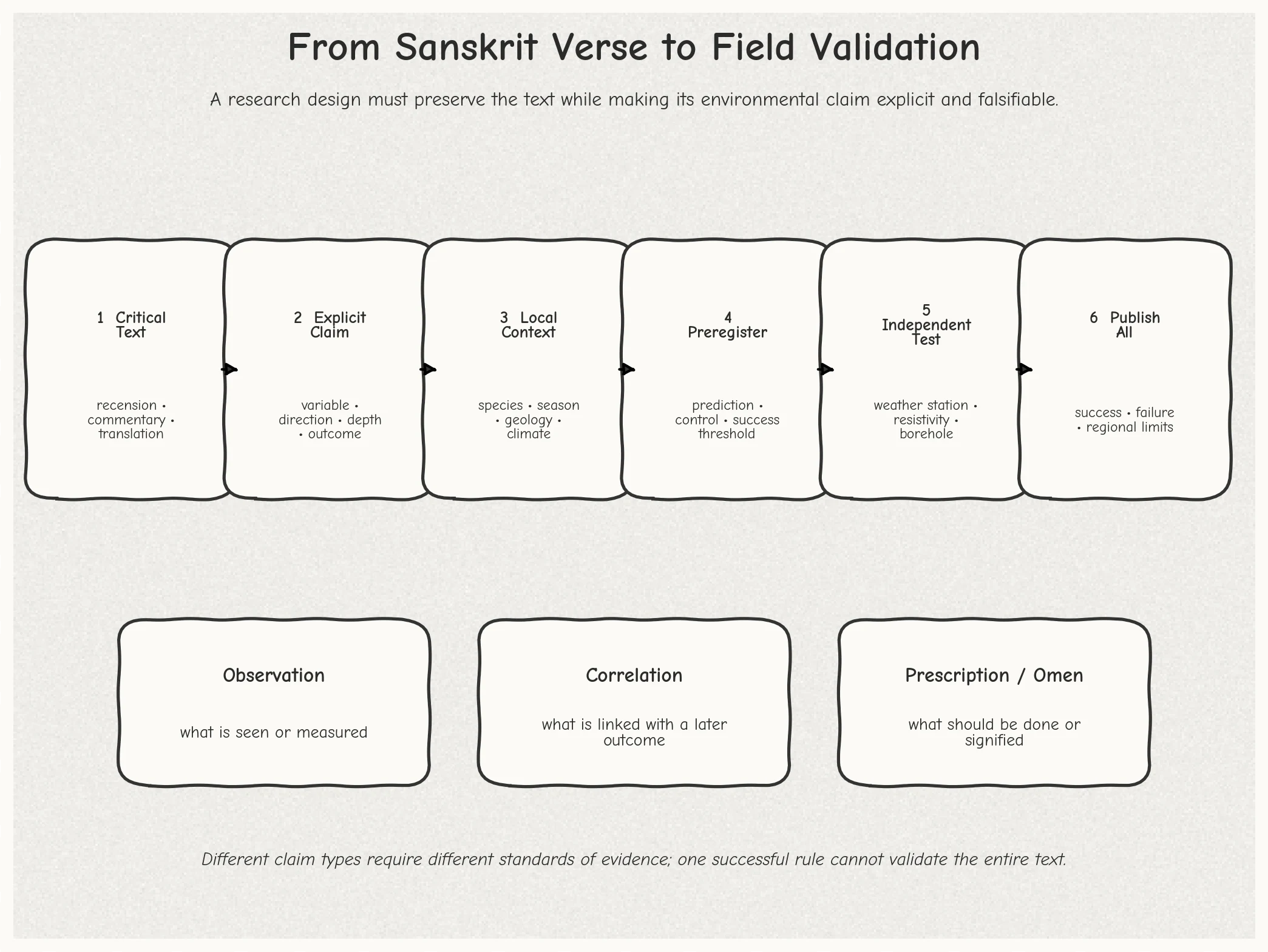
Figure 6. A responsible research programme moves from critical text to explicit claim, local context, preregistered field test, independent measurement and publication of both successful and failed results.
A source matrix for the environmental chapters
| Domain | Principal chapters | Main evidence | Type of knowledge | Primary caution |
|---|
| Seasonal rain | 21–27 | Clouds, wind, lunar windows, direction, colour, lightning | Long-range observation and forecast | Qualitative categories and regional transfer |
| Immediate rain | 28, 30 | Heat, stillness, halos, animals, thunder, twilight | Short-range environmental indicators | Selective observation and species ambiguity |
| Rain measurement | 23 | Collector, āḍhaka, droṇa, timed showers | Instrumented measurement plus forecast | Unit conversion and forecast validity are separate |
| Plant phenology | 29 | Flowering, fruiting, leaf condition | Seasonal and economic correlation | Mixed empirical and symbolic associations |
| Crop outlook | 40–42 | Celestial configurations, crop classes, prices | Agrarian prognosis | Causal mechanism often unspecified |
| Groundwater | 54 | Trees, mounds, soil, rock, animals, depth and direction | Surface-indicator exploration | Local geology and textual identification |
| Tree care | 55 | Soil, propagation, season, spacing, watering, disease | Horticultural prescription | Ingredients and species require reconstruction |
| Habitation | 53, 56–57 | Site, plan, vegetation, materials, binders | Architecture and material practice | Ritual geometry and engineering must be distinguished |
The matrix makes visible why “environmental science in the Bṛhat Saṃhitā” is too broad a single category. The text contains several methods and several standards of evidence.
The intellectual value of a living Earth
The lasting importance of these chapters does not depend upon proving that every forecast was correct.
Their value begins with the decision to observe the world as connected.
Rain is not only a cloud event. It becomes food, price, health and political stability. Groundwater is not only hidden liquid. It is inferred through vegetation, soil, rock and terrain. A tree is not only a symbol. It is propagated, watered, spaced, wounded and treated. A building is not only geometry. It begins with ground, water, plants and material.
This relational reasoning is easy to praise in general and difficult to preserve in detail. The Bṛhat Saṃhitā preserves the detail.
It also preserves error, overreach and inherited association. That is precisely why it is useful as a research archive rather than as a book of slogans. A living knowledge tradition is not honoured by declaring every verse infallible. It is honoured by reading carefully enough to discover which observations can be reconstructed, which correlations can be tested, which prescriptions can be evaluated, and which symbolic structures belong to another order of meaning.
Varāhamihira’s environmental observer does not stand outside nature. He depends upon the rain he measures, the water he seeks, the plants he tends and the ground upon which he builds.
The sky enters the soil. The soil changes the water. The water sustains the tree. The tree reveals the site. The site becomes habitation.
That sequence is the deepest environmental proposition of the text.
Notes and sources
[1] Varāhamihira, Bṛhat Saṃhitā, especially the chapter sequence preserved in the editions of N. Chidambaram Iyer, The Bṛhat Saṃhitā of Varāha Mihira, 2 vols. (Madura: South Indian Press and Foster Press, 1884–1885), and V. Subrahmanya Sastri and M. Ramakrishna Bhat, trans., Varahamihira’s Brihat Samhita, 2 vols. (Bangalore: V. B. Soobbiah, 1947). On the text as an encyclopaedic source, see A. M. Shastri, India as Seen in the Bṛhatsaṁhitā of Varāhamihira (Delhi: Motilal Banarsidass).
[2] Bṛhat Saṃhitā 21.2 names Garga, Parāśara, Kāśyapa, Vajra and others. Varāhamihira’s comparison of inherited authorities also appears elsewhere in the text and in his astronomical work, the Pañcasiddhāntikā.
[3] Bṛhat Saṃhitā 21.1: food supports living beings and depends upon rain; the laws of rainfall must therefore be investigated.
[4] Bṛhat Saṃhitā, chapters 21–30; see the chapter index in Iyer’s translation and M. Ramakrishna Bhat, trans., Bṛhat Saṃhitā of Varāhamihira, Part I (Delhi: Motilal Banarsidass, 1981; later reprints).
[5] Bṛhat Saṃhitā 21.6–7, on the beginning of cloud-pregnancy observations and the 195-day interval.
[6] Bṛhat Saṃhitā 21, especially the seasonal signs extending from Mārgaśīrṣa through Vaiśākha.
[7] Bṛhat Saṃhitā 23.1–2, specifying a circular-mouthed rain collector and measurement by the āḍhaka.
[8] T. M. Srinivasan, “Measurement of Rainfall in Ancient India,” Indian Journal of History of Science 11, no. 2 (1976): 148–157; R. N. Iyengar, “Description of Rainfall Variability in Bṛhat-Saṃhitā of Varāha-Mihira,” Journal of the Geological Society of India 68, no. 3 (2006): 545–548.
[9] Bṛhat Saṃhitā 24.20–21, on cloud forms, colour, lightning, sound and duration in the Rohiṇī-yoga observation.
[10] Bṛhat Saṃhitā 24, especially verses 1–27 on preparation, temporal division, winds, clouds and water pots representing the rainy months.
[11] Bṛhat Saṃhitā 29.1–13, the kusumalatā chapter.
[12] For the difficulty of botanical identification and the plant-rich scope of the text, see R. S. Boddupalli, “A Historical Review on the Botanical Facets of Bṛhat Saṃhitā—Varāhamihira’s Magnum Opus,” Journal of History, Archaeology and Architecture (2024), and the botanical glossaries appended to older translations of the Bṛhat Saṃhitā.
[13] Bṛhat Saṃhitā 29.14.
[14] Bṛhat Saṃhitā 54.1–2. The text compares terrestrial watercourses to bodily channels and states that water changes colour and flavour through contact with ground.
[15] Bṛhat Saṃhitā 54.6 onward. The chapter gives numerous plant–mound–direction–depth sequences and excavation indicators.
[16] Rajani R. Joshi, U. D. Kulkarni, A. V. Vartak and I. A. Khan, “Dakargalam—An Ancient Water Exploration Technique Based on Varahamihira’s Brhat Samhita,” Asian Agri-History 17, no. 2 (2013): 175–181; Pushpendra Kumar Singh, Pankaj Dey, Sharad Kumar Jain and Pradeep P. Mujumdar, “Hydrology and Water Resources Management in Ancient India,” Hydrology and Earth System Sciences 24 (2020): 4691–4707, doi:10.5194/hess-24-4691-2020.
[17] Bṛhat Saṃhitā 54.2.
[18] Bṛhat Saṃhitā 54, throughout; the chapter repeatedly distinguishes sweet, saline, mineral, abundant, limited and persistent supplies.
[19] Bṛhat Saṃhitā 55, vṛkṣāyurveda.
[20] Bṛhat Saṃhitā 55.2, 9 and 12, on soil, seasonal watering and spacing.
[21] Bṛhat Saṃhitā 55.13–15, on symptoms and treatment of diseased trees.
[22] Bṛhat Saṃhitā 53, vāstu-vidyā, particularly the site-selection passages near the end of the chapter. See also A. M. Shastri, India as Seen in the Bṛhatsaṁhitā of Varāhamihira, section on selection of sites and habitations.
[23] Bṛhat Saṃhitā 57.1–8, on vajralepa preparations and a metallic cement attributed to Maya.
[24] Bṛhat Saṃhitā 28, sadyovarṣaṇa, on signs of immediate rain including solar appearance, still air, frogs, fish, ants, reptiles and other phenomena.
[25] Bṛhat Saṃhitā 30, sandhyā-lakṣaṇa, on twilight colours, cloud forms, wind and rain indications.
[26] Bṛhat Saṃhitā 27, vātacakra, on winds and directional classifications.
[27] Bṛhat Saṃhitā 40, sasya-jātaka, and chapters 41–42, linking crop outlook and commodity conditions with calendrical and celestial configurations.
[28] Iyengar, “Description of Rainfall Variability,” 545–548. Iyengar treats the rainfall material as an ancient model of monsoon variability and compares aspects with long-term rainfall data; the study should be read as exploratory rather than comprehensive validation.
[29] K. Vanadeep, R. Sada Siva Murty and M. Krishnaiah, “Meticulous and Meritorious Meteorology Enshrined in the Brihat Samhita—A Comparative Case Study over Four Indian Regions Situated in Diverse Climatic Zones,” Indian Journal of Innovations and Developments 1, no. 4 (2012): 229–239. The selected-rule design is informative but does not resolve the full text’s multiple-testing and regionality problems.
[30] Singh et al., “Hydrology and Water Resources Management in Ancient India,” 4691–4707, for the wider history of hydrological knowledge, water structures and management in India.
[31] M. S. Mate, “Building in Ancient India,” World Archaeology 1, no. 2 (1969): 236–246, doi:10.1080/00438243.1969.9979442, for archaeological and textual perspectives on construction.
[32] N. Chidambaram Iyer’s nineteenth-century English translation is valuable and openly accessible but reflects the terminology and assumptions of its period. M. Ramakrishna Bhat’s later translation and notes should be consulted alongside the Sanskrit and Utpala’s commentary.
[33] A. M. Shastri, Varāhamihira and His Times and India as Seen in the Bṛhatsaṁhitā of Varāhamihira, for historical context, textual organization and the social world reflected in the work.
[34] Sabita Dash and Niranjan Sabar, “Geobotanical Content in Brihat Samhita” (2022), for a modern survey of the groundwater chapter’s plant indicators; its identifications should be checked against critical botanical and Sanskrit sources.
[35] R. S. Boddupalli’s botanical review notes that plant material is distributed across several chapters, including kusumalatā, dakārgala, vṛkṣāyurveda, forest entry, perfumes and tooth-sticks; this distribution supports reading plants as more than one isolated topic.
[36] The 1946/1947 Sastri–Bhat edition is available in public-domain digital collections; bibliographic records describe two volumes printed by V. B. Soobbiah in Bangalore.
[37] The Bṛhat Saṃhitā’s internal chapter count varies by edition and treatment of supplementary chapters. The environmental argument here does not depend on resolving that enumeration; chapter references follow the commonly used Iyer/Sastri–Bhat sequence.
[38] The terms “meteorology,” “hydrogeology,” “phenology” and “materials science” are used here as present-day analytical labels. They should not be mistaken for claims that Varāhamihira divided knowledge into identical modern disciplines.