When the Moon Entered the Stars
Nakṣatra, ritual time and the Indian science of living time
By Vamsikrishna Sankarayogi ·
The nakṣatras are now usually introduced through a personal question: What is your birth star? The question belongs legitimately to contemporary Jyotiṣa, but it begins at the end of a much longer intellectual history. Before a nakṣatra became a statement about temperament, compatibility or the unfolding of a life, it helped answer a more immediate question: where is the Moon tonight?
The answer required comparison. The prominent stars return in nearly the same configurations, while the Moon changes its stellar neighbourhood from one night to the next. An observer who comes back to the sky repeatedly can see the difference without an instrument. The Moon that stood near one recognizable group yesterday appears farther east today. Over the course of a sidereal month it completes a circuit against the stellar background and returns to approximately the same region. The apparently fixed stars thus become a scale, and the Moon becomes a moving index upon it.
This elementary observation should not be confused with an elementary knowledge system. To turn nightly displacement into a calendar, a society must identify stable markers, preserve their order, reconcile the lunar circuit with phases and seasons, and transmit the sequence accurately enough for ritual and public use. It must also decide what counts as a station. Is the nakṣatra the principal star, the visible group surrounding it, the region within which the Moon is said to reside, or an equal mathematical division of the lunar path? The Sanskrit sources do not always separate these meanings as neatly as a modern technical manual would.
That ambiguity is not a defect to be removed by selecting one definition and applying it everywhere. It is evidence of historical development. The same word came to operate in observational, ritual, calendrical, mathematical, environmental and natal settings. A responsible history has to follow those settings separately before explaining how they were joined.
I will therefore use three expressions where the distinction matters: stellar marker for an identifiable star or asterism; lunar station for the named celestial neighbourhood through which the Moon is understood to pass; and equal sector for the standardized division of 13°20′ used in the mature twenty-seven-fold system. These objects overlap in later practice, but they should not be projected unchanged into every Vedic passage.[1]
The argument developed here is that the nakṣatra is best understood as a relational unit. It connects the Moon’s movement with a remembered stellar order; that order with a calendar; the calendar with ritual action; the ritual field with a devatā; and, in later Jyotiṣa, the celestial condition at birth with the interpretation of a human life. The movement from sky to biography was neither immediate nor uniform. Its stages can be studied.
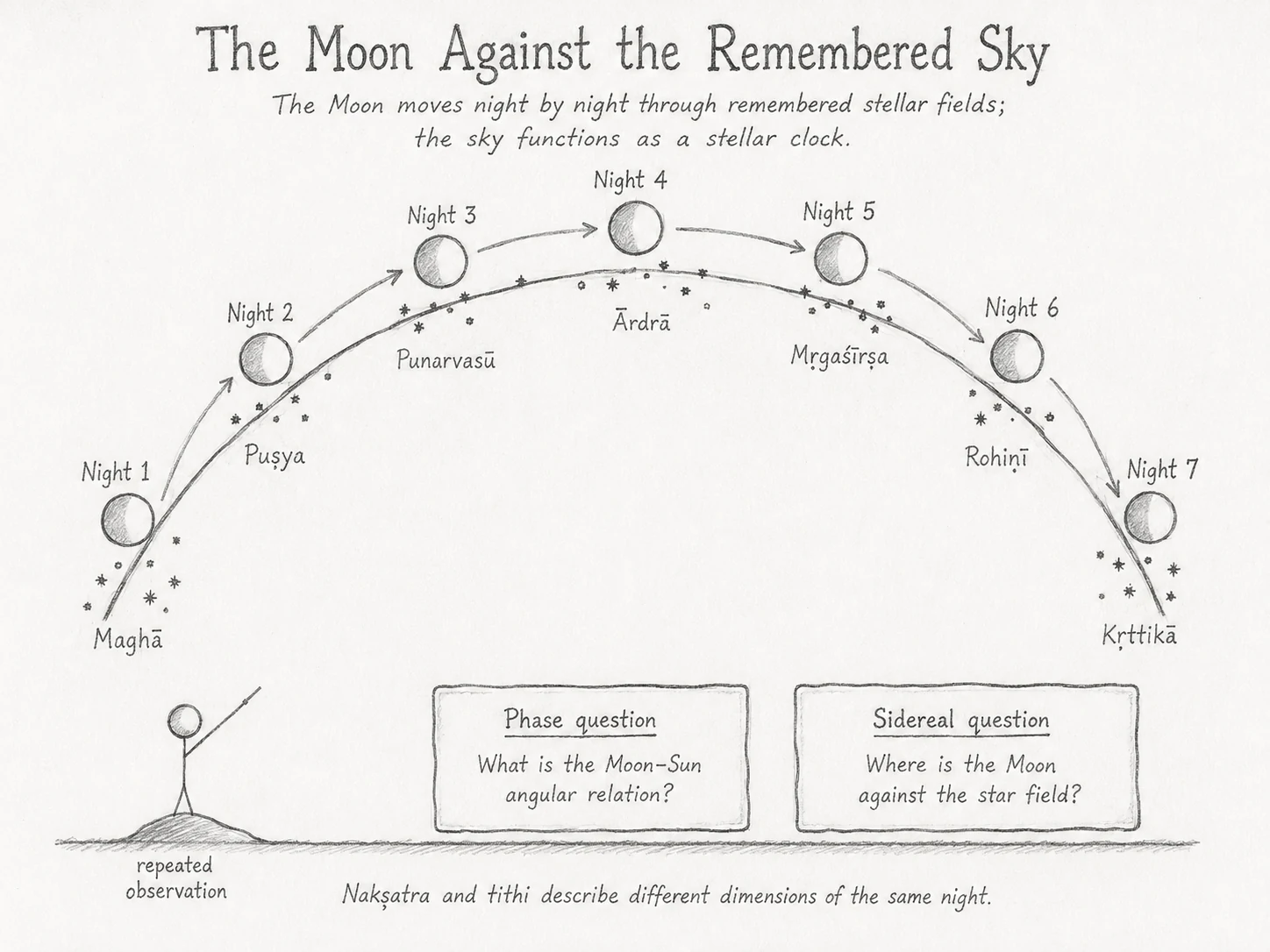
Figure 1. The stellar pattern supplies a relatively stable reference, while the Moon’s changing position creates an ordered sequence. The figure is schematic and does not represent the actual angular distance travelled on seven particular dates.
The Moon as a moving index
The expression “lunar mansion” is useful only if one remembers that the inhabitant moves. A mansion in ordinary language is fixed and occupied for a long period. The Moon, by contrast, remains in the vicinity of each station for roughly a day. The image is therefore closer to a sequence of nightly residences or fields of passage.
A trained observer does not need to see the entire lunar path at once. The knowledge is cumulative. One night may establish that the Moon is close to a bright star. The next establishes displacement. Repetition reveals direction and sequence. Seasonal visibility introduces further complications: some stations may be near the Sun and therefore difficult to observe; bright moonlight can obscure faint neighbouring stars; cloud and horizon conditions affect recognition. The observational tradition had to depend upon a mixture of direct sight, remembered order and computed expectation.
A Vedic statement such as the one in the marriage hymn that places Soma in the vicinity of the nakṣatras is suggestive because it assumes that lunar position can be expressed by reference to the stellar field.[2] It does not yet provide a table of longitudes. Nor does it tell us exactly which star later astronomers identified as the principal marker of each station. The oldest texts frequently preserve names and sequences without supplying coordinates, diagrams or descriptions sufficient to identify every asterism beyond dispute.
This gap matters. Later siddhāntic and calendrical works preserve yogatārās, or principal stars associated with the nakṣatras, but those catalogues are separated from the earliest Vedic sources by many centuries. They are indispensable witnesses to the received astronomical tradition; they are not transparent photographs of the earliest system. The historian cannot simply take a late coordinate, apply precession backwards and announce that every earlier occurrence of the name denoted the same precise point.[3]
The safest conclusion is more modest and more useful. Early Indian observers possessed an ordered set of named stellar references associated with the Moon’s circuit. The names were stable enough to be transmitted and to support ritual and calendrical rules, though the exact boundaries and stellar identifications may have changed or become standardized over time.
Such a system is already a considerable achievement. It converts the sky into a recurrent sequence without first requiring a numerical coordinate grid. The observer can say “the Moon is in Rohiṇī” before being able to state its longitude in degrees. Named location precedes numerical location in many knowledge traditions. The development of Jyotiṣa lies partly in the conversion of the first into the second.
One word, several astronomical objects
The dual use of nakṣatra for both a star or asterism and a lunar mansion has long caused interpretive difficulty. A visible star group is not the same thing as an equal segment of the ecliptic. Star groups differ in apparent width, brightness, shape and distance from the ecliptic. Equal sectors, by definition, do not.
The distinction can be stated precisely.
A stellar marker is observational. It may consist of one prominent star or several recognizable stars. Its usefulness depends on visibility and recognition. A lunar station is relational. It is the region named through association with such a marker and through which the Moon is said to move. An equal sector is mathematical. In a twenty-seven-fold division of the full circle, every sector measures 13°20′, regardless of the number, brightness or distribution of the stars associated with its name.
A later practitioner can use all three at once. The Moon may be computed at a particular sidereal longitude, assigned to the equal sector called Rohiṇī, and then described as occupying the Rohiṇī nakṣatra whose principal star belongs to a recognizable stellar grouping. The operations appear seamless because the tradition has already coordinated them. Historical analysis has to reverse that seamlessness and ask when each operation became explicit.
The Vedāṅga Jyotiṣa is especially important here. In addition to transmitting a sequence of nakṣatras and their deities, it contains numerical procedures that have been interpreted as treating the nakṣatras as equal sectors. The text states that the Sun remains in each nakṣatra for 13 and 5/9 days. Given its calendrical model of solar motion, this implies a sector of approximately 13⅓ degrees and an equal division of the circle.[4] Whatever the earlier history of visible asterisms, the late Vedic calendrical tradition was capable of abstracting the nakṣatra from the irregular appearance of its stars.
This is a conceptual transition of some importance. Once the nakṣatra becomes a sector, the Sun or Moon can occupy it even when the associated stellar marker is not visible. The coordinate survives daylight, cloud and seasonal invisibility. Observation remains the historical foundation of the system, but calculation extends it beyond the conditions of immediate sight.
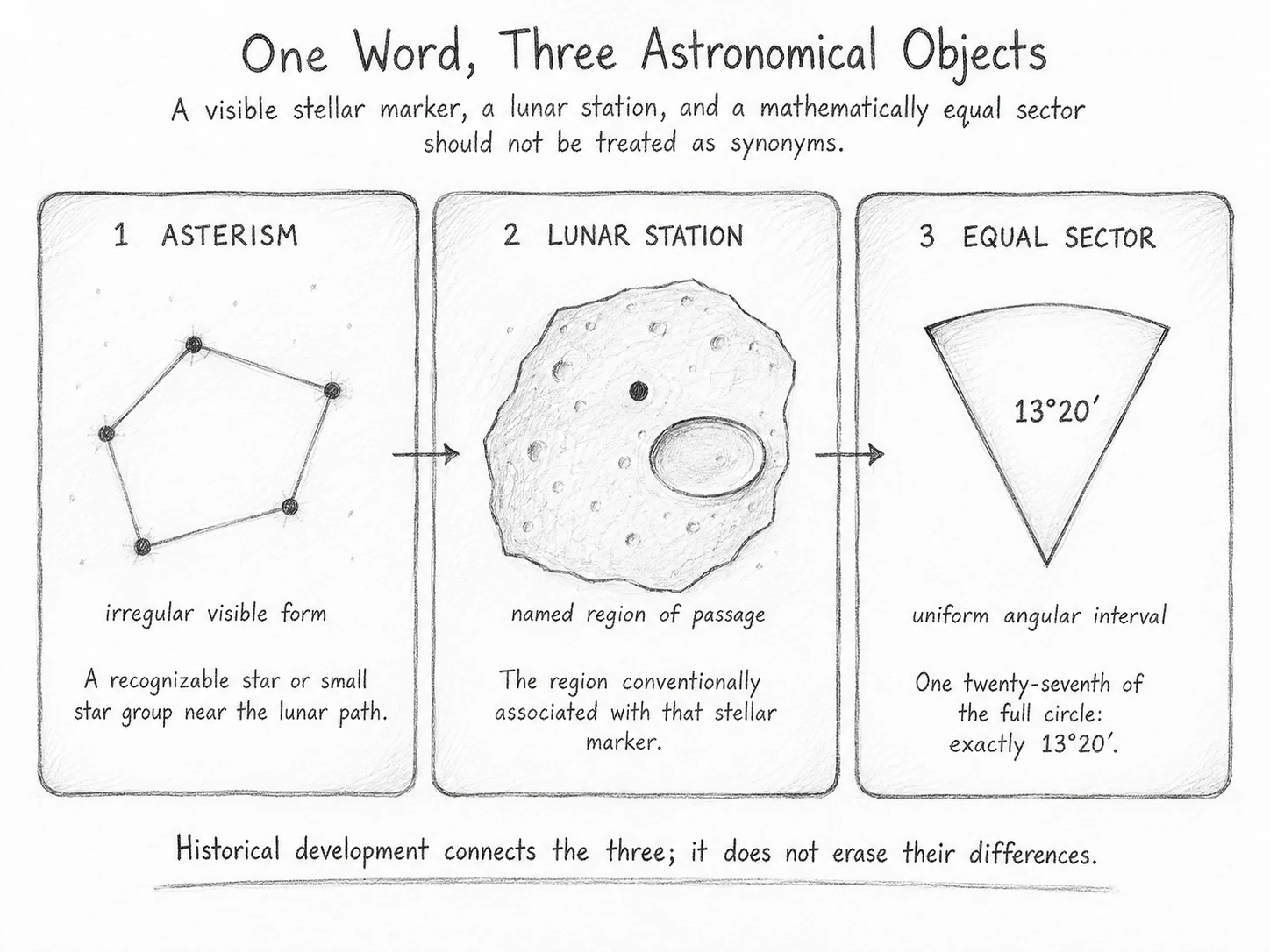
Figure 2. A principal star, a named lunar neighbourhood and an equal sector are related but distinct objects. Many historical errors arise from treating them as identical in every textual period.
The Vedic stellar archive
The nakṣatra tradition is not preserved in one original list. It survives through several textual witnesses whose genres and purposes differ. Among the most important are the nakṣatra hymn of the Atharvaveda, the litany in the Taittirīya Saṃhitā, the nakṣatra rites of the Taittirīya Brāhmaṇa, and the lists and algorithms of the Vedāṅga Jyotiṣa.[5]
These sources should not be blended into a single synthetic “Vedic list” before their differences are examined. A hymn that invokes the nakṣatras, a ritual text that assigns offerings, and a calendrical manual that computes time do not necessarily require the same ordering or the same definition of a station. Their overlap demonstrates continuity; their variation shows use.
The Vedic lists commonly begin with Kṛttikā rather than Aśvinī. They also preserve both twenty-seven- and twenty-eight-member arrangements, with Abhijit occupying the disputed additional position. Names vary in form: Tiṣya and Puṣya, Śroṇā and Śravaṇa, Śraviṣṭhā and the later Dhaniṣṭhā, Proṣṭhapadās and Bhādrapadās. Some names are singular, some dual, some plural. The grammar itself can preserve a trace of whether the referent was imagined as one star, a pair or a group, though grammar alone cannot settle the astronomical identification.[6]
The deity associations are equally important. Kṛttikā is linked with Agni, Rohiṇī with Prajāpati, Mṛgaśīrṣa with Soma, Ārdrā with Rudra, Punarvasu with Aditi, Puṣya with Bṛhaspati, Maghā with the Pitṛs, Hasta with Savitṛ, Citrā with Tvaṣṭṛ, Anurādhā with Mitra, Śravaṇa with Viṣṇu and Revatī with Pūṣan, among others. The details and nomenclature vary across witnesses, but the underlying structure is clear: the celestial sequence is also a sequence of divine agencies.[7]
It would be anachronistic to translate these agencies directly into modern personality types. Agni is not simply “a fiery person,” and Rudra is not merely “emotional turbulence.” The deity locates the nakṣatra within a larger Vedic field of ritual action and cosmological meaning. Agni consumes, transforms and carries offerings. Prajāpati generates and organizes living multiplicity. Soma nourishes, delights and replenishes. Rudra wounds, terrifies and heals. Aditi releases and encompasses. Bṛhaspati governs sacred formulation and counsel. The Pitṛs make ancestry present as obligation and continuity.
The deity therefore operates as more than a label. It supplies a grammar through which a period of time can be judged suitable for one kind of action and unsuitable for another. This is a crucial intermediate stage between astronomy and natal interpretation. Before the nakṣatra becomes a trait of a person, it becomes a quality of an occasion.
The following table summarizes the principal textual layers used in this study. It is deliberately schematic; dates, recensions and internal strata remain subjects of debate.
| Textual witness | Principal use of nakṣatra | Count or order | Methodological caution |
|---|
| Atharvaveda 19.7 | Hymnic invocation of stellar powers | Received sequence includes Abhijit | A liturgical list is not automatically an equal-sector coordinate table |
| Taittirīya Saṃhitā 4.4.10 | Nakṣatras with presiding deities | Kṛttikā-first sequence | Deity association does not by itself establish later natal meanings |
| Taittirīya Brāhmaṇa 3.1 | Nakṣatra offerings and ritual applications | Twenty-eight-member ritual field | Ritual sequence and astronomical boundary need not be identical |
| Vedāṅga Jyotiṣa | Calendar, yuga, lunar and solar reckoning | Twenty-seven in computation; Kṛttikā-first list and jāvādi arrangement | Surviving recensions are layered; astronomical epoch and redaction date are not the same question |
| Varāhamihira’s Bṛhat Saṃhitā | Social taxonomy, environmental prognosis, action classification and natal description | Both twenty-eight and twenty-seven, depending on chapter | A single author can preserve parallel systems for different purposes |
The table makes visible what popular summaries usually conceal: the nakṣatra is not one object moving unchanged through history. It is a stable name carried across changing procedures.
The calendar becomes technical
The Vedāṅga Jyotiṣa, attributed to Lagadha and preserved in Ṛgvedic and Yajurvedic recensions, is the earliest surviving compact Sanskrit work devoted specifically to the calendar. Its absolute date remains debated, and the date of the astronomical conditions represented in the text should not be confused automatically with the date at which the surviving recensions reached their present form.[8] Its practical aim is less controversial. The calendar had to determine the proper time for Vedic rites.
The text works with a five-year yuga of 1,830 civil days. Within that model it coordinates sixty-two synodic lunar months and sixty-seven sidereal lunar months, along with tithis, seasons and intercalation.[9] The numbers are not exact by later standards, but they show a clear understanding of the problem: a phase month, a sidereal month and a solar year are different cycles. A usable calendar must bring them into temporary agreement and then correct the drift.
The yuga is described as beginning around the winter solstice when Sun and Moon are together in Śraviṣṭhā. This is simultaneously a solar, lunar and stellar statement. The solstice identifies the seasonal hinge. Conjunction identifies the lunar phase. Śraviṣṭhā identifies the stellar sector. Three forms of time are made to coincide in one calendrical origin.[10]
The text also contains the jāvādi arrangement, a sequence of abbreviated nakṣatra or deity names used in computation. The sequence does not simply reproduce the ordinary circular order. It steps through the circle in a numerical pattern associated with the succession of full and new moons in the five-year model. This is evidence that the nakṣatras were not retained merely as mythic names. They were components of algorithmic thought.[11]
The calendar therefore changes the status of the star list. A memorized sequence becomes a computational register. The Moon’s station can be predicted, not only recognized after it appears. The observation of the sky remains necessary for maintaining and correcting the system, but the calendar now creates expectations against which observation can be compared.
The development also changes the meaning of accuracy. For a ritual community, an error is not only a numerical discrepancy. It can place an observance in the wrong season, attach the wrong tithi to a day, or disconnect a rite from its prescribed stellar condition. Astronomy is socially consequential because calendars govern coordinated action.
The Vedāṅga Jyotiṣa should therefore not be read as a primitive prelude to “real astronomy.” It represents a distinct intellectual achievement: the construction of a working luni-solar system from several non-commensurable cycles. Its nakṣatras are part of that reconciliation.
The twenty-eighth problem
The difference between twenty-seven and twenty-eight is frequently narrated as though one nakṣatra was simply removed from an original complete list. The textual evidence is less linear.
A lunar sidereal circuit lasts approximately 27.3 days. Twenty-seven stations therefore provide a convenient relation between nightly lunar motion and one full circuit. They also permit the full circle to be divided into equal sectors of 13°20′. Twenty-eight named stations, however, are well attested in ritual and classificatory settings. Their existence does not require twenty-eight equal geometrical divisions. An observational sequence may contain irregular stellar regions; a ritual sequence may retain a name that a continuous computational system treats differently.
Abhijit is usually placed between Uttarāṣāḍhā and Śravaṇa in the twenty-eight-member order. The standard later twenty-seven-fold ecliptic scheme proceeds directly from Uttarāṣāḍhā to Śravaṇa. It is tempting to imagine a clean editorial event in which Abhijit was “deleted.” Such language implies that one universal list existed and was later damaged. A more plausible historical model is functional pluralism: the name remained available in ritual and muhūrta contexts while the equal-sector calendar operated with twenty-seven.
Varāhamihira offers unusually strong evidence for this view because the two systems appear within the same work. Chapter 98 of the Bṛhat Saṃhitā, on the qualities of actions under the nakṣatras, enumerates twenty-eight, explicitly including Abhijit. It assigns deities and groups the stations as stable, sharp, fierce, light, soft, mixed or moving according to the actions suited to them.[12] Chapter 101, by contrast, gives birth effects for twenty-seven nakṣatras and passes from Uttarāṣāḍhā directly to Śravaṇa.[13]
This is difficult to explain as forgetfulness. The more reasonable inference is that Varāhamihira inherited several operational lists. The twenty-eight-member sequence remained useful when classifying occasions and ritual actions. The twenty-seven-member sequence functioned as the continuous framework for lunar birth positions. The additional station did not have to be either wholly present or wholly absent from the tradition.
The same caution applies to modern discussions of Abhijit as a “lost secret.” The textual problem is interesting without being sensationalized. It shows that Indian astronomical and ritual categories were capable of overlapping without being uniform. A mature tradition does not always resolve every inherited plurality into one table.
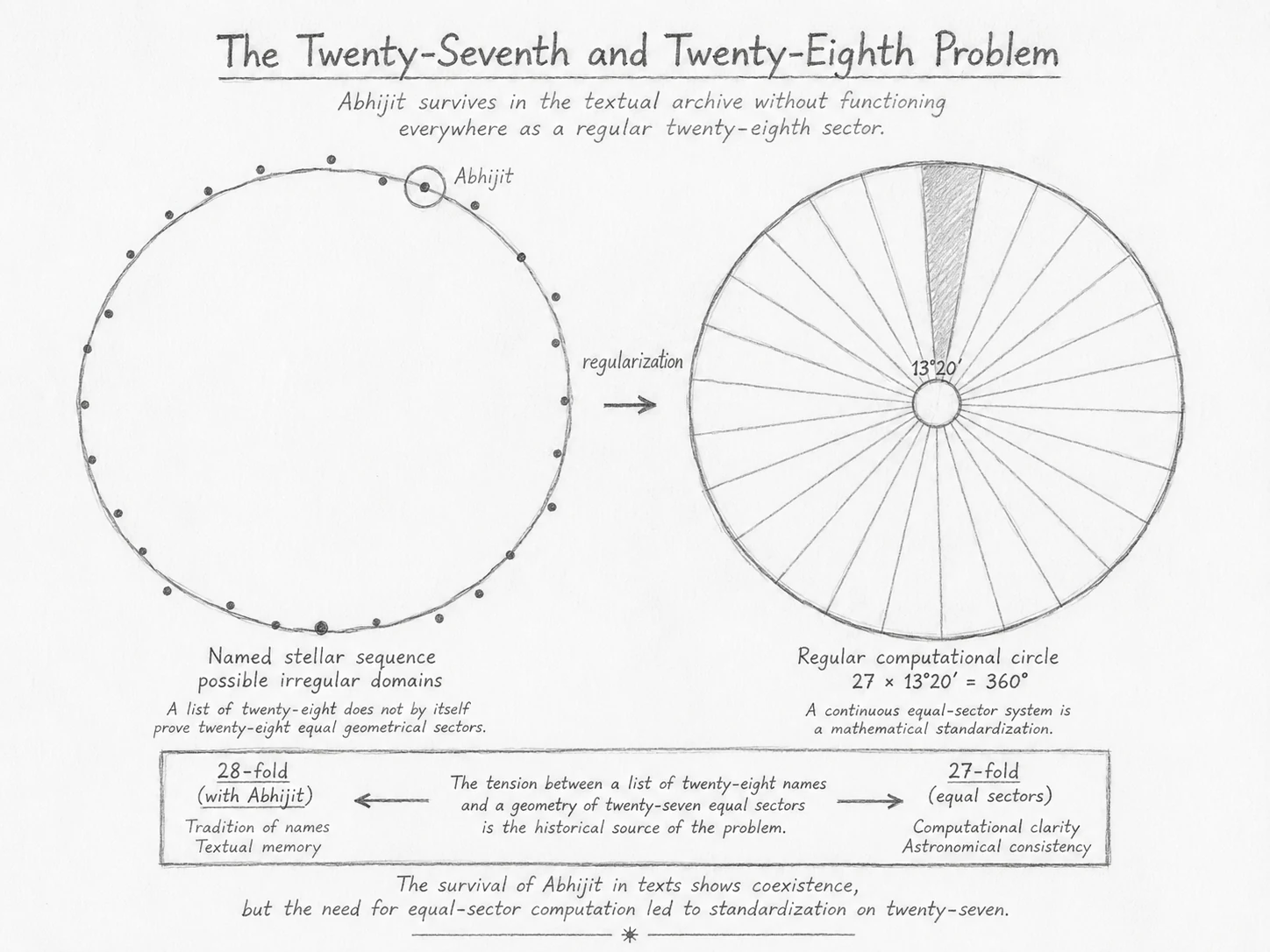
Figure 3. Twenty-seven equal sectors form a continuous computational circle. A twenty-eight-member textual sequence can retain Abhijit without implying twenty-eight equal sectors. Varāhamihira’s work preserves both operations.
Kṛttikā, Aśvinī and the meaning of a beginning
The starting point of a list is often treated as astronomical evidence of a single calendrical epoch. Kṛttikā-first Vedic lists and Aśvinī-first later lists are then converted into dates by assuming that the first name marks an equinoctial zero. The procedure can be legitimate only when the text actually indicates such a zero and when the passage can be shown to record an observation rather than a conventional order.
A list can begin for several reasons. It may begin with the station associated with a ritual year, with a seasonal marker, with the first item in a mnemonic sequence, with the origin of a computation, or with the zero point of a later coordinate system. These beginnings need not coincide.
The Vedic lists commonly begin with Kṛttikā. The mature twenty-seven-fold natal sequence begins with Aśvinī. The Vedāṅga Jyotiṣa itself complicates any simple chronology because it preserves a Kṛttikā-first ordinary list while also using a jāvādi computational arrangement beginning with an abbreviation associated with Aśvayujau. The computational order is generated by a numerical stepping procedure, not necessarily by the location of an equinox.[14]
Astronomical dating based on nakṣatras remains valuable, but it requires several safeguards. The passage must describe a celestial relation unambiguously. The stellar identification must be secure. Precession must be modelled. The possibility of textual preservation or later redaction must be considered. Above all, the meaning of “beginning” must be established from the genre.
This restraint does not reduce the antiquity or sophistication of the tradition. It protects both. Dates announced from one ambiguous line are fragile; an argument that distinguishes ritual order from coordinate origin is much harder to dismiss.
From asterism to equal sector
The mature mathematical system divides the full ecliptic into twenty-seven equal nakṣatras:
360° ÷ 27 = 13°20′
Each nakṣatra is then divided into four pādas:
13°20′ ÷ 4 = 3°20′
This geometry has an important consequence. The nakṣatra becomes computable from sidereal longitude even if no star is visible. The principal star need not lie at the centre of the sector, and the visible asterism need not fill it. The name now identifies a coordinate interval.
Consider a simple example. Suppose the Moon has a sidereal longitude of 46°. In a twenty-seven-fold sequence beginning at 0° with Aśvinī, the intervals are:
- Aśvinī: 0°–13°20′
- Bharaṇī: 13°20′–26°40′
- Kṛttikā: 26°40′–40°
- Rohiṇī: 40°–53°20′
The Moon is therefore in Rohiṇī. Its distance from the beginning of Rohiṇī is 6°. Since each pāda measures 3°20′, the Moon occupies the second pāda.
Nothing in that calculation requires a statement about personality. The result is an astronomical coordinate. Interpretation begins only when another textual rule assigns a deity, quality, syllable, action, compatibility, daśā ruler or phala to that coordinate.
This sequence is worth emphasizing because contemporary explanations often reverse it. They begin with the interpreted meaning and treat the sky position as a supporting detail. Historically and logically, the position must come first. Without a reproducible method of assigning the Moon to a station, the interpretive system has no stable object.
The pāda introduces another level of abstraction. A quarter of a nakṣatra is smaller than the nightly displacement of the Moon, so it is not simply a “night” within the old sequence. It is a finer mathematical index used to connect the lunar sector with other components of the chart and with naming or divisional procedures. Its existence belongs to a more developed coordinate system than the early list of stellar fields.
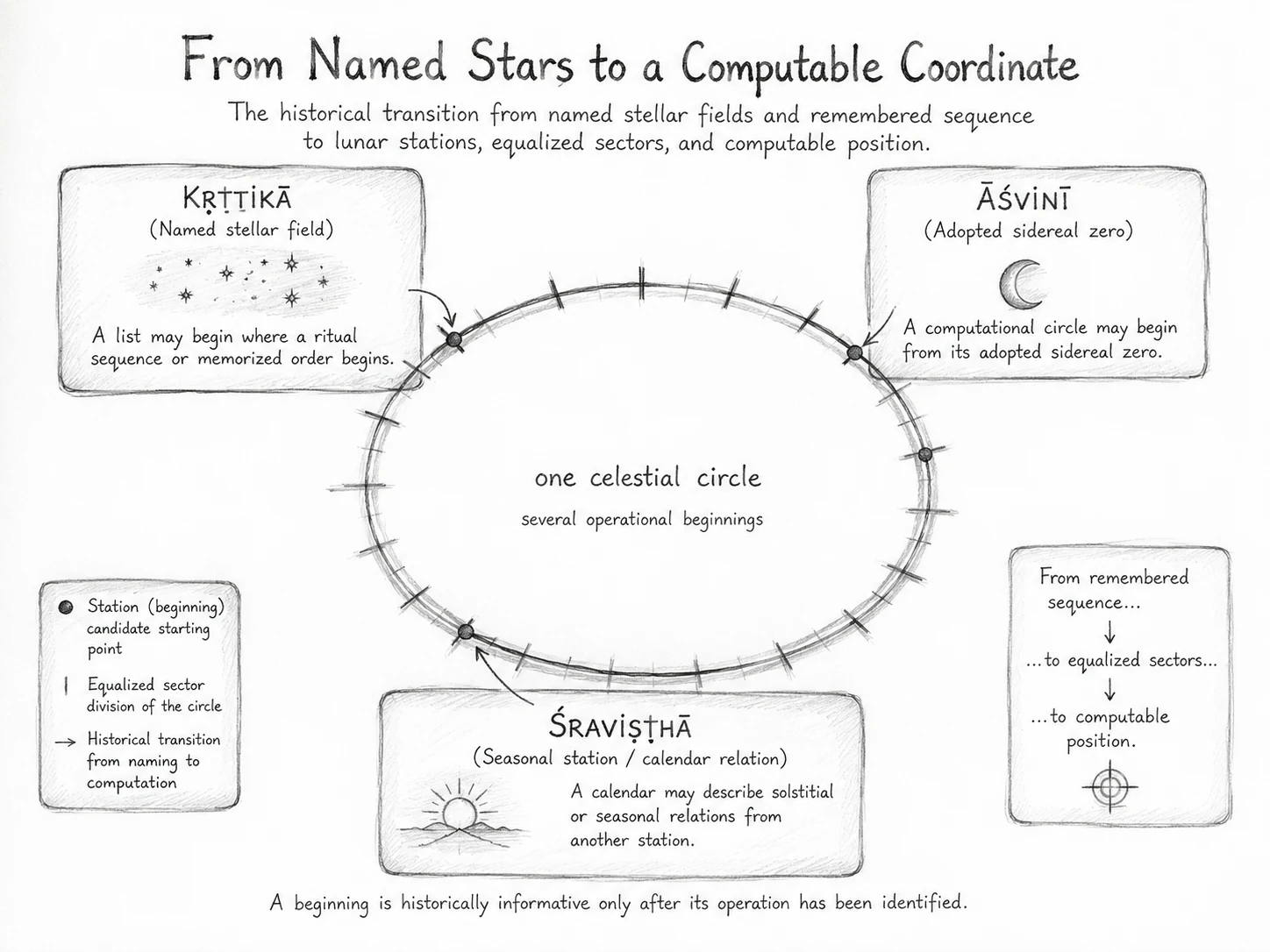
Figure 4. The movement from a named stellar sequence to equal sectors and pādas is a movement of abstraction. The worked example separates calculation from the meanings subsequently attached to the result.
The devatā as a grammar of action
It is easy to describe the nakṣatra deities as mythological ornaments surrounding an astronomical core. That reading misses their technical role. The deity supplies a vocabulary for deciding what kind of process a time supports.
Kṛttikā, presided over by Agni, provides a clear example. Agni is the transforming fire of the offering, but also the power that cooks, separates, purifies and conveys. Later classifications that treat Kṛttikā as mixed, sharp or associated with acts requiring decisiveness are not arbitrary personality metaphors added to a cluster of stars. They extend an older ritual semantics of fire into a theory of action.[15]
Rohiṇī, associated with Prajāpati, belongs to a different field. Prajāpati is linked with generation, ordering and the multiplication of life. Rohiṇī’s later associations with cattle, agriculture, fertility, wealth and cultivated abundance become intelligible within that field. Varāhamihira’s social taxonomy places farmers, cattle, rulers, merchants and mountain produce under Rohiṇī.[16] The association is broader than “attractiveness,” the adjective often emphasized in popular natal descriptions.
Ārdrā is linked with Rudra. Rudra’s field includes storm, injury, fear, wildness and healing. The nakṣatra therefore becomes suitable, in later action classifications, for sharp or disruptive operations. This does not mean that every person born under Ārdrā is destructive. It means that the inherited semantic field from which later judgment develops is one of rupture and powerful disturbance.
Maghā is presided over by the Pitṛs. The central themes are lineage, inheritance, authority received from the past and obligations toward ancestors. A natal interpretation may later turn these into statements about status or family identity, but the deeper structure is temporal: the present life is placed within a line of transmission.
Mūla, associated in the classical deity list with Nirṛti, carries the language of root, dissolution and the region outside ordered prosperity. The later association of Mūla with roots, drugs, seeds and garden work in the Bṛhat Saṃhitā is particularly revealing.[17] “Root” is botanical, causal and destructive at once. The semantic field permits both the search for origins and the undoing of established form.
Śravaṇa belongs to Viṣṇu, whose strides establish and traverse ordered space. The name also evokes hearing. Movement, transmission, reputation and learning can therefore gather around the station without being reducible to one original meaning. Revatī, linked with Pūṣan, draws together nourishment, protection, roads, animals and safe passage. Varāhamihira associates it with boatmen, aquatic produce, pearls, conch, salt and fragrant substances.[18]
These examples show why the deity should be studied before the personality profile. The deity is a node connecting ritual, material activity, ethical expectation and cosmic function. A later natal statement is one particular application of that network.
There is also a methodological warning. A sufficiently rich symbolic field can support many interpretations after an event. Historical reconstruction requires us to identify which associations are actually attested in which texts. Agni’s Vedic significance, Varāhamihira’s action category and a modern psychological description are related, but they are not contemporary evidence of one unchanged doctrine.
Varāhamihira’s inhabited sky
The Bṛhat Saṃhitā demonstrates how far the nakṣatra system had moved beyond a list of stars while still retaining an astronomical basis. Chapter 15, nakṣatra-vyūha, allocates persons, occupations, plants, animals, commodities and regions of work to the nakṣatras. The chapter is sometimes summarized as a set of birth descriptions, but its intellectual structure is more extensive. It is a taxonomy of the inhabited world.[19]
Rohiṇī contains merchants, rulers, cattle owners, farmers and wealth from mountain produce. Citrā includes jewels, fine cloth, writers, singers, perfumers, mathematicians, weavers, surgeons and oculists. Mūla includes druggists, roots, fruits, flowers, seeds and garden work. Pūrvāṣāḍhā includes boatmen, sea travel and aquatic flowers and fruits. Revatī contains salt, pearls, conch shells, water creatures, perfumes and navigation. Aśvinī includes horses, riders, physicians, commanders and those who work with transport.[20]
These lists are uneven and sometimes morally severe. They reflect the occupational structure, social hierarchy and prejudices of their period. A research article should not sanitize them into timeless archetypes. Their value lies precisely in their historical density. They show what kinds of work, substance and social identity an encyclopedic Jyotiṣa text attempted to map onto the stellar order.
The map functions prognostically. If a nakṣatra is afflicted by particular planetary or celestial conditions, the persons and materials assigned to it are expected to suffer; if it is free of affliction, they prosper. The nakṣatra therefore becomes an indexing system. Instead of predicting one event from one star, the text links a celestial sector to a cluster of earthly referents and then assesses the condition of that cluster through planetary relations.[21]
Chapter 98 organizes the stations by the kinds of action suited to them. Stable nakṣatras are recommended for coronations, planting, town building, public works, sowing and acts intended to endure. Sharp stations are assigned to acts of punishment, separation or coercion. Light stations support learning, ornament, art, medicine, trade and travel. Soft stations support friendship, clothing, music and auspicious social acts. Moving stations are used for undertakings involving motion.[22]
The categories reveal a theory of time that is qualitative without being vague. “Good time” is not universally good. A stable time is good for permanence, but may be ill-suited to an action requiring speed. A sharp time may be undesirable for marriage yet appropriate, within the text’s ethical world, for cutting or separation. Muhūrta is therefore not the search for a single auspicious substance called luck. It is the attempt to match the character of an action with the character assigned to a time.
This matching principle also explains why the deity matters. A time associated with Agni, Mitra, the Pitṛs or Pūṣan is not simply fortunate or unfortunate. It has a mode of operation. The nakṣatra becomes a grammar for choosing verbs.
Rohiṇī-yoga and the making of an environmental record
The most instructive case in the Bṛhat Saṃhitā is the chapter on the Moon’s conjunction with Rohiṇī. It brings calculation, ritual preparation, meteorological observation, seed testing and agricultural forecast into one procedure.
Varāhamihira opens by acknowledging earlier authorities, including Garga, Parāśara, Kāśyapa, Maya, Bṛhaspati and Nārada. The invocation of lineage establishes that he is not presenting a private discovery. Yet he does more than repeat names. He directs the astronomer to calculate the relevant annual conjunction, observe the Moon’s size, brightness, colour and direction, and attend to winds and portents at the time.[23]
The occasion is not the Moon’s ordinary monthly passage through Rohiṇī. The chapter concerns a particular annual configuration in the dark half of Āṣāḍha, treated as an observation point for the coming rainy season. The astronomical condition functions as a repeatable date on which several terrestrial variables are examined.
The observer prepares seeds of different kinds, sanctifies them and places them in water. At the conjunction, the proportion that has sprouted is examined; the text treats this percentage as an indicator of which grains will flourish and to what extent.[24] A fine black streamer is raised on a twelve-cubit staff to determine wind direction. Directions are established through a level surface, a circle and a gnomon whose morning and afternoon shadows define the cardinal lines.[25]
The winds are watched through divisions of the day. Watches are mapped onto later fortnights or months of the rainy season, so that the observed sequence becomes a temporal forecast. Contrary winds are compared by strength. Clouds are classified by colour, mass, shape, lightning and thunder. The sounds and orientation of birds and animals are noted. Clear sky, unvitiated breeze and particular cloud formations enter the judgment.[26]
The procedure deserves neither uncritical praise as a modern experiment nor casual dismissal as an omen. It is a mixed practice.
Its observational strengths are real. The date is predetermined rather than selected after the weather is known. The observer records several environmental variables. Wind direction is externalized through a streamer rather than left wholly to impression. Seed response is expressed proportionally. The protocol can be repeated annually, and it is tied to agricultural outcomes that matter socially.
Its limitations are equally real. The mapping of a three-hour watch onto a later fortnight is analogical rather than physically demonstrated. Cloud categories are vivid but not standardized in a way that guarantees agreement between observers. There is no preserved control series showing whether the same signs perform better than chance or better than ordinary seasonal knowledge. Failed predictions may not have been copied with the same care as successful rules. Regional ecology can alter the relationship between early-season signs and later rainfall.
The chapter therefore belongs to the history of environmental intelligence. It shows a culture organizing repeated observation around a celestial calendar and then joining observation to inherited prognostic rules. Its scientific value cannot be decided by the presence or absence of ritual language alone. The ritual sets the observational occasion; the validity of each forecast remains an empirical question.
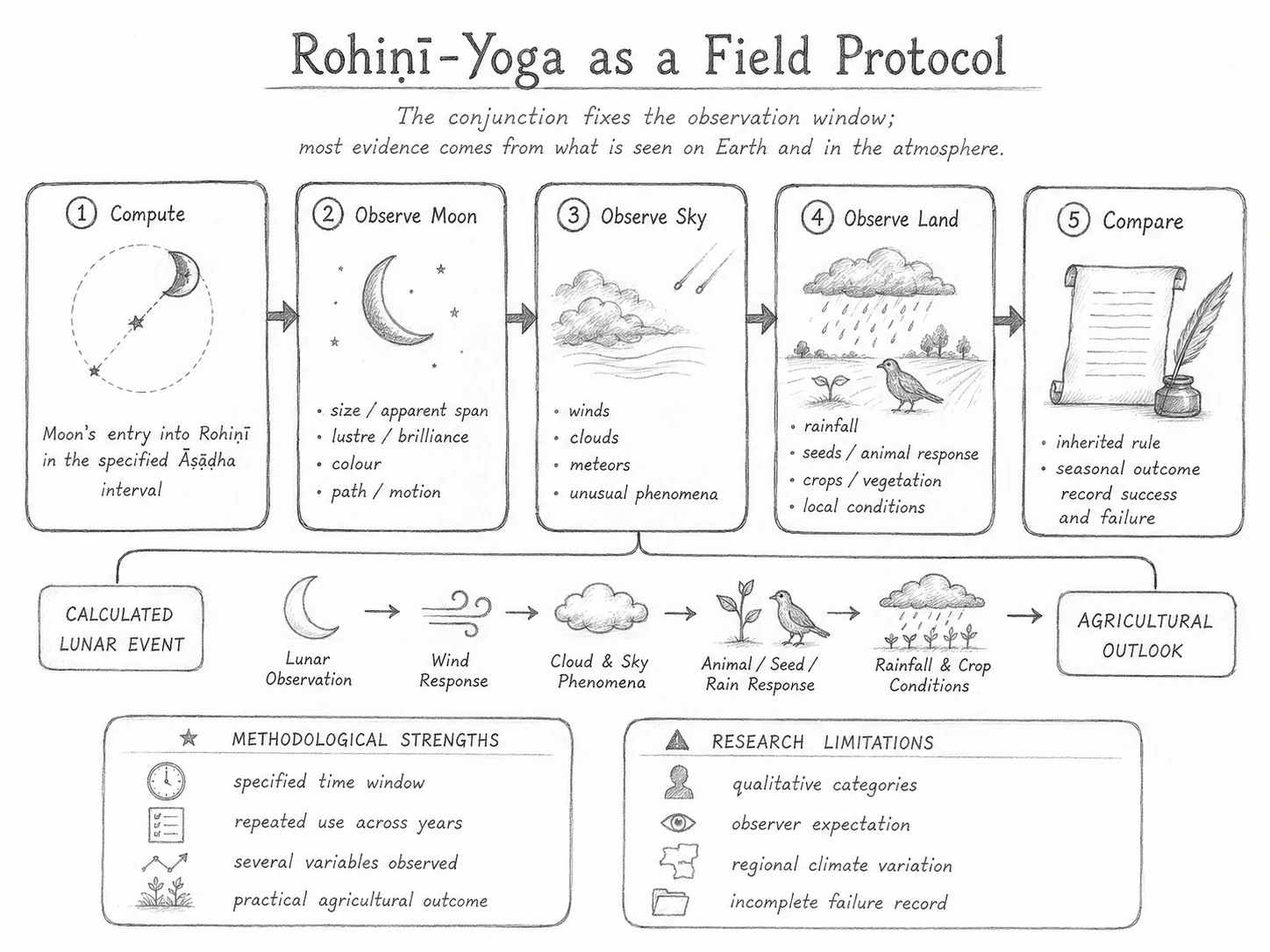
Figure 5. The Rohiṇī-yoga chapter coordinates a calculated celestial event, instruments and prepared seeds with observations of wind, clouds and living behaviour. The forecast is produced through both measurement and analogy.
From public time to birth time
The earliest technical need served by nakṣatras was collective. Ritual communities, agricultural calendars and public observances required a shared temporal reference. The janma-nakṣatra applies the same celestial order to an individual beginning.
At birth, the Moon occupies a determinate sidereal longitude. That longitude can be assigned to a nakṣatra and pāda. The astronomical statement is straightforward. The interpretive statement is more demanding: why should this lunar sector describe the native?
The internal logic of Jyotiṣa begins with the Moon’s association with manas, reception, memory, habit and the continuity of experience. The first article in this series examined that relation through Vedic cosmology, classical horā and the Soma principle. Within that framework, the Moon’s stellar field at birth becomes a way of specifying the condition of the mind-principle as it enters a particular embodied life.
This is a traditional explanation, not a demonstrated physiological mechanism. The stars defining a nakṣatra are not known to emit a distinctive influence that imprints a neonatal nervous system according to 13°20′ boundaries. Nor does the astronomical fact that the Moon occupied Rohiṇī prove the character traits assigned to Rohiṇī in a natal text. The coordinate and the interpretation have different evidentiary status.
The distinction is visible within Varāhamihira’s own corpus. Chapter 101 of the Bṛhat Saṃhitā, corresponding to the nakṣatra chapter of the Bṛhat Jātaka, gives concise traits for birth under each of twenty-seven stations. The descriptions include appearance, speech, wealth, conduct, learning, mobility and social disposition.[27] They are not identical to the much larger web of modern nakṣatra attributes. The later tradition adds planetary rulers, animal symbols, syllables, compatibility classes, bodily correspondences and increasingly elaborate psychological readings.
A serious account should therefore identify the textual layer of each attribute. “Presiding deity” may be Vedic. “Suitable action” may be developed in saṃhitā and muhūrta literature. “Birth trait” is explicit in classical horā. “Planetary ruler” belongs to the organization of later daśā systems. A contemporary phrase such as “attachment style” is a modern translation into psychological language, not a recovered Vedic category.
The janma-nakṣatra also remains only one coordinate in a full horoscope. Lagna, planetary placements, strengths, aspects, yogas, daśā and age modify interpretation. To infer an entire biography from the Moon’s station alone is a simplification even within the classical system.
How spatial position became a sequence of life periods
The later daśā traditions perform one of the most conceptually striking operations in Jyotiṣa. They convert the Moon’s fractional progress through a nakṣatra at birth into the balance of a planetary period.
In the received Vimśottarī system, the twenty-seven nakṣatras are assigned cyclically to nine planetary rulers. Each ruler has a fixed period. The ruling planet of the birth nakṣatra determines the first mahādaśā, while the untraversed fraction of the nakṣatra determines how much of that period remains at birth.[28]
Suppose, for illustration, that the Moon has completed 45 per cent of its birth nakṣatra. Fifty-five per cent remains. If the full period assigned to that nakṣatra’s ruler is ten years, the initial balance is 5.5 years. A spatial fraction has become a temporal fraction.
The operation is mathematically clear even where its predictive rationale remains interpretive. It assumes that the position of the Moon within its sector is not only a coordinate but a phase within a life sequence. The native enters the planetary cycle partway through, just as the Moon has entered the nakṣatra partway through.
This is not a trivial extension of the calendar. The old nightly order of lunar stations has become a model of biography. The same circle that located the Moon now unfolds into periods, sub-periods and sub-sub-periods. Celestial recurrence is translated into lived duration.
The textual history of the daśā systems is complex. The surviving Bṛhat Parāśara Horāśāstra is a layered received text, and its present arrangement should not be assigned wholesale to an early date merely because it is attributed to Parāśara. Different horā works preserve different period systems and conditions of applicability.[29] For the history of nakṣatras, the important point is not that one daśā was original. It is that the equal twenty-seven-fold sequence made such transformations possible.
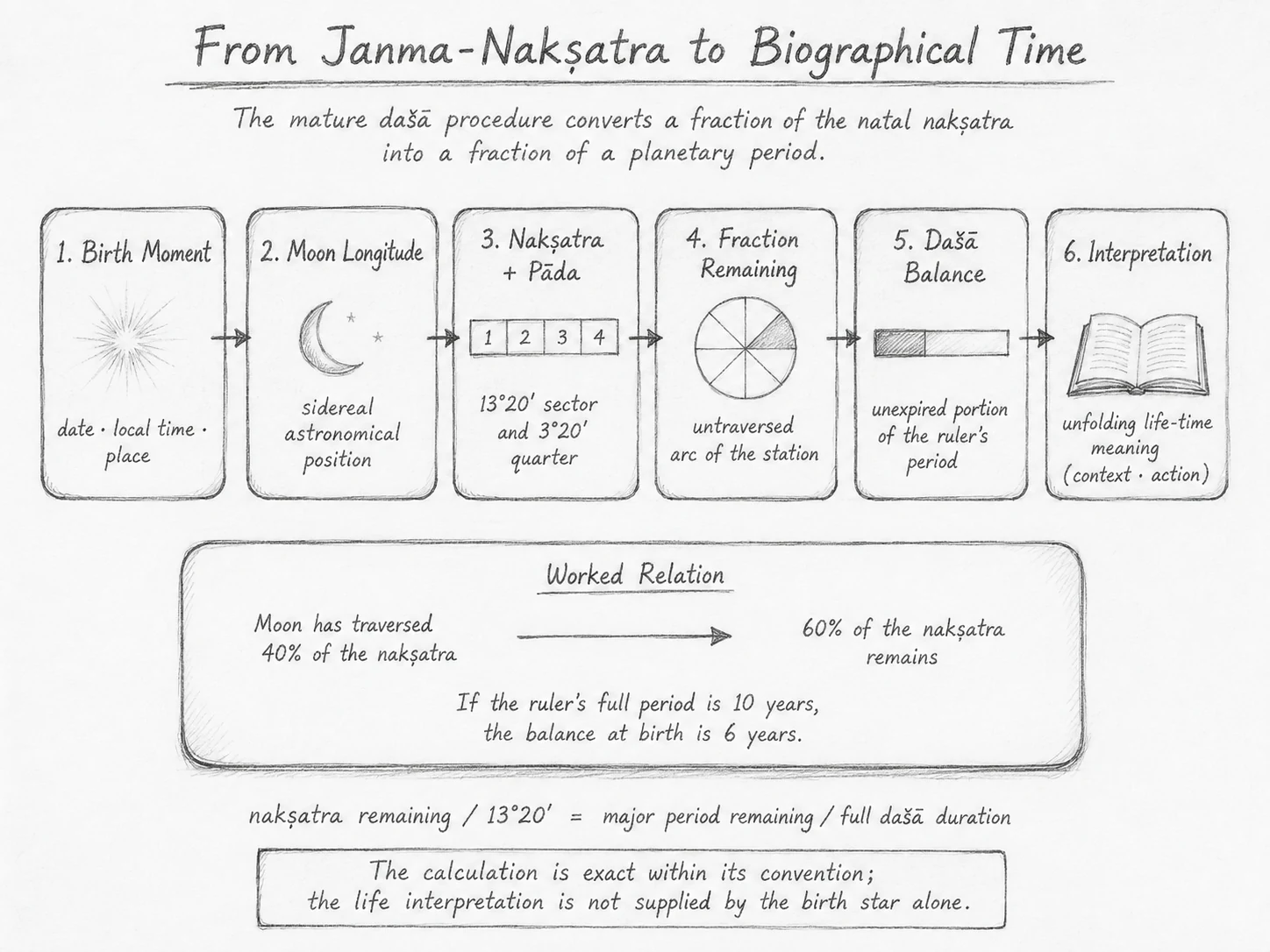
Figure 6. The birth coordinate is computationally ascertainable. Natal phala and daśā are rule-governed interpretations built upon it. The diagram does not imply that the nakṣatra alone determines a life.
Memory, recitation and contemplative attention
The origin of nakṣatra knowledge is sometimes attributed entirely to meditative revelation. The claim is reverential, but it obscures the kinds of labour visible in the texts.
A sequence of twenty-seven or twenty-eight names must be remembered in order. Deities, ritual offerings and appropriate actions must be attached to those names. Lunar and solar counts must be reconciled. Observers must recognize stars, compare nights and preserve exceptional events. Commentators must resolve variant readings. Astronomers must correct tables when prediction and sky diverge. None of this is explained by the word “meditation” alone.
Meditative and ritual discipline can nevertheless matter epistemically. Repeated recitation stabilizes an ordered archive before writing is the sole means of transmission. Fasting, vigil and prescribed observation produce sustained attention to a specific night. Tapas trains patience and restraint. Dhyāna can integrate external order with internal meaning. These practices shape the observer and the social seriousness of the observation.
They do not remove the need for calculation. Varāhamihira’s Rohiṇī protocol requires a computed conjunction, established directions, wind observation and comparison of seed response. The Vedāṅga Jyotiṣa requires arithmetic. The stellar list requires recognition. The relation is complementary: contemplation disciplines attention; gaṇita disciplines inference; textual criticism disciplines transmission.
The term ṛṣi should also be used with historical care. The seers associated with Vedic mantra, Lagadha the calendrical authority, siddhāntic astronomers and Varāhamihira the encyclopedic ācārya belong to different intellectual settings. Collapsing them into one timeless category makes the tradition appear simpler than it was.
What links them is not one method but one concern. Time is ordered, that order can be observed, and human action is improved when it is brought into an intelligible relation with it.
What can be researched now
A contemporary research programme on nakṣatras should begin by refusing the question “Do the twenty-seven types work?” The category is too coarse and historically confused. The first task is to specify what kind of claim is being tested.
A critical textual map
Every nakṣatra occurrence in a defined corpus could be entered into a chronological database with fields for text, recension, grammatical number, deity, ritual use, astronomical function, environmental correspondence, action category and natal result. Variant readings should be preserved rather than normalized silently. Such a database would make it possible to see when a particular association first appears and how it changes.
The project would also separate inherited attributes from recent additions. A claim that Mūla is associated with Nirṛti, for example, belongs to the classical deity tradition. A claim that every Mūla native pursues one specific modern profession requires a different source and a different test.
Astronomical reconstruction
The visible sky should be reconstructed for plausible Indian observing latitudes and historical epochs, but without forcing uncertain yogatārā identifications into false precision. The research questions would include:
- Which proposed stellar markers are bright enough to be recognized near the Moon?
- How close does the Moon actually pass to them?
- During which seasons are they visible at useful hours?
- How do precession and proper motion affect later attempts to identify early observations?
- When does an equal sector diverge substantially from the visible asterism carrying the same name?
The result would not be one final map labelled “the Vedic sky.” It would be a set of confidence levels and competing reconstructions.
Reconstructing calendrical algorithms
The five-year yuga and jāvādi arrangement can be implemented computationally and compared with the astronomical cycles they approximate. This would clarify what the Vedāṅga Jyotiṣa was designed to accomplish, where its internal rules are elegant, and how quickly its calendar drifts if not corrected.
The exercise is historically valuable even if later astronomy is more accurate. It reveals the logic of the system from within rather than judging it only by modern numerical error.
Repeating environmental protocols
The Rohiṇī-yoga procedure can be translated into preregistered variables: exact lunar condition, wind direction and speed, cloud type, humidity, temperature, seed variety, germination percentage, rainfall onset, seasonal total and crop yield. The same protocol could be repeated over many years and at several locations.
The aim would not be to validate the entire chapter through one correlation. It would be to determine which observations have local predictive value, which encode ordinary monsoon knowledge, and which analogical mappings fail. Null findings would be part of the result.
Studying living calendars
Pañcāṅga makers, Vedic schools, temple observances, naming ceremonies, agricultural customs and family practices preserve distinct forms of nakṣatra knowledge. Ethnographic study can show how computed sectors become lived time: when people fast, travel, name a child, begin construction or remember an ancestor.
Continuity must not be assumed merely because a practice is old in appearance. A living tradition may preserve an ancient structure while changing its explanatory language, calculation or social purpose. The history is strongest when continuity and innovation are both documented.
Testing natal propositions
Natal claims require the strictest design because twenty-seven categories, four pādas, many outcomes and flexible interpretations create an enormous risk of retrospective fitting. A valid study would need accurate birth times, preregistered hypotheses, independent training and test samples, clearly coded textual predictions, correction for multiple comparisons, and publication of negative results.
Even then, a test of one trait under one nakṣatra would not prove or disprove Jyotiṣa as a whole. It would test a specified rule from a specified text. That narrower scale is not a weakness. It is how a complex tradition becomes researchable.
The stars did not become a horoscope all at once
The nakṣatra system began with a difference visible to anyone patient enough to return to the sky: the stars retained their pattern while the Moon moved. Indian observers turned that difference into an ordered sequence. Ritual texts joined the sequence to deities and offerings. Calendrical astronomy converted it into a tool for coordinating lunar, solar and seasonal time. Equal sectors made the sequence computable. Saṃhitā literature distributed plants, occupations, commodities, weather signs and forms of action across it. Horā placed the Moon’s station at birth inside a theory of temperament and life periods.
Each transition added something and concealed something. The equal sector made calculation reproducible, but it could obscure the irregular visible asterism. Natal interpretation made the sequence personally meaningful, but it could conceal its earlier public and calendrical functions. Modern personality summaries make the tradition accessible, but they often erase textual history.
The twenty-seven and twenty-eight systems are therefore not an embarrassment to be harmonized by force. They show that the Indian temporal archive retained more than one way of organizing the Moon’s passage. Kṛttikā-first and Aśvinī-first orders likewise need not be reduced to a single disputed date. A ritual beginning, a mnemonic beginning and a coordinate beginning can coexist.
The enduring intellectual achievement lies in the relations. A moving Moon is read against remembered stars. The stars are connected with devatās. The devatās establish fields of action. Action is coordinated with season and society. A birth is placed within the same circle, and the circle is opened into a sequence of life periods.
Whether every prognostic rule survives empirical examination remains an open question. The historical structure is clearer. Long before the nakṣatra became a short description of personality, it was a method for making recurrence legible. It allowed the night sky to be remembered as ordered time and, eventually, allowed a human life to be interpreted as one passage within that order.
Notes and sources
[1] Prabhakar Gondhalekar, “The Vedic Nakṣatras: A Reappraisal,” Indian Journal of History of Science 44, no. 4 (2009): 479–508, especially the distinction between stellar markers and nakṣatra-sectors.
[2] Ṛgveda 10.85.2. The verse is important for the relation of Soma and nakṣatra, though it does not provide a technical coordinate system.
[3] Gondhalekar, “Vedic Nakṣatras,” 480–481, on the chronological gap between Vedic references and later yogatārā coordinate catalogues. See also K. D. Abhyankar, “Misidentification of Some Indian Nakshatras,” Indian Journal of History of Science 26, no. 1 (1991): 1–13.
[4] Vedāṅga Jyotiṣa, Ṛg recension 18 and corresponding Yajus recension 39, as discussed in Gondhalekar, “Vedic Nakṣatras,” 483. The implied equal sector is approximately 13⅓ degrees.
[5] Atharvaveda 19.7; Taittirīya Saṃhitā 4.4.10; Taittirīya Brāhmaṇa 3.1; Lagadha, Vedāṅga Jyotiṣa. The Vedic Heritage Portal provides digital access to the relevant Vedic corpora.
[6] For comparative lists and forms, see T. S. Kuppanna Sastry and K. V. Sarma, eds. and trans., Vedāṅga Jyotiṣa of Lagadha in Its Ṛk and Yajus Recensions (New Delhi: Indian National Science Academy, 1985), and Gondhalekar, “Vedic Nakṣatras,” table 1.
[7] Taittirīya Saṃhitā 4.4.10; Taittirīya Brāhmaṇa 3.1. Varāhamihira preserves a classical deity list in Bṛhat Saṃhitā 98.4–5. Individual witnesses and translations vary in the forms of names and in a few assignments.
[8] Sastry and Sarma, Vedāṅga Jyotiṣa, introduction. The editors survey disagreements regarding chronology and establish the text from multiple manuscripts. Astronomical dating of a represented solstitial condition and philological dating of a recension answer different questions.
[9] Vedāṅga Jyotiṣa, especially the verses on the five-year yuga. See Sastry and Sarma, edition and commentary; also A. K. Bag, “Early System of Nakṣatras, Calendar and Antiquity of Vedic Traditions,” Indian Journal of History of Science 50, no. 1 (2015): 1–27, for the calendar arithmetic. Bag’s broader chronological conclusions remain debated.
[10] Vedāṅga Jyotiṣa, Ṛg recension 5–6 and Yajus recension 6–7, on the beginning of the yuga with Sun and Moon in Śraviṣṭhā around the winter solstice.
[11] Vedāṅga Jyotiṣa, Ṛg recension 14 and Yajus recension 18, with the jāvādi arrangement; Gondhalekar, “Vedic Nakṣatras,” 482–485.
[12] Varāhamihira, Bṛhat Saṃhitā 98.1–11, nakṣatra-karmaguṇa. The chapter enumerates twenty-eight stations, including Abhijit, and classifies actions under stable, sharp, fierce, light, soft, mixed and moving categories.
[13] Varāhamihira, Bṛhat Saṃhitā 101, nakṣatra-jātaka, corresponding to Bṛhat Jātaka 16. The birth list contains twenty-seven stations and omits Abhijit.
[14] Gondhalekar, “Vedic Nakṣatras,” 481–485. The fact that an order begins with a name should not be treated automatically as an equinoctial observation.
[15] Taittirīya Saṃhitā 4.4.10; Bṛhat Saṃhitā 98. Agni’s association with Kṛttikā is early; the later action classifications extend rather than merely repeat the Vedic association.
[16] Bṛhat Saṃhitā 15.2 and 98.4–6. Rohiṇī is associated with Prajāpati in the deity list and with agriculture, cattle, wealth, merchants and rulers in the social taxonomy.
[17] Bṛhat Saṃhitā 15.17 and 98.4–7. The correct classical deity assignment in chapter 98 is Nirṛti; some older English tables contain transcription or translation errors.
[18] Bṛhat Saṃhitā 15.20, 15.25 and 98.4–5. Śravaṇa is assigned to Viṣṇu and Revatī to Pūṣan in the received deity list.
[19] Varāhamihira, Bṛhat Saṃhitā 15, nakṣatra-vyūha. See M. Ramakrishna Bhat, trans., Bṛhat Saṃhitā of Varāhamihira, Part I (Delhi: Motilal Banarsidass, 1981; later reprints).
[20] Bṛhat Saṃhitā 15.2, 15.12, 15.17–18, 15.25–26. The older translations should be read with attention to vocabulary and social assumptions.
[21] Bṛhat Saṃhitā 15.31. The logic is one of celestial indexing: the condition of the nakṣatra affects the persons and objects allocated to it.
[22] Bṛhat Saṃhitā 98.6–11. The categories are functional, not a simple scale from auspicious to inauspicious.
[23] Bṛhat Saṃhitā 24.1–3. Varāhamihira names earlier authorities and states that the conjunction is to be calculated, referring to his Pañcasiddhāntikā for conjunction with fixed stars.
[24] Bṛhat Saṃhitā 24.4 and 24.11, on preparing seeds and evaluating the percentage that sprouts.
[25] Bṛhat Saṃhitā 24.5 and Bhattotpala’s explanatory material on establishing directions with a circle and gnomon and using a streamer to observe wind.
[26] Bṛhat Saṃhitā 24.6–20. The chapter maps watches to future rain periods and describes winds, cloud forms, thunder, birds and animals. See also A. S. Ramanathan, “Contribution to Weather Science in Ancient India: V—Principles of Forecasting Rainfall,” Indian Journal of History of Science 22, no. 3 (1987): 187–210.
[27] Bṛhat Saṃhitā 101; Bṛhat Jātaka 16. The descriptions are concise and should not be confused with the much larger modern repertory of nakṣatra symbolism.
[28] Bṛhat Parāśara Horāśāstra, received chapters on daśā, especially Vimśottarī. The calculation described here is the standard later procedure: the untraversed fraction of the birth nakṣatra gives the balance of the first period.
[29] The textual history of the surviving Bṛhat Parāśara Horāśāstra is stratified and requires critical study. It is safer to speak of the received Parāśarian tradition than to assign every chapter to one early authorial moment.
[30] S. B. Dikshit, Bharatiya Jyotish Sastra, trans. R. V. Vaidya, 2 vols. (New Delhi: India Meteorological Department, 1969–1981), remains a major history of the Indian astronomical and calendrical tradition.
[31] K. S. Shukla and K. V. Sarma, eds. and trans., Āryabhaṭīya of Āryabhaṭa (New Delhi: Indian National Science Academy, 1976), for the later mathematical astronomical context within which sidereal coordinates and lunar motion were developed.
[32] T. S. Kuppanna Sastry, trans., and K. V. Sarma, ed., Pañcasiddhāntikā of Varāhamihira (Adyar: Adyar Library and Research Centre, 1993), especially its treatment of conjunctions with fixed stars.
[33] M. Ramakrishna Bhat, trans., Bṛhat Saṃhitā of Varāhamihira, 2 parts (Delhi: Motilal Banarsidass, 1981; later editions), used here alongside the Sanskrit text and the older translation of N. Chidambaram Iyer.
[34] A. M. Shastri, India as Seen in the Bṛhatsaṃhitā of Varāhamihira (Delhi: Motilal Banarsidass, 1969), for the work’s social, geographical and material classifications.
[35] The research programme proposed in the final section is methodological. It does not assume in advance that textual correspondences will be confirmed or refuted as a single body.