The Five Limbs of Time
Pañcāṅga, celestial calculation and the Indian grammar of action
By Vamsikrishna Sankarayogi ·
A date appears to be a complete answer until one asks what, exactly, has been dated. It may identify a numbered day in a month. It may tell us how many sunrises have passed since an agreed beginning. It does not necessarily tell us the phase relation of the Moon and Sun, the Moon’s position among the stars, the combined progress of the two luminaries, or the smaller interval within a lunar day through which an action is being undertaken.
The Indian pañcāṅga was constructed to retain those distinctions. Its name is usually translated as “the five-limbed almanac,” and its five limbs are familiar: vāra, tithi, nakṣatra, yoga and karaṇa. The familiarity can be deceptive. In many explanations they appear as five items printed in adjacent columns, as though they were five names for the same day. They are not. Each is generated from a different rule. Each answers a different temporal question. Their conjunction gives a moment its calendrical identity.
This article examines the pañcāṅga as a theory of qualified time. I use that expression cautiously. It does not imply that time contains an invisible substance called auspiciousness. It means that Indian calendrical thought refuses to treat every moment of equal duration as functionally identical. A time may be suitable for continuity, movement, severance, consecration, repayment, sowing, travel, mourning or rest according to the relations that compose it and the textual rules through which those relations are interpreted.
The five-limbed system also has a history. It did not descend in one completed table. Vedic ritual already depended upon the Moon, the nakṣatras, the seasons, new and full moon observances, and the proper sequence of sacrificial time. The Vedāṅga Jyotiṣa formalized a calendrical astronomy in which tithis, lunar stations, parvans and intercalation could be coordinated within a five-year yuga. The seven-day vāra, the named karaṇas and especially the twenty-seven nitya-yogas belong to later stages of technical synthesis. By the siddhāntic and muhūrta traditions, these elements had been brought together into an operational almanac.[1]
It is therefore inaccurate to describe the pañcāṅga either as an unchanged Vedic document or as a late astrological invention detached from early astronomy. It is a layered construction. Its durability comes from the way each layer solved a practical problem left open by the others.
The central claim developed here is straightforward:
The pañcāṅga does not place events inside an empty calendar. It locates action within a field of celestial relations.
The claim can be examined mathematically, textually and socially. The mathematics tells us how the five limbs are generated. The texts tell us how those quantities acquired deities, classifications and recommended actions. Lived practice shows how computed sky-time entered ritual, agriculture, family memory, fasting, travel and the regulation of the body.
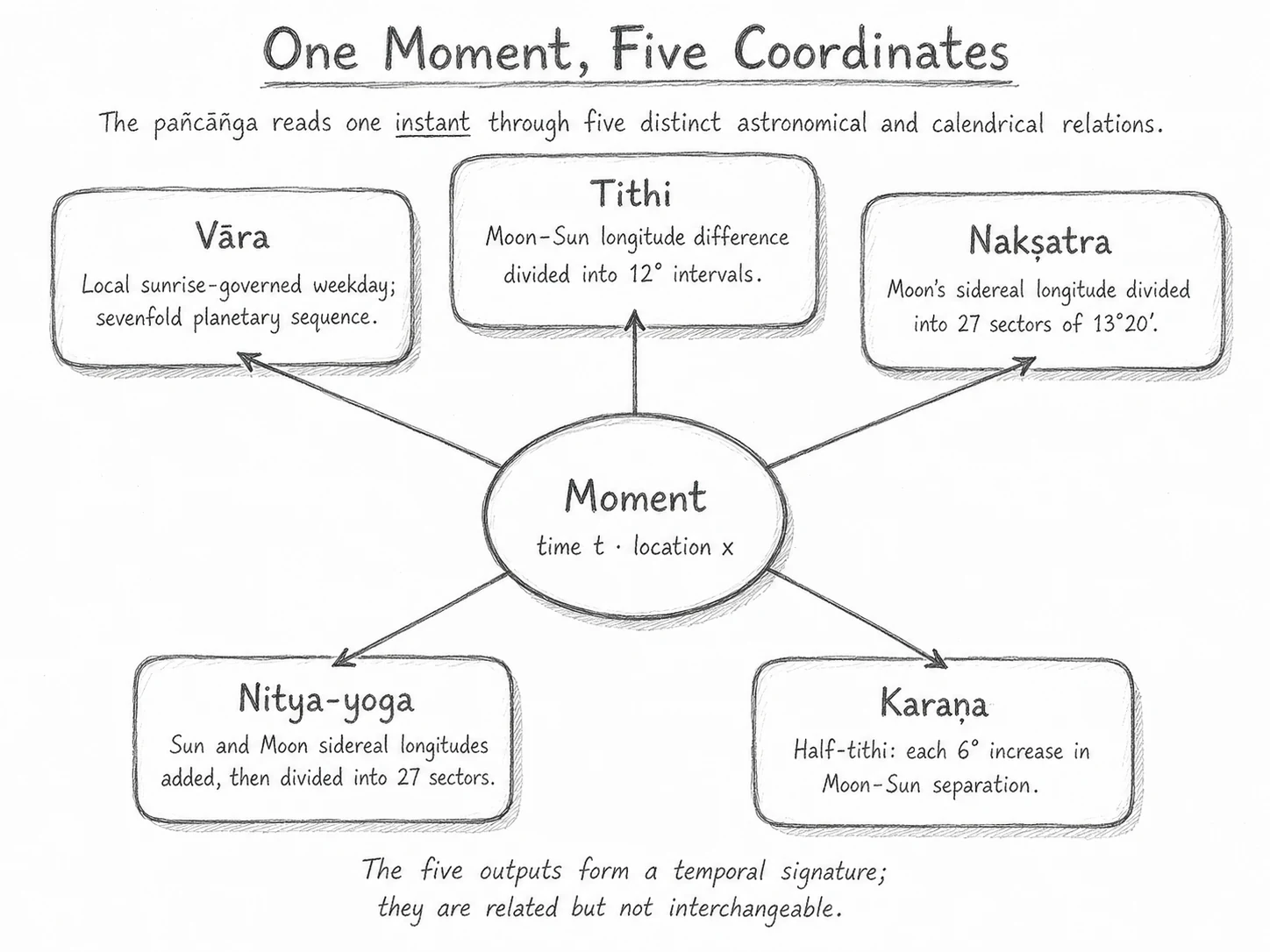
Figure 1. A pañcāṅga moment has several simultaneous coordinates. The limbs are related because they are computed for the same instant, but they are not interchangeable.
Before the five limbs: why ritual required a calendar
The intellectual premise of Jyotiṣa is stated with unusual economy in the opening of the Vedāṅga Jyotiṣa:
vedā hi yajñārtham abhipravṛttāḥ kālānupūrvyā vihitāś ca yajñāḥ | tasmād idaṃ kālavidhānaśāstraṃ yo jyotiṣaṃ veda sa veda yajñam ||
The Vedas are directed toward yajña, the rites are prescribed in temporal sequence, and therefore the discipline that orders time is necessary for understanding yajña.[2]
This statement is often cited to establish the ritual origin of Indian astronomy. Its more important implication is methodological. A rite is not specified adequately by describing what is to be offered and to whom. Its temporal relation is part of the act. A new-moon rite performed after the relevant lunar relation has passed is not simply the same rite on another date. The time belongs to the definition.
The early temporal archive did not consist of a five-column almanac. It included season, month, fortnight, lunar phase, nakṣatra, parvan, sunrise, sunset and ritual junctions. New and full moon sacrifices established especially prominent lunar pivots. The nakṣatras supplied a stellar sequence. The year required adjustment because lunar months and the solar seasonal cycle do not remain aligned without intercalation.[3]
The Vedāṅga Jyotiṣa addresses this coordination through a five-year yuga. Its parameters are not identical to those used by later siddhāntic astronomy, and its surviving recensions are terse enough to sustain disagreement in interpretation. Even so, the work clearly belongs to a stage in which the calendar has become numerical. Lunar days, nakṣatras, seasons and intercalary adjustments can be placed within a rule-governed cycle.[4]
What is still absent is equally instructive. The complete later pañcāṅga cannot simply be read backward into Lagadha’s text. The history reconstructed by Indian historians of astronomy suggests a gradual assembly: lunar and stellar measures were foundational; the weekday, karaṇa classifications and nitya-yoga entered or acquired their mature form through subsequent astronomical and muhūrta literature.[5]
This is not a story of replacement. Later elements did not abolish the earlier calendar. They increased its dimensionality.
A tithi tells us the Moon’s phase relation to the Sun. It does not tell us which nakṣatra the Moon occupies. Nakṣatra supplies that stellar coordinate but not the half-tithi through which the moment is passing. Vāra introduces the local solar-day sequence. Yoga derives a second luni-solar index from the sum rather than the difference of longitudes. Karaṇa doubles the resolution of tithi for the classification of action.
The pañcāṅga emerged when these separate answers were treated as parts of one temporal description.
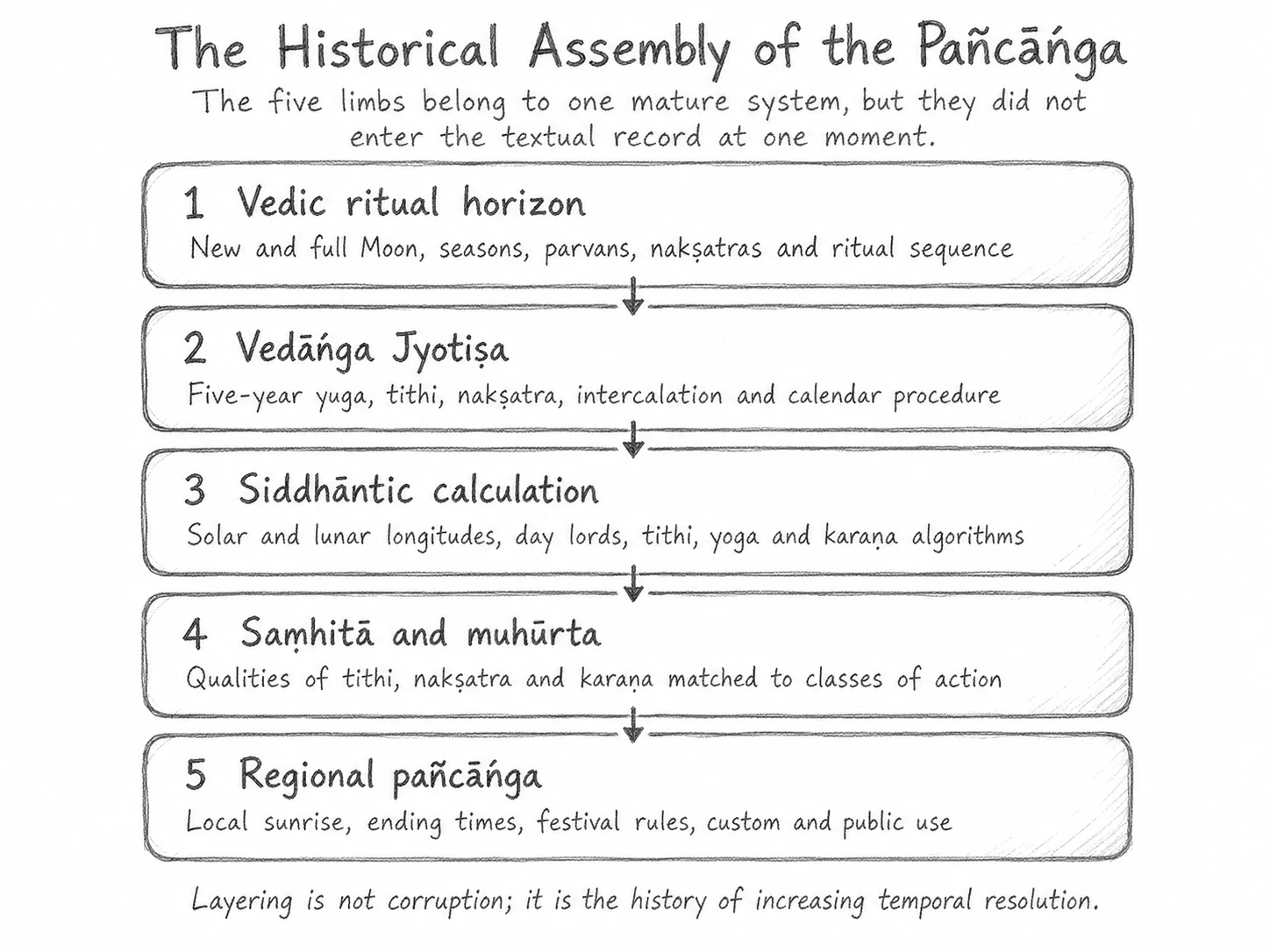
Figure 2. The five-limbed almanac is historically layered. Vedic ritual time, calendrical astronomy, siddhāntic longitude and muhūrta classification should not be collapsed into a single moment of invention.
One instant, five questions
The technical structure can be expressed through two geocentric sidereal longitudes:
- λS: the longitude of the Sun;
- λM: the longitude of the Moon.
The pañcāṅga does not use these values in only one way.
Vāra asks: which sunrise-governed day is running?
Vāra belongs to the repeating seven-day sequence. In traditional almanac use the day is normally reckoned locally from sunrise to the following sunrise, though particular rites may attend to other junctions such as sunset, pradoṣa or midnight.[6]
Tithi asks: how far has the Moon separated from the Sun?
The relevant quantity is the eastward difference:
D = (λM − λS) mod 360°
Each interval of 12 degrees is one tithi:
tithi number = floor(D ÷ 12°) + 1
Nakṣatra asks: where is the Moon in the sidereal circle?
In the standardized twenty-seven-fold system, the Moon’s longitude is divided by 13°20′:
nakṣatra number = floor(λM ÷ 13°20′) + 1
Nitya-yoga asks: what is the combined sidereal progress of Sun and Moon?
The relevant quantity is their sum:
Y = (λM + λS) mod 360°
The circle is again divided into twenty-seven intervals of 13°20′:
yoga number = floor(Y ÷ 13°20′) + 1
Karaṇa asks: which half of the tithi is running?
Each increase of 6 degrees in the Sun–Moon difference completes one karaṇa:
karaṇa segment = floor(D ÷ 6°) + 1
The sixty half-tithis of a synodic month are assigned eleven recurring names according to a fixed sequence.
These equations show why the five limbs cannot be reduced to “five auspicious factors.” Vāra is tied to local sunrise and a sevenfold sequence. Tithi and karaṇa use the difference of solar and lunar longitude. Nakṣatra uses the Moon alone. Yoga uses the sum of solar and lunar longitude. The same Moon and Sun generate several coordinates because the questions are different.
A useful analogy is not a clock with five hands pointing to the same scale. It is a field instrument with five dials, each calibrated to a separate relation.
Vāra: the day as recurrence and rulership
The weekday appears to be the simplest limb because its names are familiar: Ravi or Āditya, Soma, Maṅgala, Budha, Guru or Bṛhaspati, Śukra and Śani. Yet even vāra contains a distinction that a numbered date can conceal. Its practical boundary is local.
The Sūrya Siddhānta gives a procedure for identifying the ruler of the running day from the count of elapsed terrestrial days. The Bṛhat Saṃhitā, in describing the qualifications of an astronomer, distinguishes several kinds of day and expects knowledge of their computation. The sāvana day is treated as the interval from one sunrise to the next.[7]
This sunrise boundary is not merely a quaint convention. It joins the abstract sevenfold sequence to a place on Earth. Sunrise occurs at a different absolute instant for different longitudes and varies seasonally. Vāra is therefore not fully specified by naming a twenty-four-hour interval detached from location.
The planetary names of the weekdays also turn recurrence into a qualitative sequence. In muhūrta literature, the lord of the day contributes a field of association: solar authority, lunar nourishment, martial force, mercurial exchange, Jovian counsel, Venusian agreement, Saturnine endurance or restraint. These associations do not operate alone. A Thursday containing an unsuitable tithi or karaṇa is not automatically suitable for every undertaking. Vāra is one contribution to a composite judgment.
The later habit of listing one “good” and one “bad” weekday for an activity often removes this context. Classical electional reasoning is combinatory. The day-lord may support the act, be neutral to it, or be overridden by stronger defects and strengths elsewhere in the temporal configuration.
Historically, vāra also reminds us that the five limbs do not share one antiquity. The seven-day planetary sequence is not a central feature of the Vedāṅga Jyotiṣa. It becomes securely integrated in later astronomical and astrological practice. The mature pañcāṅga is therefore a synthesis of inherited lunar-stellar time and subsequently established cyclic conventions.[8]
Its distinctive achievement is not that every component was invented simultaneously in one school. It is that components of different origin were made computationally compatible.
Tithi: an angle that refuses to behave like a date
Tithi is frequently translated as “lunar day.” The translation is serviceable so long as day is not understood to mean a fixed twenty-four-hour container.
The Sūrya Siddhānta defines the procedure by subtracting the Sun’s place from the Moon’s place and dividing the resulting arc by 720 minutes, or 12 degrees. The quotient gives completed tithis; the remainder gives the portion elapsed in the running tithi.[9]
A tithi begins and ends when the Sun–Moon elongation crosses a multiple of twelve degrees. Its boundary can occur at dawn, noon, evening or night. Because the apparent motions of the Sun and especially the Moon vary, tithis are not equal in duration. A tithi can begin after one sunrise and end before the next; another can extend across two sunrises.[10]
This produces two calendrical phenomena often misunderstood as irregularities in the almanac.
A kṣaya tithi is not “missing” from the sky. It begins and ends between two consecutive sunrises and therefore does not appear as the tithi prevailing at sunrise on either civil day. A vṛddhi or repeated tithi spans two sunrises and consequently appears on two successive almanac days.[11]
The distinction between astronomical existence and calendrical naming is crucial. The tithi exists as an angular interval whether or not a sunrise falls within it. The printed almanac must decide how to associate that interval with a locally experienced day.
This is why festival determination cannot be reduced to looking for a number beside a date. Different observances require the tithi to prevail at a relevant part of the day: sunrise, aparāhna, pradoṣa, niśītha or another ritual interval. The rule follows the structure of the rite. A night vigil and an afternoon ancestral offering do not ask the same temporal question.[12]
The fifteen tithis of each pakṣa are also classified. Varāhamihira’s Bṛhat Saṃhitā groups them cyclically as Nandā, Bhadrā, Jayā or Vijayā, Riktā and Pūrṇā. The first, sixth and eleventh belong to the Nandā class; the second, seventh and twelfth to Bhadrā; the third, eighth and thirteenth to Jayā; the fourth, ninth and fourteenth to Riktā; the fifth, tenth and fifteenth to Pūrṇā.[13]
The names are functional rather than merely decorative:
- Nandā carries increase, delight or growth;
- Bhadrā carries welfare, steadiness or auspicious settlement;
- Jayā/Vijayā carries overcoming and victory;
- Riktā, literally empty, suits reduction, clearance or acts not requiring accumulation;
- Pūrṇā carries completion or fullness.
Varāhamihira also assigns deities to the individual tithis and recommends actions consonant with their fields. The system does not say that a Riktā tithi is metaphysically evil. It says that its quality is poorly matched to acts requiring plenitude and may be better matched to acts of removal or confrontation.[14]
This is one of the central principles of muhūrta: suitability is relational. A surgeon’s incision, a seed planting, a coronation and a debt settlement do not seek the same temporal character.
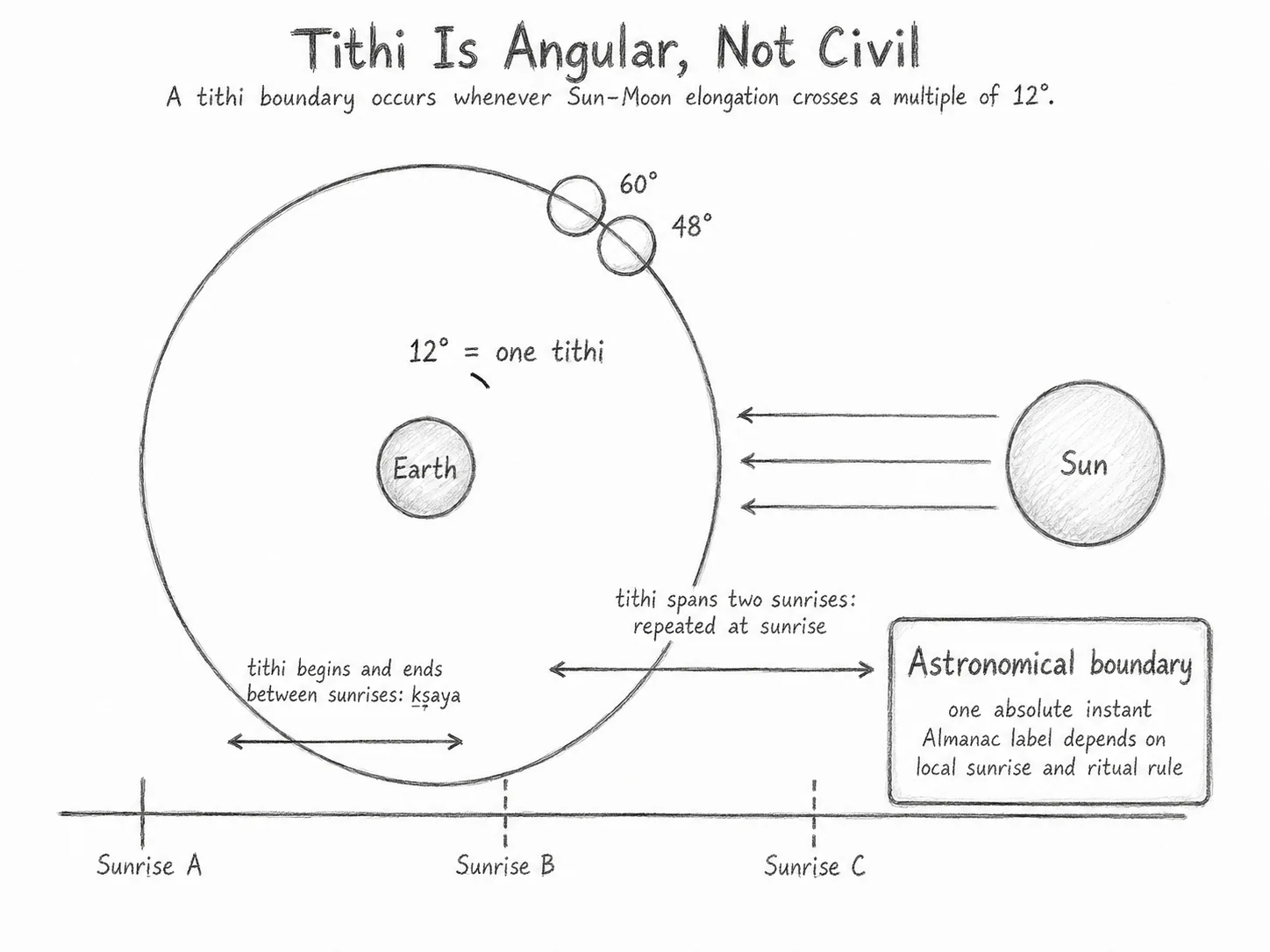
Figure 3. A tithi is completed by 12 degrees of increasing Sun–Moon separation. Sunrise samples the running tithi locally; it does not create the tithi boundary.
Nakṣatra: the Moon’s address in the stellar field
The preceding article in this series examined the nakṣatra system at length. Only the elements necessary for the pañcāṅga need be repeated here.
In the mature equal-sector scheme, the sidereal circle is divided into twenty-seven intervals of 13°20′. The Moon’s longitude determines the running nakṣatra. The astronomical object should be distinguished from the visible asterism that supplied its name. A stellar marker, a named lunar station and an equal mathematical sector belong to one historical tradition but are not identical objects.[15]
Within the pañcāṅga, nakṣatra contributes a coordinate unavailable from tithi. Two moments can have the same tithi while the Moon occupies different nakṣatras. Conversely, the Moon can remain in one nakṣatra while the tithi changes, because tithi depends on the Moon’s changing separation from the moving Sun.
The difference can be stated simply:
- tithi asks where the Moon is relative to the Sun;
- nakṣatra asks where the Moon is relative to the sidereal circle.
Classical action taxonomies assign nakṣatras to stable, moving, light, soft, sharp, mixed and fierce classes. These classifications are linked to their deities and inherited semantic fields. A stable nakṣatra may suit foundations or planting; a moving one may suit travel; a sharp one may suit cutting or punitive action. The categories are not reducible to fortunate and unfortunate.[16]
In a pañcāṅga judgment, nakṣatra often supplies the broad mode of action while tithi supplies the phase-like condition of growth, victory, emptiness or completion. Their agreement can strengthen a choice. Their disagreement requires judgment rather than mechanical addition.
This is why the pañcāṅga cannot be used responsibly by counting favorable labels. A soft nakṣatra and a Riktā tithi do not produce a mathematically averaged “half-good” time. One asks whether the intended action requires softness, emptying, permanence, speed or some combination of these.
Nitya-yoga: the neglected geometry of the sum
Of the five limbs, yoga is the most frequently misdescribed. It is often explained as a conjunction, a vague planetary combination, or a general measure of auspiciousness. The technical definition is more precise.
The nitya-yoga is produced from the sum of the sidereal longitudes of the Sun and Moon. Once the sum reaches 360 degrees, the circle is reduced modulo 360. The resulting arc is divided into twenty-seven sectors of 13°20′, beginning with Viṣkambha.[17]
The Sūrya Siddhānta describes this operation by adding the places of the Sun and Moon, reducing the total to minutes and dividing by 800 minutes. The quotient gives the completed yogas; the remainder gives the elapsed portion of the current yoga.[18]
This is not the same as angular separation.
Suppose the Sun stands at 100 degrees and the Moon at 220 degrees.
The tithi quantity is:
220° − 100° = 120°
The yoga quantity is:
220° + 100° = 320°
The same pair of luminaries produces two different indices because one operation measures divergence and the other combined progress through the sidereal frame.
What does the sum mean conceptually? It should not be mistaken for the physical distance between the Sun and Moon. It is a constructed coordinate. As both bodies advance eastward, their longitudes contribute to a combined cycle. The twenty-seven nitya-yogas divide that cycle into named intervals.
This mathematical construction appears to be a later addition to the almanac than tithi and nakṣatra. The surviving historical record does not support the claim that the complete nitya-yoga system was already present in the earliest Vedic calendar. Indian scholarship on the development of the pañcāṅga places its clear technical incorporation in the later siddhāntic period; the received Sūrya Siddhānta contains the mature computation.[19]
The twenty-seven names—Viṣkambha, Prīti, Āyuṣmān, Saubhāgya, Śobhana and onward to Vaidhṛti—acquired interpretive values in muhūrta. Some are treated as supportive of welfare, continuity or accomplishment; others, especially Vyatīpāta and Vaidhṛti in many electional traditions, require caution or special handling.[20]
The historical lateness of the mature scheme does not make it less Indian or less integral to the pañcāṅga. It shows that the tradition continued to create new astronomical abstractions rather than preserving only inherited categories.
There is an intellectual elegance in the pairing:
- difference generates tithi;
- sum generates yoga.
The pañcāṅga reads the Moon–Sun relation in two directions at once.
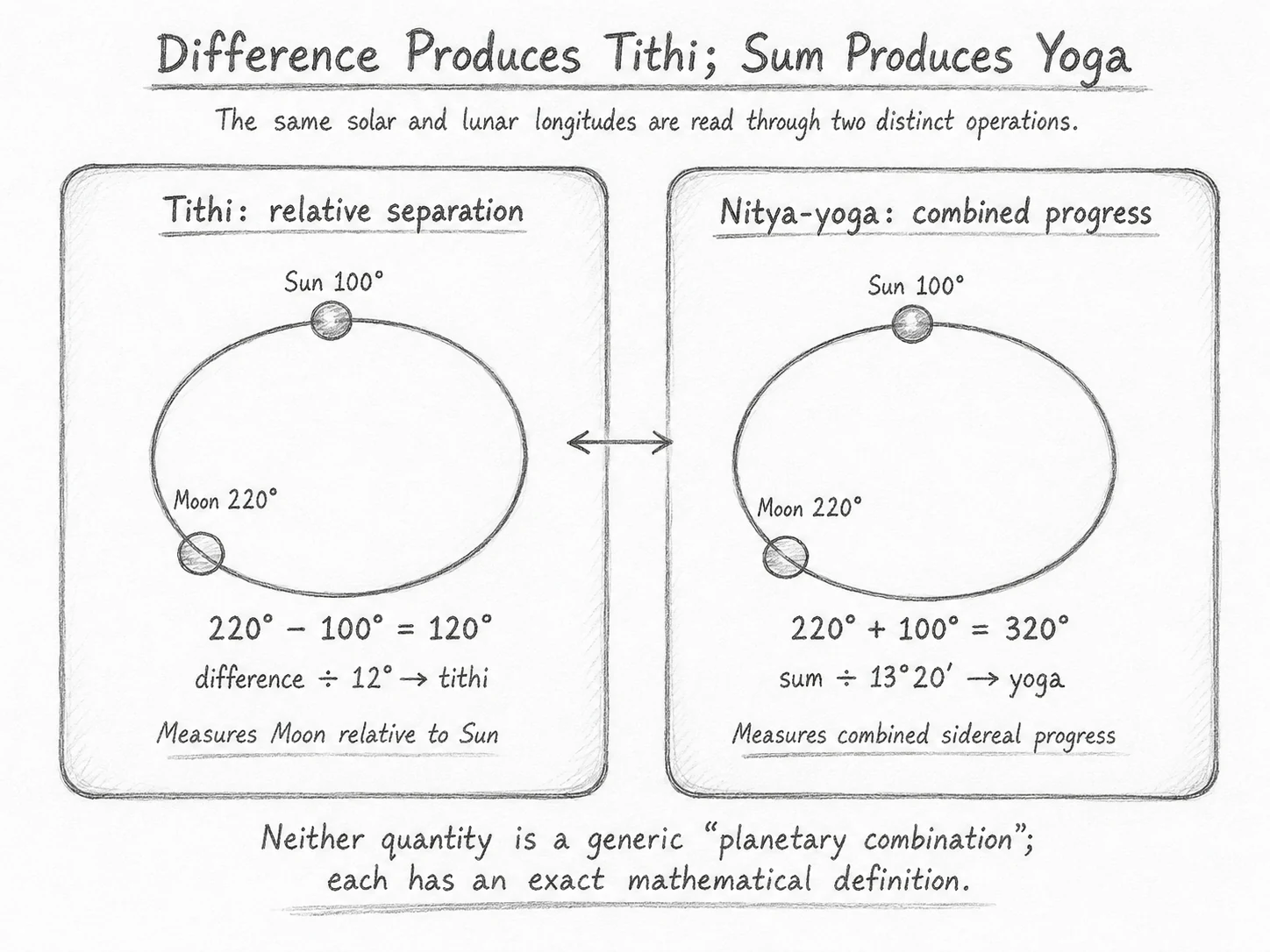
Figure 4. Tithi and nitya-yoga are both luni-solar, but they are generated by different operations. Confusing them erases the mathematical architecture of the pañcāṅga.
Karaṇa: the action-sized unit of lunar time
A karaṇa is half a tithi. Its boundary is crossed whenever the Sun–Moon difference increases by six degrees. There are therefore sixty karaṇa intervals in a synodic month.
Yet the tradition does not give sixty unique names. It uses eleven.
Four are fixed (dhruva or sthira):
- Śakuni;
- Catuṣpada;
- Nāga;
- Kiṃstughna.
Seven are movable (cara):
- Bava;
- Bālava;
- Kaulava;
- Taitila;
- Gara;
- Vaṇij;
- Viṣṭi, also called Bhadrā in many regional traditions.
The four fixed karaṇas occupy the month’s junction: from the latter half of Kṛṣṇa Caturdaśī through the first half of the next Śukla Pratipad. The seven movable karaṇas then repeat eight times through the remaining fifty-six half-tithis.[21]
The structure is worth pausing over:
4 fixed + (7 movable × 8 repetitions) = 60 karaṇas
This is not an arbitrary list attached to half-days. It is a cyclic coding system. The repeating sevenfold sequence supplies names to most of the lunation, while the four fixed karaṇas mark the closure and reopening of the monthly phase cycle.
Why divide tithi at all?
The answer becomes visible in electional practice. A tithi can last close to a day, sometimes more or less. Many actions require finer timing. Karaṇa supplies a sub-phase, allowing the first and second halves of the same tithi to carry different operational associations.
Varāhamihira’s chapter on the qualities of the karaṇas is explicit. Bava is assigned auspicious, health-producing and both temporary and enduring acts. Bālava supports religious or meritorious activity. Kaulava is connected with friendship and affection. Taitila supports popularity, shelter and domestic concerns. Gara is associated with cultivation, seeds and building. Vaṇij supports trade and durable transactions. Viṣṭi is unsuitable for ordinary beneficent undertakings but is assigned to hostile, coercive or destructive action.[22]
The fixed karaṇas receive their own fields: Śakuni for remedies, herbs and certain strategic acts; Catuṣpada for cattle, ancestors and political concerns; Nāga for forceful or severe undertakings; Kiṃstughna for meritorious and auspicious beginnings.[23]
These prescriptions belong to Varāhamihira’s social and ethical world. They should not be reproduced uncritically as instructions for contemporary harm. Their historical importance lies elsewhere. They show that karaṇa was conceived as the most immediately operative limb—the one concerned with what is being set in motion now.
The Sanskrit word karaṇa itself has a wide semantic field: doing, instrument, means, operation. Within the pañcāṅga it is tempting to hear that resonance. Tithi describes a lunar phase interval; karaṇa subdivides it into an action-sized unit.
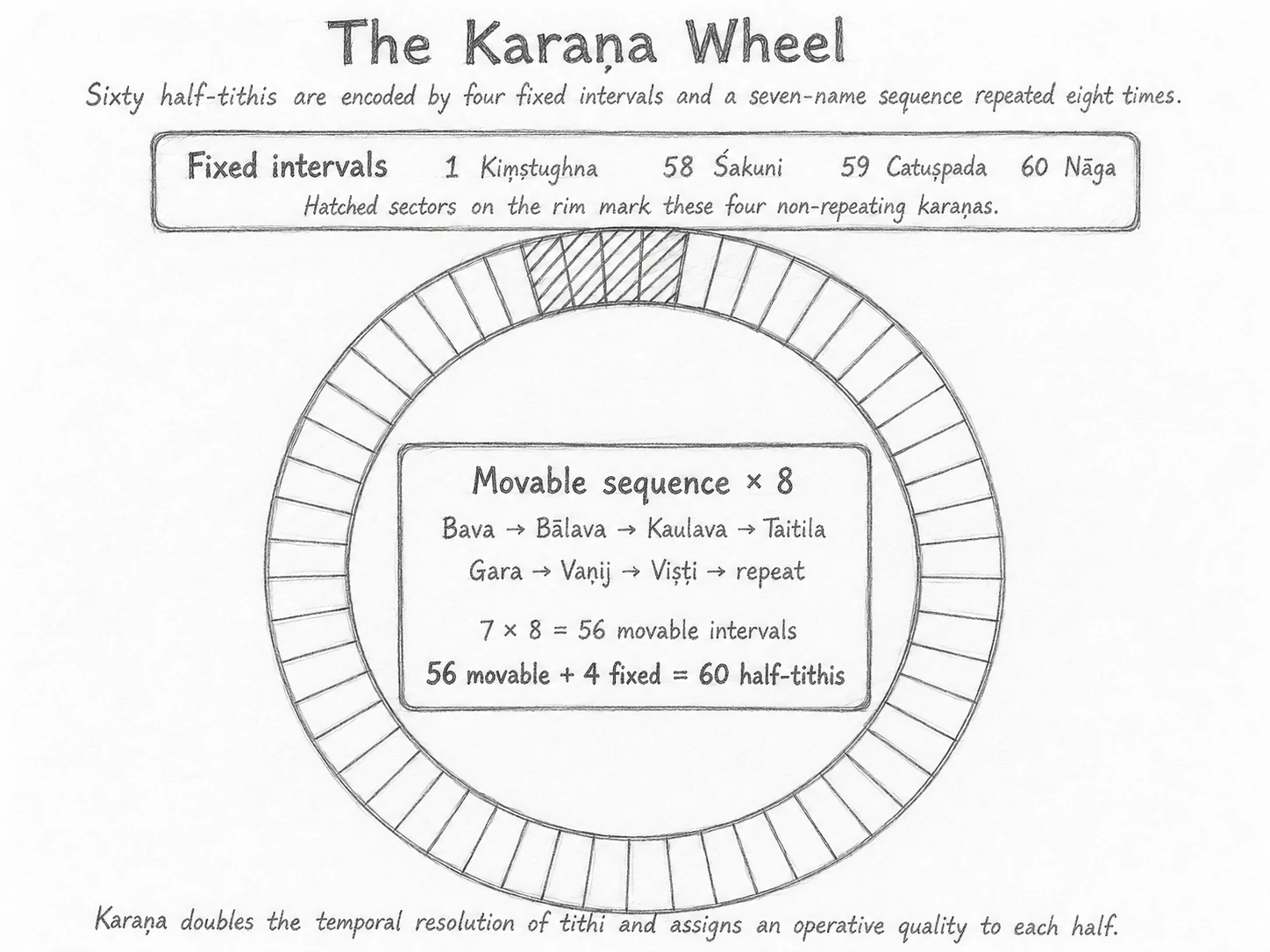
Figure 5. Sixty half-tithis are encoded by eleven names: four fixed karaṇas at the monthly junction and seven movable karaṇas repeated eight times.
A worked pañcāṅga moment
The distinctions become clearer through a hypothetical calculation.
Assume that, at a chosen instant and location:
- the sidereal longitude of the Sun is 102°40′;
- the sidereal longitude of the Moon is 157°10′;
- the local day is Guru-vāra.
Tithi
The Sun–Moon difference is:
157°10′ − 102°40′ = 54°30′
The interval from 48° to 60° is Śukla Pañcamī. The moment therefore falls in the fifth tithi of the waxing fortnight.
Karaṇa
Each karaṇa spans 6 degrees. A difference of 54°30′ lies in the segment from 54° to 60°, the second half of Pañcamī. In the standard sequence this is Bālava.
Nakṣatra
The Moon at 157°10′ lies between 146°40′ and 160°, the sector of Uttaraphālgunī.
Yoga
The longitude sum is:
102°40′ + 157°10′ = 259°50′
Dividing by 13°20′ places the moment in the twentieth nitya-yoga, Śiva.
Vāra
The local sunrise-to-sunrise day is Guru-vāra.
The moment’s pañcāṅga signature is therefore:
Guru-vāra – Śukla Pañcamī – Uttaraphālgunī – Śiva yoga – Bālava karaṇa
The line is not a sentence with five adjectives. It is the compact output of four astronomical operations and one local cyclical reckoning.
Interpretation begins after calculation. A muhūrta specialist would then ask what action is proposed, whether the Moon is otherwise strong, whether the relevant lagna can be chosen, whether the tithi and nakṣatra support the same kind of act, whether specific prohibitions apply, and whether local custom assigns the observance to another temporal anchor.
Calculation supplies the state. Judgment relates the state to the action.
The pañcāṅga as a temporal signature
It is useful to think of the five limbs as a vector:
P(t, x) = [V, T, N, Y, K]
Here t is the instant and x is the location required for the local day and sunrise. The notation is analytical rather than classical, but it clarifies the architecture. Two moments belong to the same tithi yet differ in nakṣatra or yoga. Two locations share the same absolute tithi boundary yet assign it differently to a sunrise-governed day. A karaṇa can change while the tithi remains unchanged.
The vector model also prevents a common mistake: treating auspiciousness as a score obtained by adding five independent positive or negative values.
Classical muhūrta is closer to pattern matching.
An action has properties:
- Should it endure or conclude quickly?
- Does it involve movement or settlement?
- Is it generative, contractual, medical, devotional, agricultural or destructive?
- Does it belong to day, evening or night?
- Is it tied to a particular deity, ancestor, season or life-cycle rite?
The pañcāṅga offers a temporal pattern. The practitioner seeks correspondence between the proposed action and that pattern.
Varāhamihira’s chapters on nakṣatra, tithi and karaṇa repeatedly use this logic. Actions appropriate to a deity or quality are assigned to times carrying the corresponding field. The object is not to locate a day upon which “everything will succeed.” No such day exists in the system. A time supporting permanence may be ill suited to emergency movement. A time supporting severance may be useful for removal and inappropriate for union.[24]
This is a more demanding theory than simple good-day selection. It requires description of the act before judgment of the time.
The best question is therefore not “Is this muhūrta auspicious?” but:
Auspicious for what, for whom, at which phase of the action, and under which regional rule?
Sunrise, locality and the problem of the printed day
The celestial longitudes used for tithi, nakṣatra and yoga are computed for instants. The almanac is printed by days. Moving from one to the other requires a convention.
Sunrise supplies the dominant anchor. A regional pañcāṅga usually lists the limbs prevailing at local sunrise and gives their ending times. Because sunrise depends on latitude, longitude and season, an almanac prepared for one city cannot be transferred without adjustment to a distant location when precision matters.[25]
Tithi itself does not begin separately in each city. Its angular boundary corresponds to one astronomical instant. What changes is the local clock reading and its relation to sunrise. The same tithi may be present at sunrise in one region and absent at sunrise in another.
The issue becomes more complex for festivals. A rule may require the tithi at sunrise, during aparāhna, at pradoṣa or during niśītha. When two tithis touch the required interval, dharma and nibandha literature supplies precedence rules. Regional traditions can differ because they follow different textual authorities or month systems.[26]
This is why two reputable pañcāṅgas can occasionally assign an observance to different civil days without one of them having made a simple arithmetic error. The disagreement may arise from:
- the astronomical parameters or ephemeris used;
- the adopted sidereal reference;
- the definition and computation of sunrise;
- the location for which the almanac was prepared;
- the rule used when a tithi overlaps a prescribed ritual interval;
- amānta or pūrṇimānta month reckoning;
- regional deśācāra and inherited decision texts.
Some differences are computational and can be audited. Others are jurisprudential: they concern which rule should govern the rite. Calling all variation “inaccuracy” misunderstands the relationship between astronomy and dharma.
The astronomer determines when the celestial boundary occurs. The ritual authority determines which occurrence satisfies the action’s temporal condition.
From computed sky to lived body
The pañcāṅga becomes socially powerful only when its abstractions alter behaviour.
A tithi can schedule fasting or feasting. A nakṣatra can determine a naming rite or temple observance. A vāra may shape weekly worship. Amāvāsyā can reorganize ancestral practice; pūrṇimā can produce night vigils, pilgrimage or communal gathering. Agricultural communities may align sowing, transplanting or ritual preparation with lunar and stellar conditions. The almanac therefore enters the body through meals, sleep, movement, exposure to light, emotional expectation and collective rhythm.
This distinction is essential when discussing physiological effects.
An observed bodily difference on a festival tithi need not be caused directly by a remote celestial force. It may result from fasting, altered meal timing, reduced sleep, prolonged recitation, night-time illumination, travel, social gathering or expectation. These are not distractions from the calendar’s influence. They are among the ways calendrical time becomes embodied.
Indian medicine already treats time as clinically relevant through dinacaryā and ṛtucaryā: daily and seasonal routines are adjusted to the changing condition of body and environment. The pañcāṅga is not a medical treatise, and its five limbs should not be converted casually into doṣa diagnoses. Yet both traditions share an aversion to temporally indifferent action. Food, sleep, cleansing, exercise, medicine and ritual are not assumed to have identical effects at every season and hour.[27]
A research programme on pañcāṅga and physiology should therefore separate at least three pathways:
- astronomical environment — moonlight, season, temperature and timing of sunrise;
- calendar-mediated behaviour — fasting, vigil, travel, worship and social synchronization;
- interpretive expectation — the psychological effect of believing a time is charged, restricted or supportive.
The pathways can interact. They should not be collapsed into a single claim that “tithi affects the body.”
The strongest proposition is more precise:
A calendrical system can become physiological when it repeatedly organizes human behaviour around celestial cycles.
That claim is historically plausible and empirically testable.
Muhūrta is not fatalism
Electional astrology is sometimes described as the belief that a perfect moment guarantees success. The classical material is less absolute.
A muhūrta is an attempt to begin action under conditions judged consonant with its purpose. It does not remove deficient skill, unethical intention, inadequate resources, illness, weather, opposition or chance. Varāhamihira’s own encyclopedic work places celestial timing beside architecture, agriculture, water detection, animal behaviour, polity and observation. Timing belongs within a field of causes.[28]
The agricultural analogy is useful. A farmer chooses a season and soil condition suitable for a crop. The choice matters, but it does not manufacture germination without seed, water and labour. Likewise, muhūrta seeks a supportive temporal environment. The act still requires competent agency.
The language of phala reinforces this point. Fruit arises through seed, field, nourishment, damage, season and time. Jyotiṣa often privileges temporal condition because that is its own domain, just as medicine privileges constitution and pathology. Neither domain logically excludes the others.
A serious recovery of pañcāṅga practice should therefore resist two exaggerations:
- that the five limbs mechanically cause every outcome;
- that, because they do not guarantee outcomes, they have no practical meaning.
Their historical function is advisory. They help communities coordinate action, remember obligations, select ritual intervals and interpret temporal fit.
What the pañcāṅga preserves that a simple calendar loses
A simple calendar is optimized for stable enumeration. The pañcāṅga preserves dynamic transitions.
It records that:
- a tithi may end at 10:43 rather than at midnight;
- a nakṣatra may change in the afternoon;
- a yoga may conclude before sunrise the next day;
- two karaṇas ordinarily occur within one tithi;
- the day begins locally at sunrise;
- an observance may depend on which limb prevails during a specified segment of the day.
The document is therefore closer to an ephemeris joined to a ritual decision system than to a grid of numbered boxes.
It also preserves multiple scales of time. A traditional saṅkalpa may locate the performer within cosmological, historical, seasonal, monthly, fortnightly, daily and stellar cycles. The act is spoken from a place inside nested time rather than from an isolated date.[29]
This nesting helps explain why the pañcāṅga remains culturally resilient. It is not used only to remember appointments. It links domestic action with temple calendars, ancestral rites, local festivals, agricultural seasons and narratives of cosmic order.
The almanac mediates between calculation and memory. Its tables may be produced by specialists, but its outputs enter oral culture: the name of the year, the pakṣa, the tithi, the nakṣatra, the time of moonrise, the beginning of a vrata, the closing of a festival.
The pañcāṅga is thus both technical and public. Its authority depends upon computation; its survival depends upon use.
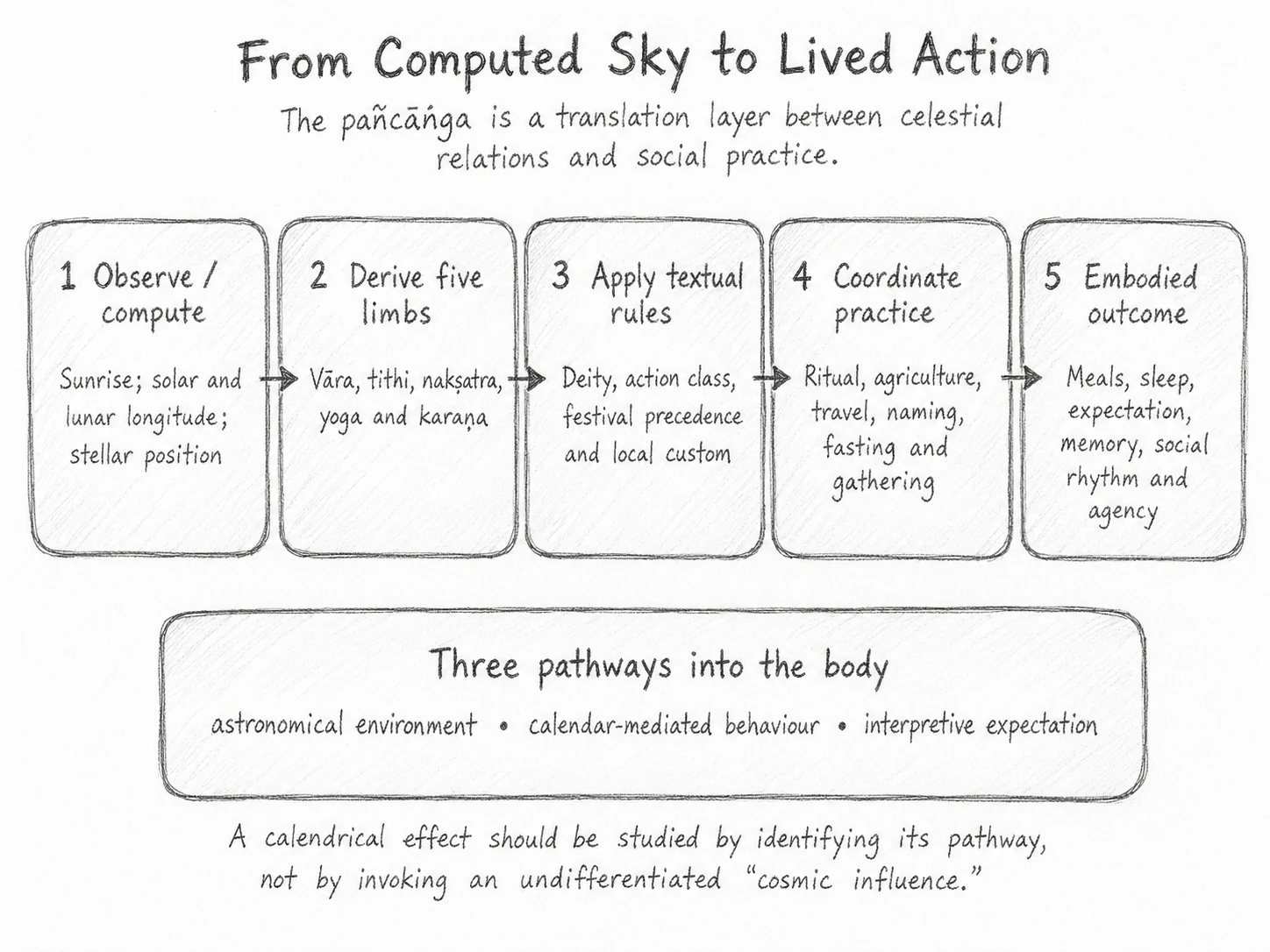
Figure 6. The pañcāṅga is a translation layer. Astronomical relations are computed, classified and then embodied through ritual, agriculture, social coordination and personal discipline.
A research programme for the five-limbed calendar
The pañcāṅga is unusually suitable for interdisciplinary study because its astronomical quantities are explicit while its interpretations are culturally dense. A rigorous programme would proceed in several stages.
1. Establish the textual chronology of each limb
The first task is not to prove that all five limbs are Vedic. It is to identify when each is attested and in what form.
A source matrix should distinguish:
- Vedic references to new and full moon, parvan, nakṣatra and ritual sequence;
- the tithi and nakṣatra procedures of the Vedāṅga Jyotiṣa;
- early evidence for vāra and karaṇa;
- the emergence of the twenty-seven nitya-yogas;
- the siddhāntic algorithms preserved in the received Sūrya Siddhānta;
- the action classifications of Bṛhat Saṃhitā chapters 98–100;
- later muhūrta and festival-decision literature.
Every claim should be tagged by genre. A mathematical rule, a deity assignment, a festival rule and a natal interpretation are not the same kind of evidence.
2. Build a reproducible computational model
The formulas for tithi, nakṣatra, yoga and karaṇa can be implemented directly from sidereal solar and lunar longitude. A research implementation should declare:
- ephemeris source;
- sidereal reference or ayanāṃśa;
- geocentric or topocentric treatment where relevant;
- sunrise definition;
- geographic coordinates;
- rounding rules;
- treatment of boundary instants.
Historical algorithms can then be compared with contemporary astronomical computation without assuming that one text represents all regional traditions.
3. Audit disagreement among almanacs
A multi-year corpus of regional pañcāṅgas could be compared limb by limb. Disagreements should be classified rather than merely counted:
- longitude difference;
- sunrise difference;
- textual festival rule;
- month convention;
- typographical error;
- deliberate regional practice.
Such a study would reveal where contemporary variation is astronomical and where it is juridical or customary.
4. Test action-specific predictions
Muhūrta claims should be formulated prospectively. “Auspicious outcome” is too elastic. A study might ask whether tasks begun under a particular class of nakṣatra and karaṇa differ in completion time, error rate or durability, with the outcome defined in advance.
The exercise would be difficult. Human selection introduces confounding: people may reserve important tasks for preferred times and bring greater preparation and confidence to them. That influence is itself worthy of study, but it must be separated from an astronomical effect.
5. Study calendar-mediated physiology
Longitudinal studies could compare fasting and non-fasting tithis, full and new moon observances, sleep during night vigils, meal timing, mood and heart-rate variability. The pañcāṅga variables should be modelled separately. Tithi, lunar illumination and nakṣatra are not synonyms.
The aim should not be to validate every traditional prescription at once. It should be to identify the pathway by which temporal practice affects the body.
6. Document the knowledge of pañcāṅga makers
The production of an almanac involves more than applying formulas. Practitioners inherit regional tables, correction procedures, festival-decision texts and conventions for communicating transitions. Oral interviews and manuscript study could preserve this knowledge before software interfaces make the intermediate reasoning invisible.[30]
A calculation can be automated while the rule governing its use is forgotten. Documentation should capture both.
The five limbs as an Indian philosophy of relation
The pañcāṅga rests on an idea that is easy to overlook because it is expressed through tables: a moment has no single astronomical identity.
The Sun rises locally and establishes vāra. The Moon separates from the Sun and establishes tithi. It moves through the sidereal field and establishes nakṣatra. The two longitudes are added to establish yoga. Their difference is halved to establish karaṇa. None of these operations alone exhausts the moment.
This is not philosophical speculation placed upon astronomy after the fact. The philosophy is present in the computation. Time is known through relation:
- luminary to horizon;
- Moon to Sun;
- Moon to stars;
- combined luminary motion to the sidereal circle;
- action to a sub-phase of the lunation.
The system therefore avoids two simplifications.
First, it does not treat the sky as a set of isolated objects exerting independent influences. The operative quantities are often relational. Tithi and yoga do not belong to the Moon or Sun separately.
Second, it does not treat human action as temporally neutral. The same act begun under another temporal configuration is regarded as differently situated, even when the duration available to perform it is identical.
Whether every inherited interpretation is empirically defensible is a separate question. The architecture itself deserves accurate description before judgment.
Conclusion: the day has an anatomy
The pañcāṅga is often opened to answer a practical question: When is Ekādaśī? Which nakṣatra is running? At what time does a tithi end? Is the proposed hour suitable for a journey or ceremony?
Behind those questions lies a substantial intellectual construction.
Vāra anchors recurrence to local sunrise and planetary sequence. Tithi measures the widening and closing relation of Moon and Sun. Nakṣatra locates the Moon within the sidereal field. Nitya-yoga converts the sum of solar and lunar longitude into a second twenty-seven-fold cycle. Karaṇa divides the tithi into an operative half-phase. Their combination transforms a date into a temporal signature.
The system did not arise in one stroke. Vedic ritual supplied the need to order action. Early calendrical astronomy coordinated lunar and seasonal cycles. Siddhāntic mathematics made longitude computable. Saṃhitā and muhūrta literature classified the kinds of action suited to different temporal fields. Regional almanacs translated those procedures into public life.
The pañcāṅga should therefore be approached neither as a collection of superstitious labels nor as a document in which every rule carries equal proof. It is an archive of Indian attempts to coordinate sky, action and memory. Some of its quantities are directly calculable. Some of its interpretations are historical conventions. Some may encode ecological or behavioural experience. Others require testing and may not survive it.
Its enduring insight is more fundamental than any single prescription:
A day is not exhausted by its number. It has an anatomy.
To read the pañcāṅga is to examine that anatomy—one limb at a time, and then as a living whole.
Primary-source matrix
| Source or textual layer | Principal temporal material | Relevance to the five limbs | Methodological caution |
|---|
| Vedic Saṃhitā and Brāhmaṇa literature | New and full moon rites, seasons, parvans, nakṣatras, ritual sequence | Establishes the ritual necessity of celestial timing | Does not contain the complete later five-limbed system in one standardized form |
| Vedāṅga Jyotiṣa of Lagadha | Five-year yuga, tithi, nakṣatra, parvan, intercalation, seasonal coordination | Early formal calendrical astronomy | Recensions are terse; dating and interpretation remain debated |
| Sūrya Siddhānta | Computation of weekday lords, tithi, yoga and karaṇa; division of circle and stellar longitudes | Supplies mature mathematical procedures | The received text is layered and revised; not every verse belongs to one historical moment |
| Varāhamihira’s Bṛhat Saṃhitā, chs. 2, 98–100 | Qualifications of astronomer; action classes of nakṣatra, tithi and karaṇa | Shows the joining of calculation and qualitative action | Social and ethical prescriptions reflect their historical setting |
| Muhūrta and nibandha literature | Pañcāṅga-śuddhi, festival precedence, election of actions | Converts five limbs into decision rules | Regional authorities and practices differ |
| Regional pañcāṅgas and computational traditions | Sunrise, limb-ending times, festivals, eclipses and local observances | Public operational form of the system | Requires location, parameters and interpretive convention to be stated |
Glossary
Aparāhna — the later part of the day, important in the timing of some rites.
Ayanāṃśa — the angular offset used to relate a sidereal reference to the moving equinoctial framework; different adopted values can produce small differences in sidereal longitude.
Karaṇa — half a tithi, defined by six degrees of Sun–Moon elongation.
Kṣaya tithi — a tithi that begins and ends between two consecutive sunrises and is therefore absent from the sunrise labels of successive almanac days.
Muhūrta — a time interval and, more broadly, the discipline of selecting a time suited to an action.
Nakṣatra — a lunar station; in the standardized system, one of twenty-seven equal sidereal sectors of 13°20′.
Nitya-yoga — one of twenty-seven intervals derived from the sum of the sidereal longitudes of the Sun and Moon.
Pañcāṅga — “five-limbed” almanac composed of vāra, tithi, nakṣatra, yoga and karaṇa.
Pakṣa — the waxing or waning half of the lunar month.
Parvan — a temporal joint or marked lunar occasion, especially new and full moon in early ritual contexts.
Pradoṣa — the evening period around and after sunset, ritually significant for some observances.
Tithi — one of thirty divisions of a synodic month, defined by twelve degrees of Sun–Moon elongation.
Vāra — weekday, conventionally reckoned in the pañcāṅga from local sunrise to the next sunrise.
Vṛddhi tithi — a tithi that spans two consecutive sunrises and is listed on two almanac days.
Notes and sources
[1] Shakti Dhara Sharma, “Development of Pañcāṅga from Vedic Times up to the Present,” Bulletin of the Astronomical Society of India 26 (1998): 75–90. The article is useful for distinguishing the historical entry of the five elements rather than treating them as contemporaneous.
[2] Lagadha, Vedāṅga Jyotiṣa, opening verses. See T. S. Kuppanna Sastry, trans., K. V. Sarma, ed., Vedāṅga Jyotiṣa of Lagadha in Its Ṛk and Yajus Recensions (New Delhi: Indian National Science Academy, 1985).
[3] See the darśapūrṇamāsa material in the Yajurvedic ritual corpus and the nakṣatra lists in Taittirīya Saṃhitā 4.4.10, Taittirīya Brāhmaṇa 3.1 and Atharvaveda 19.7. The sources have distinct ritual and textual functions and should not be homogenized.
[4] Vedāṅga Jyotiṣa, verses and reconstructed procedures concerning the five-year yuga, parvans, tithis, seasons and intercalation; Sastry and Sarma, 1985.
[5] Sharma, “Development of Pañcāṅga”; Śaṅkara Bālakṛṣṇa Dīkṣita, Bhāratīya Jyotiḥśāstra, English trans. R. V. Vaidya, History of Indian Astronomy, 2 vols. (New Delhi: India Meteorological Department, 1969–1981).
[6] S. Balachandra Rao, Indian Astronomy: An Introduction (Hyderabad: Universities Press, 2000), sections on Indian time measures and almanac computation.
[7] Sūrya Siddhānta, chapter 1, on determining the lord of the day from elapsed terrestrial days; Varāhamihira, Bṛhat Saṃhitā 2.5–7, on the astronomer’s knowledge of solar, sāvana, lunar and stellar measures of time.
[8] Sharma, “Development of Pañcāṅga”; Dīkṣita, History of Indian Astronomy, discussion of vāra in calendrical literature.
[9] Sūrya Siddhānta 2.66: subtract the Sun’s longitude from the Moon’s, reduce to arcminutes and divide by 720 minutes to obtain elapsed tithis and the portion of the current tithi.
[10] Rao, Indian Astronomy: Concepts and Procedures (Bangalore: M. P. Birla Institute of Management, 2000), chapters on tithi and pañcāṅga; also R. C. Gupta, studies of Indian calendrical computation in the Indian Journal of History of Science.
[11] The terms tithi-kṣaya and repetition arise from the relation between variable tithi duration and sunrise-based calendrical labeling. See Sūrya Siddhānta 1.35–37 and standard Indian calendar manuals.
[12] P. V. Kane, History of Dharmaśāstra, vol. 5, sections on festivals and calendrical determination; regional nibandhas such as Dharma-sindhu and Nirṇaya-sindhu preserve detailed precedence rules.
[13] Varāhamihira, Bṛhat Saṃhitā 99.1–3, in V. Subrahmanya Sastri and M. Ramakrishna Bhat, trans., Bṛhat Saṃhitā of Varāhamihira (Bangalore, 1946–47; later reprints).
[14] Bṛhat Saṃhitā 99, on the deities, five recurring tithi classes and actions associated with the lunar days.
[15] See Part II of this series, “When the Moon Entered the Stars”, and Sūrya Siddhānta 12.25 on division of the circle into twenty-seven nakṣatras; chapter 8 on principal stars and their coordinates.
[16] Varāhamihira, Bṛhat Saṃhitā 98, on the functions and properties of the nakṣatras.
[17] The twenty-seven nitya-yogas are conventionally ordered from Viṣkambha to Vaidhṛti. Their names and classifications are preserved in siddhāntic and muhūrta traditions.
[18] Sūrya Siddhānta 2.65: add the places of the Sun and Moon, reduce the total to arcminutes and divide by 800 minutes to determine the elapsed yoga and its remaining portion.
[19] Sharma, “Development of Pañcāṅga,” especially the discussion of yoga as a later component; the received Sūrya Siddhānta reflects textual development and revision rather than a single date of composition.
[20] See Rāma Daivajña, Muhūrta Cintāmaṇi, introductory and pañcāṅga sections, with the caution that manuscripts and regional commentaries differ.
[21] Sūrya Siddhānta 2.67–68, on the four fixed and seven movable karaṇas and their sequence through the lunar month.
[22] Varāhamihira, Bṛhat Saṃhitā 100.1–4, on the lords and functions of the movable karaṇas.
[23] Bṛhat Saṃhitā 100.5 and surrounding verses on the fixed karaṇas and their prescribed classes of action.
[24] Bṛhat Saṃhitā 98–100. The three chapters are best read together because nakṣatra, tithi and karaṇa are matched to actions through different but overlapping qualities.
[25] Rao, Indian Astronomy: Concepts and Procedures, on local sunrise and pañcāṅga construction. A technically useful pañcāṅga must state or imply the reference location.
[26] Kane, History of Dharmaśāstra, vol. 5; Dharma-sindhu and regional festival-decision manuals. The astronomical boundary and the ritual rule should be kept analytically distinct.
[27] Aṣṭāṅga Hṛdaya, Sūtrasthāna 2–3, on daily and seasonal regimen; Caraka Saṃhitā, Sūtrasthāna 6, on seasonal adaptation. These medical texts do not define the pañcāṅga but exemplify a wider Indian concern with temporally situated action.
[28] Varāhamihira’s Bṛhat Saṃhitā treats celestial timing alongside rainfall, crops, architecture, water, plants, animals and polity, showing a multicausal environmental horizon.
[29] The ritual saṅkalpa locates action through nested units of cosmic, calendrical and local time. Forms vary by region and lineage, so no single modern formula should be projected as universally ancient.
[30] For the computational diversity of Indian almanac traditions, see K. V. Sarma, A History of the Kerala School of Hindu Astronomy (Hoshiarpur: Vishveshvaranand Institute, 1972), and studies of vākya, dṛk and grahalāghava-based pañcāṅgas.
[31] S. Balachandra Rao, “Indian Calendar and Pañcāṅga,” lecture and teaching materials, Gandhi Centre of Science and Human Values, Bharatiya Vidya Bhavan, Bangalore, 2007.
[32] S. Balachandra Rao, Indian Astronomy: Concepts and Procedures, provides a concise modern exposition of ahargaṇa, solar and lunar longitude, tithi, nakṣatra, yoga and karaṇa from within the Indian astronomical tradition.
[33] T. S. Kuppanna Sastry and K. V. Sarma’s INSA edition of the Vedāṅga Jyotiṣa remains indispensable because it gives both recensions, translation, reconstructed procedures and explicit discussion of interpretive uncertainty.
[34] The Sūrya Siddhānta references in this article follow the received chapter and verse numbering. The work is a layered text; citing a rule does not require assigning the entire received recension to one century.
[35] Varāhamihira’s chapters are cited as historical evidence of classification. Their prescriptions include acts and social assumptions that should be studied contextually rather than adopted as universal contemporary guidance.